
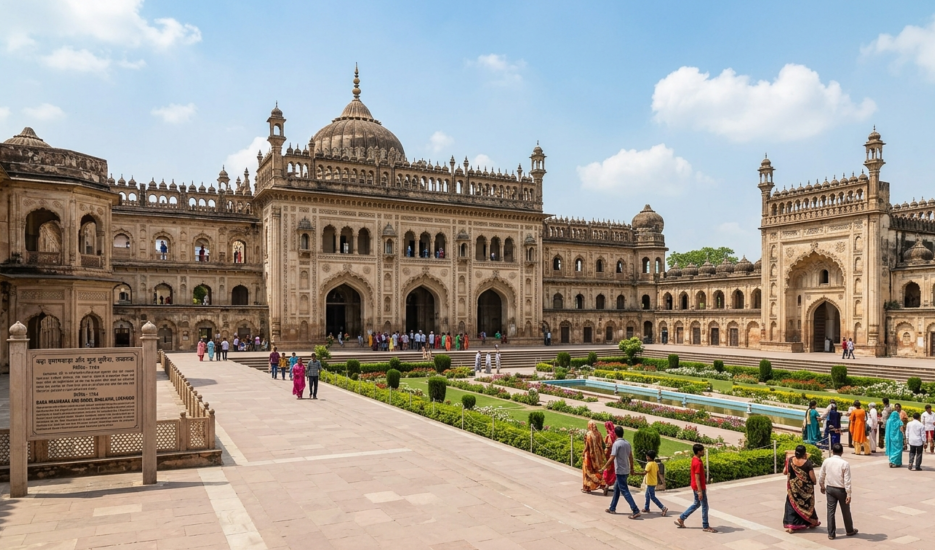
Historical Mystery :- History and Travel Guide of the Famous Bhool Bhulaiya of Bara Imambara
Detailed History
The ‘Bhool Bhulaiya’ in Lucknow, the capital of Uttar Pradesh, is not an independent building but the most famous, thrilling, and enigmatic part of the historical monument known as the ‘Bara Imambara’. This grand complex was constructed in the year 1784 by the fourth Nawab of Awadh, Nawab Asaf-ud-Daula. Behind the creation of this architectural marvel lies a deeply touching and compassionate humanitarian story.
In 1784, the entire region of Awadh was struck by a devastating and catastrophic famine. The citizens were struggling for basic sustenance. To save his people from starvation and provide them with dignified employment, Nawab Asaf-ud-Daula decreed the construction of this massive Imambara. The Nawab instituted a unique system where the common public and laborers worked on the construction during the day, and at night, the elites and upper-class citizens of Awadh (who felt ashamed to do manual labor in daylight) would dismantle a part of the structures built. This process ensured that the project lasted for nearly 11 years, successfully extending continuous employment and preserving the self-respect of thousands. The labyrinth of Bhool Bhulaiya was primarily engineered to reduce and distribute the immense weight of the central hall’s roof.
Detailed Architecture
The architecture of Lucknow’s Bhool Bhulaiya is a mind-boggling masterpiece that leaves modern-day engineers utterly astonished. Built entirely without any European architectural influence, it represents a pure blend of traditional Islamic and Rajput architectural designs.
Exterior Architecture :-
From the outside, the structure deceptively appears to be a three-story building, but internally, it spans seven layers. Strikingly, no iron, concrete, or structural beams were used in its entire construction. It was built using small bricks and bonded together by a specialized, historic mortar made from a mixture of limestone, urad lentils, jaggery, and wood-apple pulp. The central hall of the Imambara measures 50 meters in length and 16 meters in width, with its vaulted ceiling standing completely unsupported by pillars or beams. It ranks among the largest column-less vaulted halls in the entire world.
Interior Architecture
To support the incredible weight of this colossal pillar-less ceiling, the chief architect, ‘Kifayatullah‘, intricately wove a web of interconnected passages and corridors within the thick upper walls, which is known today as the ‘Bhool Bhulaiya’. It features over 1,000 interlocking pathways and steep steps to enter, but only 4 or 5 passages function as correct exits. The corridors are designed with such perfect symmetry that human senses easily become disoriented.
- Acoustics :– The acoustic engineering of the inner walls is magical. If a person whispers faintly or lights a matchstick near the wall at one end of a corridor, the sound can be heard with crystal clarity by someone standing at the far end. The Nawab’s soldiers utilized this feature to eavesdrop and spy on enemy movements.
Travel Guide & Routes
- Ticket and Entry Fee :–
- For Indian Citizens:- ₹50 per person
- For Foreign Tourists:- ₹500 per person
- (Note: Prices for digital or combo tickets encompassing nearby monuments might vary slightly).
- Visiting Days :– The historical complex remains open 6 days a week. It is strictly closed on Mondays.
- Opening and Closing Time :– From 6:00 AM to 5:00 PM.
- How to Reach :–
- By Metro :– The closest metro stations are the ‘Hussainabad Metro Station’ or the ‘Charbagh Metro Station’. From there, you can easily take an auto-rickshaw or an e-rickshaw to reach Bara Imambara.
- By Rail :– Lucknow’s central railway station, Charbagh (LKO), is located approximately 5-6 km away, offering direct local buses and autos.
- By Air :– Chaudhary Charan Singh International Airport (Amausi) is about 14 km away from the destination.
- Special Instruction (Guide Requirement) :– It is strongly advised not to venture inside the Bhool Bhulaiya alone. Registered government guides are available outside the gates (charging between ₹100 to ₹200). They are essential to help you navigate the pathways and demonstrate the wall acoustics.
- Photography Spots :– The sweeping view of Lucknow city and the iconic Rumi Darwaza from the rooftop of Bhool Bhulaiya, the grand Shahi Baoli, and the massive arched gateways of the Imambara are top photography spots.
- Local Food :– When visiting Lucknow, do not miss tasting the world-famous Tunday Kababi’s kebabs in the Chowk area, Rahim’s Kulcha-Nihari, Prakash ki Kulfi, and the traditional Chaurasia Paan.
- Nearby Markets :– Located very close to the monument are the ‘Chowk Bazaar’ and ‘Aminabad’, which are globally renowned for Lucknow’s authentic ‘Chikan Embroidery’ garments, textiles, and traditional handicrafts.
Nearby Attractions
After exploring the Bara Imambara and Bhool Bhulaiya, you can also seamlessly visit these prominent historical sites nearby.
- Rumi Darwaza :– Frequently called the signature silhouette of Lucknow, this grand, ornate gateway is located right outside the Imambara complex.
- Chhota Imambara (Hussainabad Imambara) :– Also known as the ‘Palace of Lights’, it is celebrated for its exquisite chandeliers, calligraphy, and gilt domes.
- Hussainabad Clock Tower and Picture Gallery :– Features the tallest clock tower in India alongside a historic gallery displaying portraits of the Nawabs of Awadh.
- Shahi Baoli :– A multi-layered stepwell engineered so that the reflection of any incoming outsider or intruder was visibly mirrored in the water long before they entered.
- British Residency :– A site bearing the battle scars of the First War of Indian Independence in 1857, making it a sanctuary for history enthusiasts.
Author’s Perspective
Lucknow’s Bhool Bhulaiya is not just a structural maze made of bricks and lime; it stands as a poignant monument to the empathy of the Nawabs towards their subjects and a pinnacle of structural engineering. Walking through its narrow, dim passages, time seems to stand still, and the walls whisper the secrets of a bygone era. Supporting such a massive ceiling without a single modern pillar and embedding such an intricate acoustic network reflects the supreme architectural wisdom of our ancestors. It is an absolute must-visit for anyone fascinated by history, mystery, and ancient engineering.
Interesting Facts
- Walls Have Ears :– The famous Hindi proverb “Deewaron ke bhi kaan hote hain” find its physical manifestation here, as whispers travel seamlessly across the long corridors via the walls.
- The Pillar-Less Wonder :– The central hall stands entirely independent of any internal columns, making it a revolutionary feat of pre-modern civil engineering.
- An Anti-Famine Project :– It remains one of the few grand monuments in global history constructed not to glorify a monarch’s luxury, but to feed a starving population during a natural crisis.
- The Secret Tunnels :– Legends say that deep underground chambers beneath the Bhool Bhulaiya housed secret tunnels connecting to Delhi, Faizabad, and Agra, which were sealed by the British for security reasons.
Important Questions and Answer :-
Question 1:– Where is Bhool Bhulaiya located and what is its official name?
Answer:- Bhool Bhulaiya is located in the old city area of Lucknow, Uttar Pradesh. It is officially the upper labyrinthine floor of the monument known as the ‘Bara Imambara’.
Question 2:– Who built the Bhool Bhulaiya and why?
Answer:- It was built by Nawab Asaf-ud-Daula in 1784 as a major public works project to generate employment and relief during a severe regional famine.
Question 3:- Is it safe to enter Bhool Bhulaiya without a guide?
Answer:- No, because the maze contains more than 1,000 deceptive hallways where visitors easily lose their sense of direction. Hiring an authorized guide ensures a safe and deeply educational tour.
Question 4:– On which day does the Bara Imambara and Bhool Bhulaiya complex remain closed?
Answer:- This historic complex remains completely closed to tourists every Monday.
“It is a magical corridor of Awadhi artistry, where you may temporarily lose your way, but the essence of history is found forever.”