
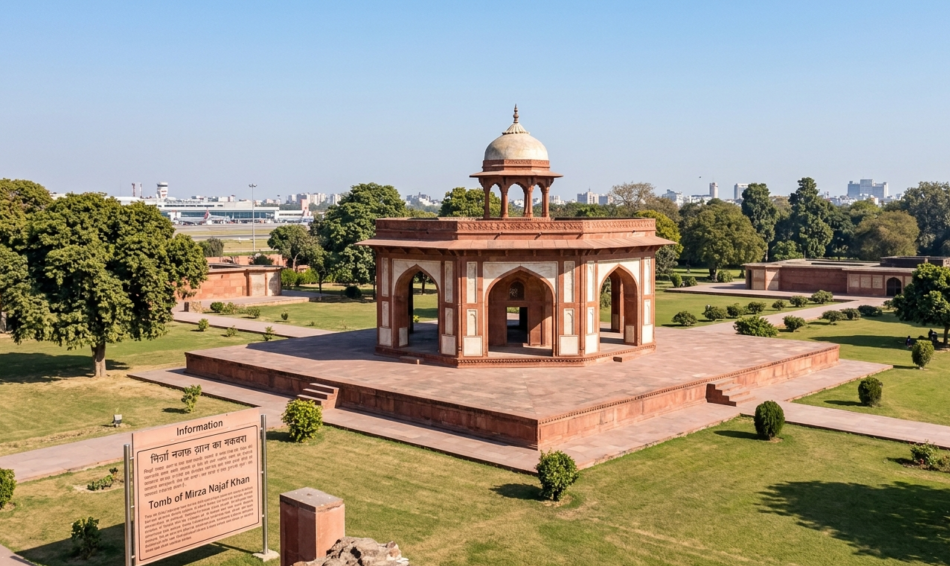
A Forgotten Monument in the Pages of History :- Tomb of Mirza Najaf Khan, Delhi
Right opposite the busy Safdarjung Airport and Lodhi Colony in Delhi, lies a serene and beautiful hidden gem for history lovers—The Tomb of Mirza Najaf Khan. The final resting place of one of the most powerful and loyal military commanders of the late Mughal era, this monument stands today as a beautifully landscaped garden under the protection of the Archaeological Survey of India (ASI). Let’s explore this offbeat and historic heritage of Delhi in detail.
Detailed History
Mirza Najaf Khan originally belonged to the Safavid dynasty of Persia (modern-day Iran). He immigrated to India around 1731 and rose to become the supreme commander of the Mughal army (Amir-ul-Umra) during the reign of Mughal Emperor Shah Alam II. He led several critical military campaigns, including the Battle of Buxar, and successfully defended the empire against various uprisings. He is remembered as a brilliant strategist who single-handedly sustained the fading Mughal power in its twilight years.
After a prolonged illness, he passed away in 1782. In honor of his exemplary service and loyalty, this grand tomb was constructed. Later, his daughter, Najaf Quli Khanam, was also buried near him within the same complex.
Detailed Architecture
The architecture of Najaf Khan’s tomb is a fine and minimalist example of the traditional Mughal ‘Charbagh‘ (four-garden) layout.
- Exterior :– The tomb is situated at the center of a massive, lush green square garden. Unlike other grand Mughal tombs (such as Humayun’s or Safdarjung’s), it lacks a massive central dome. It is built upon a wide, elevated red sandstone platform. The structure is surrounded by beautiful arched alcoves on all sides, adding an understated elegance to its simplicity.
- Interior :– At the center of the platform lies the main burial chamber, housing the marble graves of Mirza Najaf Khan and his daughter. Beneath this chamber is an underground crypt where the actual mortal remains are interred. The plaster carvings on the walls have faded over time, yet the ancient grandeur remains palpable.
Travel Guide & Routes
- Ticket :– Entry is completely Free for everyone.
- Visiting Time :– The tomb remains open from 06:00 AM to 06:00 PM on all days of the week.
- Photography Spots :– The vast green lawns stretching across the complex, the setting sun filtering through the arched alcoves, and the unique backdrop facing the Safdarjung airstrip offer fantastic frames for photography.
- Local Taste :– The nearby Lodhi Colony and Khan Market host some of Delhi’s best cafes and fine-dining restaurants. Here you can indulge in Kebabs, Butter Chicken, artisanal sandwiches, and modern fusion cuisine.
- Famous Market :– The nearby Khan Market (one of Delhi’s most premium retail hubs) and INA Market (famous for fresh produce, spices, and traditional items) are ideal for shopping.
How to Reach :–
- By Metro :– The nearest metro stations are Jor Bagh (Yellow Line) or Lodhi Colony (Pink Line). The monument is just a short walk or a brief e-rickshaw ride from these stations.
- By Bus :– Regular local buses from all parts of Delhi drop passengers near the Safdarjung Airport or Lodhi Colony bus stops.
- By Train :– New Delhi Railway Station is roughly 7-8 kilometers away, from where app-based cabs or auto-rickshaws are readily available.
Nearby Attractions
- Safdarjung Tomb :– The last monumental garden tomb of the Mughals, located just 1.5 kilometers away.
- Lodhi Garden :– A famous historical park dotted with ancient tombs and lush walking tracks.
- Khan Market :– A premium lifestyle destination for high-end shopping and dining in Delhi.
- Hazrat Nizamuddin Dargah :– The iconic Sufi shrine located about 3 kilometers from the tomb.
Interesting Facts
- The absence of a dome on Mirza Najaf Khan’s tomb reflects the declining financial prosperity of the Mughal Empire during his demise, which necessitated a simpler structural design.
- Because it lacks the heavy tourist crowds of Humayun’s Tomb, this peaceful compound is often used by locals as a quiet haven for reading and relaxation.
- Historians often refer to Najaf Khan as the ‘Last Valiant Pillar of the Mughals’, as the central authority in Delhi collapsed rapidly following his death.
Important Questions and Answer :-
Question 1:– Who was Mirza Najaf Khan?
Answer:- He was a powerful Persian adventurer who served as the supreme commander of the Mughal forces and Deputy Wazir under Emperor Shah Alam II in the 18th century.
Question 2:– Where exactly is Najaf Khan’s tomb located?
Answer:- It is situated in the Lodhi Colony area of New Delhi, right opposite the Safdarjung Airport.
Question 3:– Is there an entrance fee to visit the monument?
Answer:- No, entry into the Mirza Najaf Khan tomb complex is absolutely free for all visitors.
Author’s Thoughts
Amidst the relentless hustle of New Delhi, Mirza Najaf Khan’s tomb stands as a quiet oasis of solitude. While this commander might occupy limited space in modern history textbooks, the absolute stillness of his mausoleum echoes his glorious past. If you wish to escape the city’s chaotic pace, unwind in a tranquil historical corner, and connect with the past, this monument is highly recommended.
Signature Sentence: “Far from the clamor of history, the final guardian of the Mughal empire rests peacefully beneath the quiet arches.”