
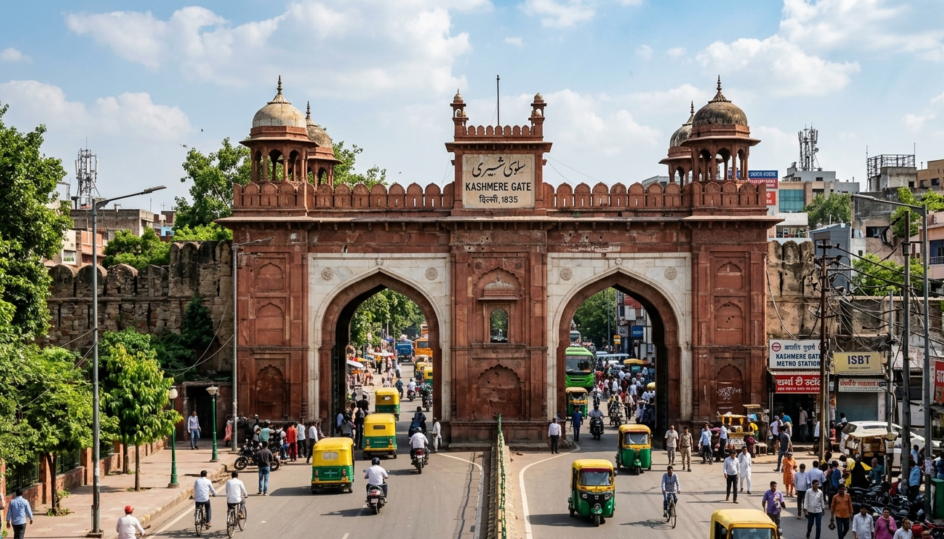
Silent Witness to the Revolt of 1857 :- Kashmiri Gate, Delhi
Located in the northern part of Old Delhi, Kashmiri Gate is not just a bustling commercial hub or a major metro interchange; it is a silent witness to one of the greatest and most daring military conflicts in Indian history. Harboring the deep scars of the First War of Independence of 1857, this historic gateway still stands tall, bearing the marks of British cannonballs on its rugged walls. Let’s explore this historic gateway of Old Delhi in detail.
Detailed History
Kashmiri Gate was built in 1638 by the Mughal Emperor Shah Jahan when he established his new capital city, ‘Shahjahanabad’ (modern-day Old Delhi). To secure the city, a massive defensive wall with several prominent gateways was constructed. Since this particular gate faced north and led to the highway connecting directly to Kashmir, it was named ‘Kashmiri Gate’.
The most defining moment for this historical site came during the Revolt of 1857. When Indian freedom fighters seized control of Delhi, the British forces made Kashmiri Gate their primary target to re-capture the city. On September 14, 1857, amid fierce resistance, British engineers managed to plant explosives and blow up a section of the gate to enter the city. The intense battle marks are explicitly visible on the structure to this day.
Detailed Architecture
The architecture of Kashmiri Gate is a unique blend of classical Mughal military design and subsequent British structural reinforcements.
- Exterior :– The monument is constructed using robust red sandstone and local Delhi quartzite stones. In the 1830s, it was remodeled into a double-arched gateway by British military engineer Major Robert Smith to accommodate wider carriage traffic. It features bastions and battlements on top for sentries. The exterior walls are riddled with deep bullet and cannonball craters (battle scars) preserved exactly as they were left after the war.
- Interior :– The inner structure contains defensive chambers once used by guards. Today, a small, well-maintained patch of green lawn surrounds the gateway. Right next to the gate, a British historical memorial plaque is installed, dedicated to the memory of the officers and soldiers who lost their lives while breaching the gate during the assault of 1857.
Travel Guide & Routes
- Ticket :– Entry to this monument is completely Free.
- Visiting Time :– The site is accessible 24/7 as it stands by the main road, but the ideal time to explore it is between 06:00 AM and 06:00 PM.
- Photography Spots :– The battle-scarred red sandstone walls, the main facade of the double-arched gateway, and the neighboring historic St. James’ Church offer remarkable frames for heritage photography.
- Local Taste :– The area around Kashmiri Gate is packed with legendary Old Delhi flavors. Don’t miss out on trying the famous Chole Bhature, Bedmi Kachori-Sabzi, and authentic street food from Chandni Chowk located nearby.
- Famous Market :– The adjacent Kashmiri Gate Automobile Market (one of the largest wholesale spare parts markets in India) and the legendary Chandni Chowk and Chor Bazar are located just a short distance away.
How to Reach :–
- By Metro :– The nearest metro station is Kashmiri Gate (Red, Yellow, and Violet Line Interchange). The monument is situated within walking distance right outside Gate No. 1 or 2 of the metro station.
- By Bus :– Kashmiri Gate houses Delhi’s largest Inter-State Bus Terminus (ISBT), which connects Delhi to various parts of the city and neighboring states via direct bus services.
- By Train :– Old Delhi Railway Station is located just 1-2 kilometers away from the site.
Nearby Attractions
- St. James’ Church :– The oldest surviving church in Delhi, located just a 5-minute walk from the gate, built by Colonel James Skinner.
- Mutiny Memorial (Jeetgarh) :– A grand gothic-style monument built on the Kamla Nehru Ridge near Kashmiri Gate to commemorate the soldiers of the 1857 war.
- Red Fort & Chandni Chowk :– The iconic UNESCO World Heritage Site, Red Fort, is just a 10-minute drive away.
- Dara Shikoh Library :– Located within the vicinity, it is the historic library building belonging to Shah Jahan’s eldest son.
Interesting Facts
- The deep craters visible on the walls of Kashmiri Gate are not regular structural wear and tear; they are the actual impacts of cannonballs fired by British artillery during the fierce siege of 1857.
- When the British army blew open Kashmiri Gate with gunpowder, the explosion was so massive that its echo resonated across the entire city of Delhi.
- This vicinity also gave birth to Delhi’s early modern administrative setup, including the first government court and the old St. Stephen’s College building of Delhi University.
Important Questions and Answer :-
Question 1:- Why is this monument called Kashmiri Gate?
Answer:- It served as the northern gateway of the walled city of Shahjahanabad, and the road passing through this gate led straight towards Kashmir, hence gaining its name.
Question 2:– What caused the deep holes and marks on the walls of Kashmiri Gate?
Answer:- Those craters are the authentic remnants of the heavy crossfire and cannon bombardments between the Indian revolutionaries and the British forces during the Uprising of 1857.
Question 3:– Is there any entry fee or ticket required to visit Kashmiri Gate?
Answer:- No, it is an open historical site, and entry is completely free for all national and international visitors.
Travel Guide & Routes (Author’s Thoughts)
We often pass through the Kashmiri Gate metro station during our daily commutes, but right next to this modern rush stands a monument that altered the destiny of India. Touching the rugged red stones of Kashmiri Gate allows you to feel the echo of the freedom struggle and the raw grit of 1857. This place serves as a stark reminder of the sacrifices embedded deep within the foundations of our freedom. Make sure to halt and spend a few quiet moments in front of this glorious gateway when you tour Old Delhi.
“Amidst the roar of the metro and the chaos of the modern city, the red stones of Kashmiri Gate still whisper the heroic tales of the 1857 revolution.”