
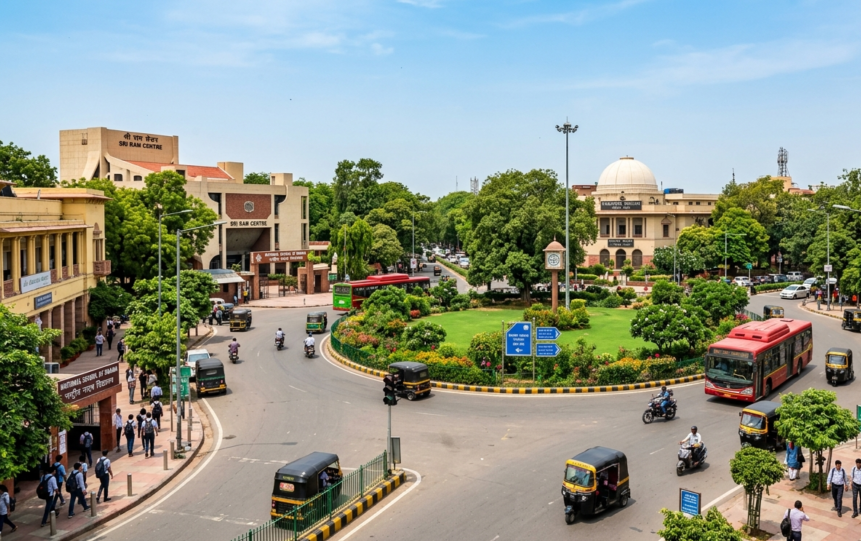
Mandi House Delhi :- The Cultural & Theatre Hub :- History, Art, and Complete Visitor Guide
Detailed History :-
Mandi House is a legendary locality situated in the heart of New Delhi, widely celebrated as the cultural and theatrical pulse of the capital. Located in close proximity to Connaught Place, this vibrant district is globally recognized for its premier auditoriums, elite art galleries, and national cultural institutions. However, the history of this place is deeply fascinating, carrying a name that links back to India’s princely states and colonial urban planning.
During the British Raj, when the capital of India was officially relocated from Calcutta (now Kolkata) to Delhi in 1911, Sir Edwin Lutyens designed the layout of New Delhi. As part of this grand plan, various ruling princes of Indian states were allotted plots of land around the central vista to construct their regional royal residences. Consequently, the Raja of the princely state of Mandi (Raja Joginder Sen) from Himachal Pradesh was granted land here, where he built a magnificent palace. This palace came to be known as ‘Mandi House’. Post-independence, the Government of India acquired the palace, and the original structure was eventually dismantled to make way for the massive headquarters of Doordarshan (India’s national television network). Although the physical palace no longer stands, the name ‘Mandi House’ became permanently etched into the cultural topography of Delhi. Today, it is not just a geographical location but the definitive breeding ground for India’s finest actors, directors, playwrights, and artists.
Detailed Landscape & Ambience :-
The structural layout and visual ambiance of Mandi House stand in sharp contrast to the commercial or residential skyscrapers of contemporary Delhi. It reflects the graceful essence of Lutyens’ urban layout.
- Urban Layout :– Mandi House is primarily designed as a large, beautifully landscaped, and tree-lined traffic roundabout. From this central node, several prominent avenues branch out in different directions, including Barakhamba Road, Tansen Marg, Sikandra Road, Safdar Hashmi Marg, and Bhagwan Das Road. Wide pedestrian footpaths shaded by old canopy trees border the roundabout, offering an ideal setting for leisurely walks.
- Architectural Essence :– The buildings flanking this zone feature an intriguing mix of modern and brutalist architectural styles. While the soaring Doordarshan Bhawan commands the skyline with modern functionalism, structures like the Shri Ram Centre are celebrated architectural marvels featuring innovative exposed brickwork and cylindrical designs. The National School of Drama (NSD) complex reflects a traditional Indian academic environment layered with creative simplicity.
- Artistic Ambience :– The walls of the streets winding through Mandi House frequently serve as open canvases for street art and expressive murals. As dusk falls, the entire zone turns into an interactive hub where artists gather around street-side tea stalls to discuss scripts, exchange ideas, and debate literature amidst colorful posters of upcoming theatrical productions.
Cultural & Theatre Guide :-
To visit Mandi House is not merely about sightseeing a specific building; it is about immersing oneself in its rich artistic lifestyle. If you wish to experience this cultural hub, here is your comprehensive guide.
- Entry & Show Tickets :– There is absolutely no entry fee to explore the public roundabouts, tree-lined lanes, or open institutional campuses of Mandi House. However, if you wish to watch a theatrical play or performance at any of the auditoriums, ticket prices typically range from ₹100 to ₹500, which can be easily booked online via platforms like ‘BookMyShow’ or purchased directly from the respective auditorium box office counters.
- Timings :– The various art galleries and institutional complexes are generally active from 10:00 AM to 08:00 PM. The main evening theatre shows usually commence around 06:30 PM. While it is vibrant year-round, the winter months and pleasant evenings are the best times to explore the area on foot.
- How to Reach :– Positioned centrally, Mandi House boasts flawless connectivity across Delhi-NCR:
- By Metro :– The district is served by its own dedicated station, the ‘Mandi House Metro Station’, which acts as a key interchange node between the Blue Line and the Violet Line of the Delhi Metro. Exiting the station places you directly at the doorstep of the major cultural institutions.
- By Bus & Auto :– Direct public buses connect Mandi House to all major commercial sectors of Delhi. It is also just a short 10-minute auto-rickshaw or e-rickshaw ride away from the New Delhi Railway Station.
- Photography Spots :– The beautifully lit courtyard of the Triveni Terraces, the iconic exposed-brick facade of the Shri Ram Centre, the outdoor avant-garde installations at the Lalit Kala Akademi, and the candid expressions of street performers offer phenomenal frames for photography.
- Local Food & Cafes :– The cafe culture of Mandi House is a massive hit among the literati:
- Triveni Terrace Cafe :– A highly popular garden café where artists and theater enthusiasts congregate over delicious Shami Kebabs, Sabudana Vada, and authentic filter coffee.
- Shri Ram Centre Canteen & Bengali Pastry Shop :– Grabbing a quick samosa, mutton cutlet, and hot tea during play intervals is a long-standing tradition for theatre-goers here.
- Famous Markets :– The elite commercial center of ‘Connaught Place’ (CP) and the bustling traditional stalls of ‘Janpath Market’ are located barely 1.5 kilometers away, offering great opportunities for buying books, artifacts, apparel, and souvenirs.
Key Institutional Attractions :-
The true essence of Mandi House is anchored by these legendary cultural landmarks and auditoriums.
- National School of Drama (NSD) :– India’s premier theater training institute that has gifted the Indian film and theater industry with stalwarts like Naseeruddin Shah, Om Puri, Irrfan Khan, Nawazuddin Siddiqui, and Pankaj Tripathi. Its in-house stages like ‘Sammukh’ and ‘Abhimanch’ host exceptional student productions.
- Shri Ram Centre for Performing Arts :– Located right on the roundabout, this independent auditorium is considered the bedrock of contemporary Hindi theater in Delhi.
- Triveni Kala Sangam :– A multi-arts complex housing extensive art galleries, photography studios, classical dance departments, and a beautiful open-air amphitheater.
- Lalit Kala Akademi & Sangeet Natak Akademi :– Located within the Rabindra Bhawan complex, these are India’s apex national academies for fine arts, music, dance, and drama, frequently organizing free national exhibitions.
- Kamani Auditorium :– One of the most prestigious large-scale auditoriums in Delhi, boasting state-of-the-art acoustics, ideal for massive theatrical productions, ballets, and classical concerts.
Interesting Facts :-
- Mandi House is often called the ‘Nursery of Bollywood’ because hundreds of India’s most critically acclaimed cinematic actors spent their formative years polishing their acting skills on the stages and streets of Mandi House.
- The street named ‘Safdar Hashmi Marg’ looping off the roundabout is dedicated to the memory of Safdar Hashmi, a legendary street theater activist who pioneered political and social street theater in urban India.
- Mandi House Metro Station serves as an underground art gallery in itself, featuring large permanent photo murals and historical archival prints mapping the evolution of New Delhi.
- Every winter, the locality hosts the grand ‘Bharat Rang Mahotsav’ (National Theatre Festival), organized by NSD, which is officially recognized as the largest theater festival in Asia.
Important Questions and Answer :-
Question 1:- Why is this area called Mandi House?
Answer:- During the development of New Delhi by the British, the royal palace of the Raja of the princely state of Mandi (Himachal Pradesh) stood at this precise location. The area retained the name long after the palace made way for modern institutions.
Question 2:- What is Mandi House most famous for?
Answer:- Mandi House is widely famous as the apex cultural, artistic, and theater zone of Delhi, housing world-class institutions like the National School of Drama, Kamani Auditorium, and Triveni Kala Sangam.
Question 3:- Do we need to book theater tickets in advance at Mandi House?
Answer:- Yes, especially for popular weekend shows, it is highly recommended to secure your seats in advance via online ticketing platforms or by visiting the auditorium box office early.
Question 4:– Which is the closest transit point to reach Mandi House?
Answer:- The Mandi House Metro Station, located directly on the Blue and Violet Lines of the Delhi Metro network, is the most efficient transit point.
Author’s Thoughts :-
While tourists usually flock to Delhi for its medieval tombs or swanky shopping districts, those who wish to discover the actual soul and artistic temperament of the capital must spend an evening at Mandi House. It is a mesmerizing corner where you will witness young, bright-eyed dreamers debating complex scripts over small cups of cutting chai on the pavement. There is an unmistakable intellectual energy in the air that inspires you to slow down, observe, and appreciate life through the lens of art. Whether you are a hard-core theater buff, an art connoisseur, or simply a traveler looking to soak in a highly authentic and sophisticated cultural scene, the tree-lined avenues of Mandi House will embrace you warmly. It is a timeless slice of Delhi that recreates itself every single evening when the stage lights turn on.
“Thriving under the dense canopy of Lutyens’ trees where characters come to life and art breaks all boundaries, Mandi House remains the ultimate sanctuary for creative souls in the heart of Delhi.”