
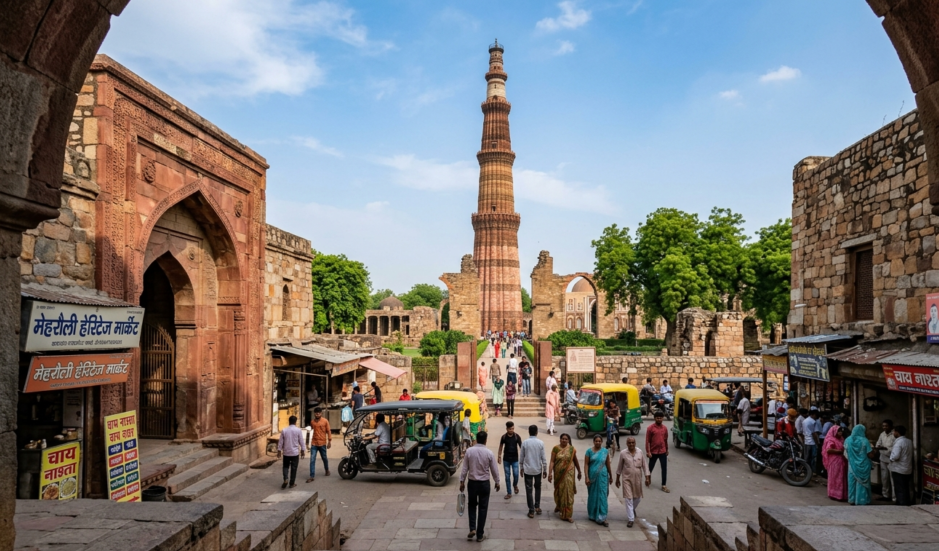
The Epic Heritage of Mehrauli Delhi :- History, Architecture, and Complete Travel Guide
Detailed History :-
Mehrauli is not merely a locality within Delhi; it is the oldest living canvas and the foundational witness to the evolution of Delhi’s legendary seven historical cities. Situated in South Delhi, Mehrauli is universally acknowledged as the earliest continuously inhabited region of the capital. Its recorded history dates back to the 8th century AD when Raja Anangpal Tomar I of the Tomar Dynasty established the ‘Lal Kot’ fortress, effectively laying the first bricks of Delhi. This fort was later expanded by the legendary Rajput ruler Prithviraj Chauhan, who renamed it ‘Qila Rai Pithora’. Following the landmark Battle of Tarain in 1192 AD, Qutb-ud-din Aibak of the Slave Dynasty established his base here, making Mehrauli the first official capital of the Delhi Sultanate.
The nomenclature of Mehrauli is deeply connected to spiritual mysticism and folklore. During the medieval era, this terrain evolved into the epicenter of prominent Sufi saints, most notably Hazrat Khwaja Qutbuddin Bakhtiyar Kaki. Owing to his spiritual aura, the region was revered as ‘Mihir-Wali‘ (the sanctuary of the saint), which gradually morphed into the contemporary name ‘Mehrauli‘. From the Slave, Khilji, Tughlaq, and Lodhi dynasties to the Mughals and the British colonial officers, every ruling elite left an indelible imprint on its landscape. Every single alleyway, crumbling rampart, and deep stepwell in Mehrauli acts as a fascinating chapter of India’s multi-layered history.
Detailed Architecture :-
The architectural vocabulary of Mehrauli is uniquely diverse, presenting a seamless chronological transition across Hindu, Rajput, early Islamic (Sultanate era), Mughal, and British imperial structural designs. The core architectural characteristics of this heritage landscape are detailed below:
- Construction Material & Design :– The earliest structures of Mehrauli extensively utilize indigenous grey quartzite stone blocks and rich red sandstone. The region is highly celebrated for displaying the infancy of Indo-Islamic architecture, where intricately carved pillars from older temples were masterfully re-engineered to support majestic arches and domes (as vividly observed in the Quwwat-ul-Islam Mosque).
- The Majesty of the Qutub Complex :– The iconic Qutub Minar represents the absolute pinnacle of medieval masonry. This 5-story minaret, built of fluted red sandstone and white marble, is embellished with dense, fine bands of Quranic calligraphy and traditional geometric arabesques. Directly adjacent stands the 4th-century Iron Pillar of the Gupta period—a global marvel of ancient Indian metallurgy that continues to stand completely rust-free despite 1,600 years of open exposure to the elements.
- Architectural Layout of Stepwells & Tombs :– The sub-terranean stepwells or Baolis (such as Rajon ki Baoli and Gandhak ki Baoli) feature multi-tiered vertical layouts lined with structural stone galleries and symmetrical steps. On the other hand, the individual tombs scattered across the area (such as the Mausoleums of Iltutmish and Ghiyas-ud-din Balban) physically document the introduction of the ‘True Arch’ and formal dome stabilization techniques in India.
Travel Guide & Routes :-
Since Mehrauli spans a vast geographical heritage zone, exploring it systematically requires a well-structured travel itinerary
- Admission Ticket :–
- Qutub Minar Complex :– Admission costs ₹40 for Indian nationals and ₹600 for international tourists (discounts apply for digital bookings).
- Mehrauli Archaeological Park, Jahaz Mahal & other landmarks :– Entry to these extensive parks and heritage enclaves is completely Free of cost.
- Timings :– Most standalone monuments under the Archaeological Survey of India (ASI) remain accessible daily from 06:00 AM to 06:00 PM. The Qutub Minar looks deeply dramatic when floodlit after sunset, making late afternoon visits highly popular. The pleasant winter months from October to March are the best times to tour the open ruins.
- How to Reach :–
- By Metro :– The most efficient transit nodes are the ‘Qutub Minar’ and ‘Chhattarpur’ metro stations, both located on the Yellow Line of the Delhi Metro network. From either station, you can readily hop onto a local auto-rickshaw or an e-rickshaw for a nominal fare of ₹10-20 to enter the historic core of Mehrauli.
- By Bus & Road :– The centralized Mehrauli Bus Terminal is well-linked via direct public bus routes to prime hubs like Kashmiri Gate, New Delhi Railway Station, and Anand Vihar.
- Photography Spots :– Framing the colossal Qutub Minar through the skeletal stone arches of the complex, capturing the dramatic symmetry of Rajon ki Baoli, and photographing the serene dome of Jahaz Mahal mirroring across the historic waters of Hauz-i-Shamsi are prized frames for travel photographers worldwide.
- Local Food & Fine Dining :– The traditional bazaars of Mehrauli serve authentic local street eats like crispy kachoris, bedmi poori, and traditional halwas. Conversely, the perimeter of the Qutub Minar is globally renowned for hosting India’s most luxurious fine-dining rooftop restaurants and avant-garde cafes (such as One Style Mile, Olive Bar & Kitchen), where patrons can savor global cuisines with stunning views of the illuminated minaret.
- Famous Markets :– The old ‘Mehrauli Main Bazaar’ remains a busy hub for traditional wedding trousseaus, ethnic textiles, and brass utensils at competitive prices. For high-end luxury labels and designer boutiques, the adjoining ‘Ambawatta One’ complex and the nearby ‘Select Citywalk Mall in Saket’ offer top-tier retail therapies.
Key Heritage Attractions in Mehrauli
Ensure these highly significant monuments are on your checklist when traveling through Mehrauli.
- Qutub Minar Complex :– A stellar UNESCO World Heritage Site featuring the tallest brick minaret in the world, the massive Alai Darwaza, the uncompleted Alai Minar, and the rust-resistant Iron Pillar.
- Mehrauli Archaeological Park :– A sprawling 200-acre sanctuary containing over a hundred historic ruins nestled in dense foliage, including the historic Tomb of Balban, Jamali Kamali Mosque, and the magnificent Rajon ki Baoli.
- Jahaz Mahal & Hauz-i-Shamsi :– A charming Lodhi-era palace situated on the banks of a large medieval reservoir, acting as the epicenter for the annual ‘Phool Walon Ki Sair’ festival.
- Dargah of Khwaja Qutbuddin Bakhtiyar Kaki :– One of India’s most ancient and deeply revered Sufi shrines, offering an unparalleled atmosphere of spiritual peace and devotional qawwalis.
- Yogmaya Temple :– A deeply sacred ancient temple dedicated to Goddess Yogmaya, with strong mythological ties extending back to the epic Mahabharata era.
Interesting Facts :-
- Mehrauli is uniquely acclaimed as the singular destination in Delhi that displays a continuous, unbroken line of architectural history spanning nearly 1,000 years under one micro-region.
- The Tomb of Balban located inside the Archaeological Park is highly significant as it houses the earliest structurally surviving ‘True Arch’ constructed in Indian masonry.
- The annual ‘Phool Walon Ki Sair’ festival of Mehrauli is a magnificent symbol of India’s secular fabrics, where a unified procession offers floral fans to both the Yogmaya Temple and the Sufi Dargah.
- The ancient stepwell named ‘Gandhak ki Baoli‘ is fed by natural spring water high in sulfur content, traditionally believed to possess therapeutic properties capable of curing skin ailments.
Important Questions and Answer :-
Question 1:- Why is Mehrauli documented as the first city of Delhi?
Answer:- Mehrauli is designated as the first city of Delhi because the earliest structured urban fortification and imperial capital of the region began here with the construction of the ‘Lal Kot’ fortress by the Tomar Rajputs in the 8th century AD.
Question 2:– What makes the Mehrauli Archaeological Park completely unique?
Answer:- The park is unique because it preserves over 100 heritage structures from across different eras—ranging from the 12th-century Sultanate ruins to British-era colonial additions—spaced out across a massive 200-acre free-to-enter green landscape.
Question 3:- Which is the closest metro station to access the core heritage points of Mehrauli?
Answer:- The ‘Qutub Minar‘ Metro Station on the Yellow Line is the closest transit point, from where local e-rickshaws can take you to the major monuments within 5 minutes.
Question 4:– What is the scientific significance of the ancient Iron Pillar?
Answer:- Located inside the Qutub complex, this 4th-century iron pillar from the Gupta Empire is a marvel of ancient Indian metallurgy. Despite being completely exposed to rain, sun, and humidity for over 1,600 years, it has not rusted at all.
Author’s Thoughts :-
People often map Delhi through its swanky modern malls, corporate business parks, and fast metro networks, but to truly feel the historical soul of this immortal metropolis, one must wander through Mehrauli. Mehrauli is not just a collection of stone ruins; it is an enchanting time capsule that teleports you right back through the centuries. While the grand height of the Qutub Minar leaves you awestruck, the silent, moss-covered tombs within the archaeological park inspire a deep sense of stillness and contemplation. The coexistence of ancient village markets alongside high-end designer cafes is absolutely fascinating. For any heritage lover, slow traveler, or passionate photographer, an afternoon spent walking through Mehrauli is a poetic experience that permanently redefines how you perceive the city of Delhi.
“From the ancient ramparts of Lal Kot to the mystical echoes of Sufi shrines, Mehrauli continues to hold the pulse of Delhi’s thousand-year-old journey alive within its weathering stones.”