
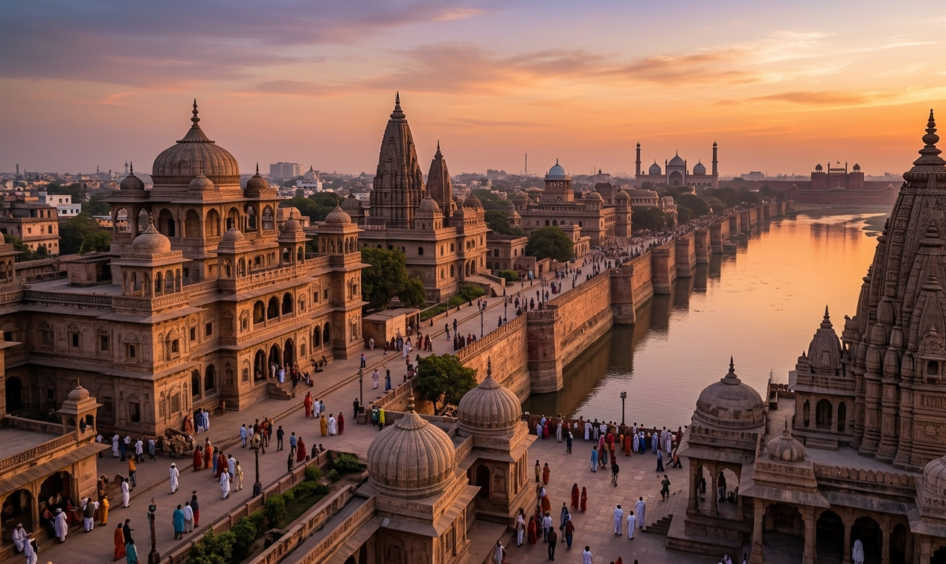
The Mythological Origin of Delhi :- The Ancient Kingdom of ‘Indraprastha’
When we talk about the multifaceted history of Delhi, our timeline often begins with the Qutub Minar, the Red Fort, or the courts of the Delhi Sultanate. However, Delhi’s story is not merely a few centuries old; it spans thousands of years into antiquity, stretching its roots back to the Dwapara Yuga and the epic Mahabharata. The very first and most ancient name of Delhi was ‘Indraprastha’, established by the Pandavas as their capital. Today, where Delhi’s monumental ‘Purana Qila’ (Old Fort) stands, it is widely believed that the legendary palaces of the Pandavas rest buried underneath. In this comprehensive blog, let us journey back to the mythological and historical bedrock of Delhi—Indraprastha.
Detailed History
The legacy of Indraprastha is a brilliant compilation of epic narratives, scientific archaeological excavations, and the foundational identity of Delhi.
- The Mahabharata Genesis :– According to the epic Mahabharata, when King Dhritarashtra partitioned the Kuru kingdom, he handed over a barren, wild, and rugged forest tract known as ‘Khandavaprastha’ to the Pandavas. Undeterred, the Pandavas, with the divine guidance of Lord Krishna and the masterly architectural craftsmanship of Vishwakarma, transformed that wasteland into a celestial city. It was named ‘Indraprastha’—the city of Lord Indra, the king of the gods.
- The Magic of the Maya Sabha :– Inside Indraprastha, the demon architect ‘Mayasura‘ constructed an illusionary palace called the Maya Sabha for the Pandavas. The floors of this palace were polished to such a high gloss that solid land created the illusion of water, and water features looked like solid ground. It was within this magical palace that Duryodhana fell prey to optical illusions, triggering a sequence of humiliations that eventually catalyzed the Great War of Mahabharata.
- Historical References :– Beyond myths, ancient Jain and Buddhist texts (such as the Digha Nikaya) refer to this region as ‘Indapatt’. Up until 1947, a small village named ‘Indrapat’ thrived right inside the ramparts of Purana Qila, acting as a living linguistic link to the ancient kingdom.
Detailed Archaeology & Structure
Since the original palaces of Indraprastha do not survive above ground today, its structural layers and physical existence are understood through the scientific excavations conducted by the Archaeological Survey of India (ASI).
- Excavations at Purana Qila :– The site of Purana Qila on Mathura Road is historically verified as the core of ancient Indraprastha. Groundbreaking excavations led by renowned archaeologist Dr. B.B. Lal, and successive digs in later decades, unraveled layers of civilization that prove the site’s extreme antiquity.
- Painted Grey Ware (PGW) :– At the lowest cultural strata of the excavations, archaeologists discovered fragments of ‘Painted Grey Ware’ (specialized ancient pottery). Carbon dating and cultural mapping align this specific pottery tradition with the Mahabharata period (circa 1000–1200 BCE).
- An Unbroken Sequence of Civilizations :– The most fascinating aspect of this site’s layout is its continuous stratification. Excavations revealed a vertical timeline where artifacts from the Mauryan, Sunga, Kushan, Gupta, Rajput, Delhi Sultanate, and finally the Mughal and Suri eras (Sher Shah Suri) were found stacked on top of one another. This confirms that this patch of earth has remained continuously inhabited since the days of Indraprastha.
Travel Guide & Routes
If you wish to explore the physical site of ancient Indraprastha at Purana Qila, the following travel logistics will assist you.
- Tickets :– The entry ticket to the Purana Qila complex costs around ₹20 to ₹30 for Indian citizens (discounts apply for online bookings). Separate nominal charges apply for the specialized site museum and the evening light show.
- Visiting Time :– The complex remains open from 7:00 AM to 6:00 PM (all seven days of the week). Attending the evening Light and Sound Show is highly recommended, as it beautifully dramatizes the evolution of Delhi from Indraprastha to the modern day.
- How to Reach :–
- By Metro :– The nearest metro stations are ‘Supreme Court’ (Blue Line) and ‘Khan Market’ (Violet Line). From either station, you can hail an auto-rickshaw or e-rickshaw to reach the main gates of the fort within 5 minutes.
- By Road :– Located right on Mathura Road adjacent to the National Zoological Park (Delhi Zoo), the site is exceptionally well-connected and easily accessible via local public buses and app-based cabs.
Photography Spots
The ancient grounds of Indraprastha (Purana Qila) provide a spectacular vintage setting for history buffs and travel photographers.
- The Monumental Bada Darwaza (Main Gate) :– Built with rugged red sandstone and dressed stones, this towering gateway flanked by massive bastions offers an incredibly powerful frame for landscape photography.
- Qila-i-Kuhna Mosque & Sher Mandal :– Located inside the fort, these structures showcase the pinnacle of pre-Mughal Islamic architecture. The morning light filtering through their stone jaali screens creates stunning dramatic contrast and shadow frames.
- The Fort Lake Reflection :– The moat/lake encircling the fort walls offers a postcard view, especially during calm afternoons when the massive ancient fortifications reflect flawlessly onto the water surface.
Local Food & Famous Markets
Purana Qila rests close to some of New Delhi’s finest gourmet hubs and high street shopping districts.
- Local Food :–
- Khan Market Kebab Outlets :– The nearby market is legendary for its succulent kathi rolls, traditional seekh kebabs, and upscale artisan cafes.
- Pandara Road Market :– Famous across Delhi for its iconic fine-dining institutions like ‘Gulati’ and ‘Havemore’, which serve premium North Indian tandoori cuisines, Butter Chicken, and slow-cooked Dal Makhani.
- Famous Markets :–
- Khan Market :– Frequently ranked as one of Delhi’s most elite retail markets, perfect for book shopping, high-end boutiques, and designer goods.
- Pragati Maidan & Dilli Haat :– Located close by, hosting massive international trade fairs and cultural craft expositions from different Indian states.
Nearby Attractions
- National Zoological Park (Delhi Zoo) :– Shares its boundary wall with the fort, making it an excellent combined day outing.
- National Science Centre :– A highly interactive educational museum located just a short walk up the fort road.
- Humayun’s Tomb :– The grand precursor to the Taj Mahal, located barely 2.5 kilometers south of the fort site.
Interesting Facts
- The First City of Delhi :– Delhi is historically celebrated as the ‘City of Seven Cities’, but when we integrate its ancient timeline, Indraprastha proudly stands as the absolute First City and baseline of Delhi.
- A Vault of Sacred Art :– Excavations at the site have unearthed exquisite stone sculptures of Hindu deities like Vishnu, Shiva, and Ganesha dating back to the Rajput and Gupta eras, reflecting its deep-seated sacred geography.
- The Pandavas’ Fort :– Even when Sher Shah Suri defeated Humayun and rebuilt the citadel calling it ‘Shergarh’, contemporary folk traditions and historical charts continued to record and call the structure Pandavon Ka Qila (The Fort of the Pandavas).
Important Questions and Answer :-
Question 1:– What is the significance of Indraprastha in the Mahabharata?
Answer:– In the Mahabharata, Indraprastha was the magnificent capital of the Pandavas. It was systematically built by clearing the barren ‘Khandavaprastha’ wilderness into a highly advanced, visually stunning, and prosperous kingdom.
Question 2:– Where can one find the physical remains of Indraprastha in modern Delhi?
Answer:– The archaeological site of ‘Purana Qila’ (Old Fort) on Mathura Road is recognized as the structural location of Indraprastha, where deep excavations yielded pottery matching the epic period.
Question 3:- What is the most crucial archaeological artifact found at the Indraprastha site?
Answer:– The discovery of Painted Grey Ware (PGW) pottery fragments is the most vital evidence, scientifically pointing to an active iron-age civilization at the site around 1000–1200 BCE.
Question 4:- Which is the closest metro station to visit the Purana Qila site?
Answer:– The nearest metro stations are ‘Supreme Court’ on the Blue Line and ‘Khan Market’ on the Violet Line.
Author’s Thoughts
Standing beneath the long shadows of Purana Qila’s colossal ramparts and letting its dry dust sift through my fingers, I am hit by a profound sense of awe. It is mind-boggling to imagine that the very ground we tread today once echoed with the footsteps of Yudhishthira, the raw strength of Bhima, and the localized training of Arjuna. For me, Indraprastha is not a mere campfire fable or unverified myth; it is the absolute spiritual DNA of Delhi. Empires came and went, carving red sandstone and white marble into modern shapes, but the enduring dignity of Delhi is anchored in this ancient soil. The fragments of grey clay resting in the site museum stand as silent proofs that while history changes, the heart of Delhi has always been, and will always remain, Indraprastha.
“Resting quietly beneath the stacked historical ruins of Purana Qila, Indraprastha remains the ancient soul of modern Delhi, anchoring a high-tech metropolis to its timeless foundations of righteousness and epic glory.”