
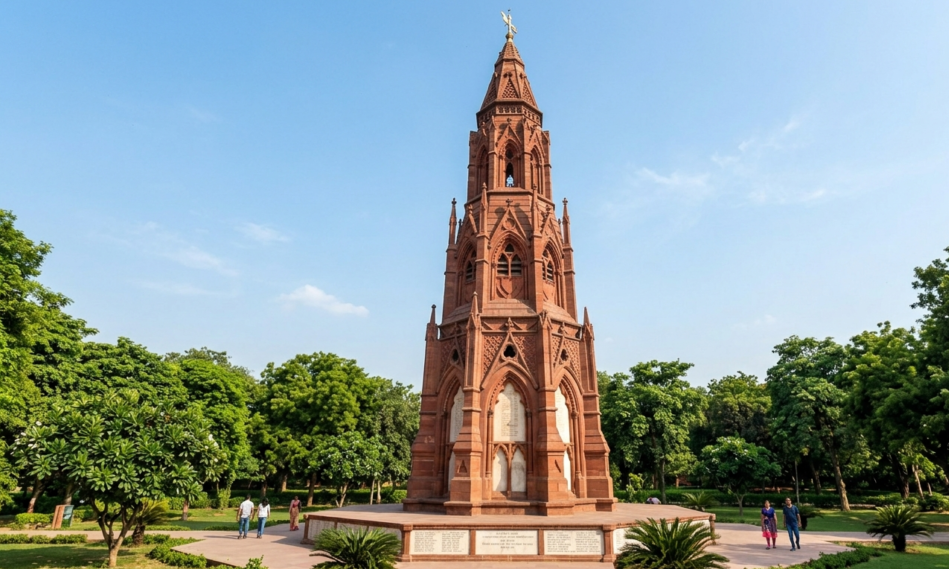
The Silent Witness of 1857 :- Mutiny Memorial (Ajitgarh), Delhi
As you drive from Old Delhi’s historic Kashmiri Gate toward the North Campus of Delhi University, a towering, slender, and intricate Gothic spire emerges from the dense, canopy-covered forests of the Kamla Nehru Ridge. Historically named the ‘Mutiny Memorial’ and rechristened as ‘Ajitgarh’ post-independence, this monument is one of the few places in Delhi that tells the gritty, blood-soaked saga of the First War of Indian Independence in 1857. In this detailed blog, let us delve deep into the historical context, unique Victorian architecture, and the complete visitor guide for this profound monument.
Detailed History
The history of the Mutiny Memorial is inextricably linked to India’s most massive anti-colonial uprising and the fierce military clashes that shook the foundations of the British Empire.
- The Reason for Construction :– When Indian sepoys rebelled against the British East India Company in May 1857, Delhi became the nerve center of the revolution. The British army retreated and fortified this elevated ‘Ridge’ area, transforming it into their strategic base to launch attacks and recapture the city. The ridge witnessed relentless, bloody skirmishes between the Indian freedom fighters and the British army.
- When and Who Built It? :– To honor the memory of the British officers, engineers, and loyal Indian soldiers of the Delhi Field Force who lost their lives during the violent Siege of Delhi, the Public Works Department of the British government erected this tower in 1863.
- The Post-Independence Metamorphosis (Ajitgarh) :– For over a century, the tower projected an exclusively pro-colonial narrative. However, marking the 25th anniversary of India’s independence in 1972, the Government of India corrected the historical equilibrium. A new plaque was installed at the base, formally paying homage to those immortal Indian revolutionaries who bravely fought against British tyranny. The monument was officially renamed ‘Ajitgarh’ (The Fortress of the Unconquered).
Detailed Architecture
The structural layout of the Mutiny Memorial is exceptionally distinct, breaking away from the standard classical styles usually chosen by British architects in India.
- Victorian Gothic Revival Style :– Constructed using fine local red sandstone, the tower is a textbook example of Victorian Gothic architecture. From a distance, its dramatic tapering silhouette resembles the high steeple of an old cathedral or a grand octagonal minaret.
- Four-Tiered Spire :– Standing upon a high octagonal plinth, the monument rises to an imposing height of approximately 33 meters (about 110 feet). It narrows progressively as it reaches for the sky. The topmost peak originally featured a prominent Christian cross, which was later modified.
- White Marble Plaques :– Embedded into the octagonal faces of the lower tiers are several authentic white marble tablets. These plaques contain meticulously carved English inscriptions detailing the names, military ranks, regiments, and exact dates of death of the British personnel who died during the intense summer of 1857.
Travel Guide & Routes
If you want to step off the beaten tourist path and visit this secluded piece of history, here is your essential travel guide.
- Tickets :– Managed jointly by the Delhi Forest Department and the Archaeological authorities, this monument is located in an open public park. Admission is completely Free.
- Visiting Timings :– The monument can be visited between 7:00 AM and 6:00 PM. Since it is located within the unlit and highly secluded forest tracks of the Ridge, it is strictly advisable to visit only during peak daylight hours.
- How to Reach :–
- By Metro :– The closest metro stations are ‘Pul Bangash’ (Red Line) and ‘Civil Lines’ (Yellow Line). Civil Lines station is roughly 1.5 kilometers away, from where you can easily hire a cycle rickshaw or an e-rickshaw to the monument gates.
- By Road :– The monument sits on ‘Rani Jhansi Marg’ on the Northern Ridge, sandwiched between Bara Hindu Rao Hospital and the university enclave. It is easily accessible via app-based cabs or auto-rickshaws coming from Kashmiri Gate or Malka Ganj.
Photography Spots
For street, architectural, and heritage photographers, this site offers a moody, serene, and deeply vintage atmosphere:
- The Low-Angle Monolithic Frame :– Positioning yourself at the base of the plinth and shooting upwards with a wide-angle lens captures the entire Gothic spire framing beautifully against the sky.
- The Interplay of Plaques :– Capturing the contrasting textures of the weathered 1863 British marble plaques alongside the 1972 Indian commemorative plaque offers an excellent visual narrative on historical perspectives.
- The Woodland Path :– The leading mud tracks cutting through the dense green woods of the Ridge towards the red sandstone tower provide fantastic frames for environmental and travel photography.
Local Food & Famous Markets
After exploring the quiet grounds of the memorial, you can head out to sample the vibrant college-town food culture and bustling markets nearby.
- Local Food :–
- Kamla Nagar Food Hubs :– A brief ride away takes you into the heart of Kamla Nagar, packed with street chaat vendors, student-friendly cafes, and North Indian snack stalls.
- Chache Di Hatti :– Located near the university campus, this legendary outlet is arguably the most famous spot in North Delhi for authentic, melt-in-the-mouth Chole Bhature.
- Famous Markets :–
- Kamla Nagar Market :– The absolute favorite shopping destination for North Campus university students, famous for trendy apparel, footwear, books, and accessories.
- Kashmere Gate Market :– Located a short distance away, known as one of the oldest automotive and commercial hubs of Delhi.
Nearby Attractions
The Northern Ridge is practically an open-air museum of 1857 history; you can comfortably club your visit with these spots.
- Flagstaff Tower :– Located just 1 kilometer further deep into the Ridge woods; this is the circular brick tower where British families gathered for safety on May 11, 1857.
- The Delhi Ridge Ashoka Pillar :– A 2,300-year-old monolithic Ashoka Pillar brought from Meerut by Feroz Shah Tughlaq, located near Hindu Rao Hospital.
- The Viceregal Lodge :– The historic building that once housed the British Viceroy (and where Lord Mountbatten lived), now serving as the Vice Chancellor’s Office of Delhi University.
Interesting Facts
- A British ‘Martyrs’ Memorial’ :– This remains one of the very few structural installations on Indian soil designed and funded by the British Empire specifically as a ‘Martyrs’ Memorial’ for their own men, marking the absolute gravity of the challenge they faced in 1857.
- Unintentional Proof of Indian Valour :– Though designed to chronicle British losses, the towering height and extensive lists of casualties on the plaques stand as a structural testament to how fiercely and desperately the Indian revolutionaries fought to liberate Delhi.
- The Colony of Bats :– The upper interior hollow chambers of the Gothic spire have long been home to a massive colony of bats, adding a distinct, eerie, and mysterious gothic aura to the monument.
Important Questions and Answer :-
Question 1:- Why was the Mutiny Memorial constructed?
Answer:– The monument was built by the British in 1863 to honor the officers and soldiers of the British Delhi Field Force who died while suppressing the Indian Uprising and recapturing Delhi in 1857.
Question 2:– What is the significance of the name ‘Ajitgarh’?
Answer:– In 1972, the Indian government renamed the structure ‘Ajitgarh’ (Fortress of the Unconquered) and placed a plaque honoring the Indian freedom fighters, balancing the one-sided history of the colonial monument.
Question 3:- Where exactly is this monument located in Delhi?
Answer:– It is situated amidst the protected forests of the Northern Ridge on Rani Jhansi Marg, very close to Kashmiri Gate and Delhi University’s North Campus.
Question 4:– Which is the closest metro station to the Mutiny Memorial?
Answer:– The nearest metro options are ‘Civil Lines’ on the Yellow Line and ‘Pul Bangash’ on the Red Line.
Author’s Thoughts :-
Standing before this looming, red sandstone Gothic spire amidst the heavy, rustling silence of the Northern Ridge, one can almost feel the weight of history hanging in the air. The Mutiny Memorial is a fascinating architectural paradox. What was conceived by an imperial power as an exclusive monument to its own fallen soldiers has been re-contextualized by a sovereign nation to respect its own freedom fighters. The marble tablets listing British casualties remind us of the fierce intensity of the conflict, while the humble 1972 Hindi plaque asserts our hard-won freedom. Away from the glossy glass facades and busy metro lines of modern Delhi, this hidden corner in the woods invites travelers to pause, look past the colonial architecture, and remember the steep price this city paid for its liberty. It is an absolute must-visit for anyone seeking an unvarnished view of history.
“Enveloped by the wild overgrowth of the Delhi Ridge, the Gothic spire of Mutiny Memorial—now proudly bearing the mantle of Ajitgarh—stands as a profound architectural bridge connecting the grim reality of colonial rule with the unyielding spirit of Indian freedom.”