
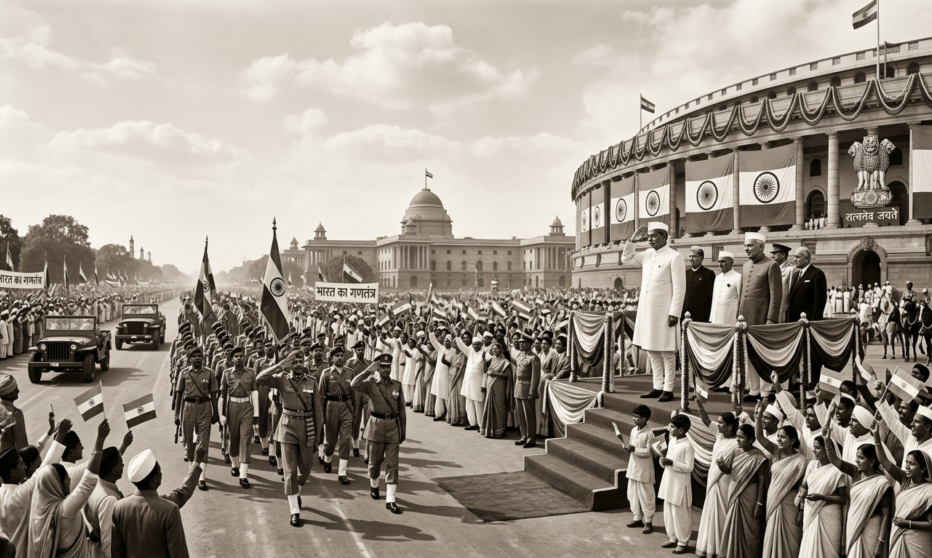
The Glorious Story of India Becoming a Republic :- A Historical Journey
Every year on the 26th of January, when the tricolor unfurls at Kartavya Path (formerly Rajpath) and the military contingents march in perfect unison, the heart of every Indian swells with pride. This day is not merely a public holiday; it represents the grand culmination of a long, historic struggle that transformed India into the world’s largest democracy and a sovereign republic. Let us explore the complete and authentic historical journey of how India became a Republic.
Detailed History :-
When India gained independence on August 15, 1947, the nation did not possess a permanent constitution of its own. Instead, the country’s laws were based on the colonial Government of India Act 1935, and technically, King George VI remained the constitutional head of state. To become a truly independent and sovereign nation, India urgently needed its own set of fundamental laws and governance frameworks.
To accomplish this monumental task, a ‘Drafting Committee‘ was constituted under the visionary chairmanship of Dr. B.R. Ambedkar. For 2 years, 11 months, and 18 days, the 389 esteemed members of the Constituent Assembly labored tirelessly, keeping in mind the diverse aspirations of every community, religion, and region of the country. Every clause, article, and section was subjected to intense debate and meticulous refinement.
Finally, on November 26, 1949, the Constitution of India was officially adopted. However, January 26, 1950 was specifically chosen as the date for it to come into legal effect due to a profound historical reason. On January 26, 1930, during the Lahore Session on the banks of the Ravi River, the Indian National Congress had declared ‘Purna Swaraj‘ (Complete Independence) for the very first time. To immortalize the memory of that historic day, the Constitution was enacted on January 26, 1950. On this momentous day, Dr. Rajendra Prasad took the oath as the first President of India, officially ushering the nation into its status as a complete ‘Republic‘.
Detailed Architecture (Structure of the Constitution) :-
Since this blog commemorates the very soul of our nation—the Constitution—rather than a brick-and-mortar monument, it is essential to understand its structural and artistic architecture. The Constitution of India holds the distinction of being the longest and most detailed written constitution of any sovereign country in the world.
The original manuscript was beautifully handwritten in flowing italic calligraphy by the renowned calligrapher Prem Behari Narain Raizada. To elevate its visual architecture, the legendary artist Nandalal Bose of Shantiniketan, along with his disciples, adorned the beginning of each chapter with exquisite hand-painted illustrations. These artworks depict iconic epochs of India’s historical and cultural journey, including the Indus Valley Civilization, the Vedic period, scenes from the Ramayana and Mahabharata, Lord Buddha, and Mahatma Gandhi’s freedom marches. These priceless original handwritten copies are preserved securely in special helium-filled glass cases in the Library of the Parliament of India.
Travel Guide & Routes :-
- Timings and Tickets :– To witness this glorious history come alive, the grand Republic Day Parade is organized every year on January 26 at Kartavya Path in New Delhi. Tickets for the parade can be booked online through the Ministry of Defence’s official portal or designated apps. Ticket prices range from INR 20 to INR 500. The parade officially commences at 9:30 AM, but visitors must be seated by 7:00 AM due to strict security protocols.
- How to Reach :– Kartavya Path in New Delhi is exceptionally well-connected via the Delhi Metro network. The closest metro stations are Central Secretariat and Udyog Bhawan. Since several roads are closed for security on Republic Day, utilizing the metro is the most convenient option.
- Photography Spots :– The majestic India Gate, the National War Memorial, and the sweeping grand vistas of Kartavya Path during the celebrations.
- Local Flavors & Famous Markets :– While exploring the capital, do not miss out on tasting Delhi’s famous ‘Spicy Chaat’, the iconic stuffed paranthas at Paranthe Wali Gali, and traditional sweets at Bengali Market. For shopping, you can head to the adjacent Connaught Place (CP), Janpath Bazaar, or Khan Market.
Interesting Facts
- No typing or printing machinery was used to produce the original Constitution of India; it was entirely handwritten from start to finish.
- The Indian Constitution is often affectionately called a ‘Bag of Borrowed Features’ because its core principles were selected from various constitutions around the world (including the USA, UK, France, and Ireland) and masterfully adapted to suit Indian socio-cultural realities.
- India officially became a republic at 10:18 AM on January 26, 1950, and exactly six minutes later, at 10:24 AM, Dr. Rajendra Prasad was sworn in as the first President.
Important Questions and Answer :-
Question 1:– How long did it take to frame the Constitution of India?
Answer:- It took a total of 2 years, 11 months, and 18 days of rigorous work to finalize the Constitution.
Question 2:- Who unfurls the national flag on Republic Day (January 26)?
Answer:- The President of India unfurls the national flag on Republic Day, whereas the Prime Minister unfurls the tricolor at the Red Fort on Independence Day (August 15).
“Bound by diversity, powered by unity—our nation stands proud as the world’s greatest republic.”