
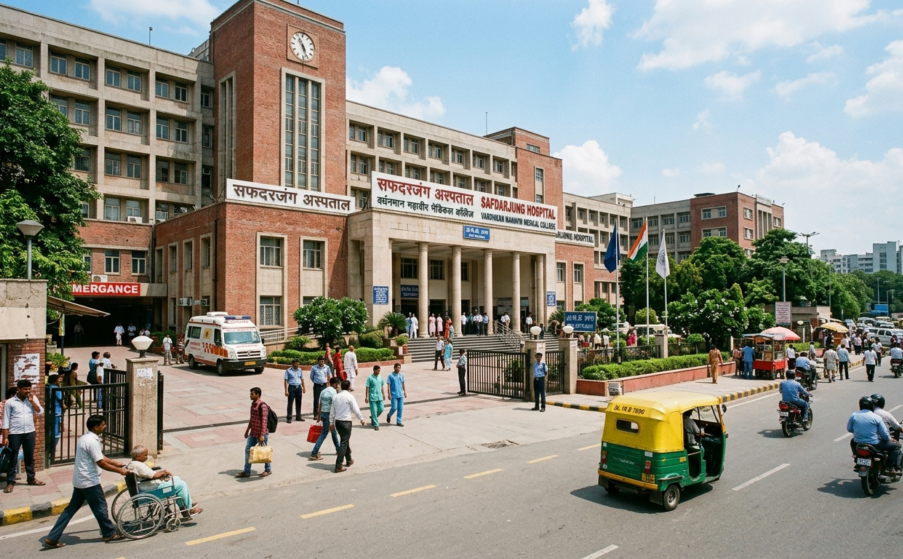
Safdarjung Hospital, Delhi :- The Lifeline of the Masses and India’s Historic Medical Pillar
Detailed History
Located at the famous intersection of Ring Road and Aurobindo Marg in New Delhi, Safdarjung Hospital is one of the largest, oldest, and busiest government healthcare institutions in India. The history of this hospital dates back to the era of the Second World War. In 1942, the British government established this medical facility primarily as a ‘Base Hospital’ to treat injured American and Allied troops fighting in the war. At that time, due to its close proximity to the Safdarjung Airfield, it was known as the ‘Safdarjung Aerodrome Hospital‘.
Following the conclusion of the World War, the Ministry of Health of the Government of India took over its management in 1947. In the wake of the partition of India, this hospital played a historic role in providing immediate, lifesaving medical relief to hundreds of thousands of refugees and citizens arriving in Delhi. In 1954, the central government completely assumed responsibility for its expansion, and later, the prestigious ‘Vardhman Mahavir Medical College‘ (VMMC) was established within its premises. Today, the hospital stands as a monumental temple of healthcare for millions of poor and middle-class families across North India, keeping its doors open 24/7 for anyone in need.
Detailed Architecture
Exterior Architecture :-
The sprawling campus of Safdarjung Hospital extends over a massive 47 acres of land. Its exterior architecture presents a fascinating evolution from a simple, British-era military base camp to a highly sophisticated modern healthcare complex. The original vintage buildings were built in a low-rise, single-story barrack style to facilitate the rapid movement of stretchers and military casualties. However, massive modernization over recent years has reshaped its skyline with majestic multi-story towers. The new ‘Super Specialty Block’ and the state-of-the-art ‘Emergency Block’ are prime examples of contemporary architectural design, featuring extensive glass facades and heavy concrete pillars that rival the grand look of premium corporate hospitals.
Interior Architecture :-
Internally, Safdarjung Hospital is strategically mapped out to smoothly handle the immense daily pressure of tens of thousands of outpatients. The interior flow of the new Emergency Block is highly scientific, boasting wide, smoothly inclined ramps for immediate ambulance access and high-capacity elevators for multi-level transfers. The main OPD corridors and inpatient walkways are designed to be exceptionally wide and airy, lined with highly durable Kota stone and granite flooring capable of enduring heavy foot traffic. The complex proudly houses Asia’s largest dedicated ‘Burns and Plastic Surgery’ wing and modern modular Operation Theatres (OTs). Vast waiting lounges are integrated throughout the layout, accompanied by bright, color-coded signages designed to help even illiterate patients easily navigate their way around different medical departments.
Travel Guide & Routes
For patients, relatives, and visitors planning to travel to Safdarjung Hospital, the comprehensive guide below provides all essential logistical details.
- Ticket and Registration Fee :– Entry into the hospital complex is absolutely Free. Being a central government institute, the OPD registration card (Parcha) is issued completely free of cost, and basic diagnostic tests, as well as essential medicines, are provided without any charges.
- Timings (OPD & Emergency) :–
- General OPD Registration Timings :– From 08:30 AM to 11:30 AM (Token generation hours).
- Emergency & Casualty Services :– Fully operational 24 hours a day, 7 days a week.
- Opening and Closing Days :– Main OPD services function from Monday to Saturday. Routine outpatient consultations remain closed on Sundays and central government gazetted holidays, while all emergency units continue running uninterrupted.
- How to Reach :–
- By Metro :– The most efficient way to reach the hospital is via the Delhi Metro network. The nearest station is the ‘AIIMS’ Metro Station, located on the Yellow Line. Exiting through Gate No. 2 or 3 lands you directly at the perimeter of the Safdarjung Hospital complex.
- By Bus :– Situated squarely on the Ring Road transit corridor, the hospital is heavily accessible via public buses from all corners of the capital. Direct DTC buses from Anand Vihar, Kashmiri Gate, Dhaula Kuan, or Uttam Nagar drop commuters directly at the Safdarjung Hospital bus stop.
- By Auto/Taxi/Cab :– Located roughly 8 km from New Delhi Railway Station, you can seamlessly hire an auto-rickshaw, e-rickshaw, or book an app-based cab to reach the main entrance gates of the hospital.
Photography Spots, Local Food, and Famous Markets
Photography Spots :-
- The Entrance Plaza & Super Specialty Block :– The modern sleek architectural look of the newly built multi-story Super Specialty Block with its contemporary glass curtain wall offers a great backdrop highlighting modern medical infrastructure.
- Vardhman Mahavir Medical College (VMMC) Campus :– The main administrative building of the college, along with its green courtyard and central emblem, is a proud photography spot for medical students.
- The Main Safdarjung Hospital Landmark Signage :– The official monument board at the primary entry gate serves as an important regional landmark photograph. (Note: Photography or video recording inside clinical wards, active treatment zones, and of patients is strictly prohibited by law due to privacy and security protocols.)
Local Food
The surroundings of the hospital offer several clean and highly budget-friendly food options for visiting families.
- The Amrit Canteen :– Situated inside the hospital compound, this facility serves freshly prepared, highly subsidized hygienic vegetarian meals, snacks, and tea/coffee.
- Local Street Stalls :– The food stalls right outside the gates serve heavily popular street snacks like piping hot Chole-Kulche, crisp Bedmi-Kachoris, bread omelets, and fresh seasonal fruit juices.
- Dilli Haat Food Court :– Located a short walk away, the food stalls inside Dilli Haat let you savor authentic regional delicacies from different Indian states (such as Naga momos or Rajasthani Pyaaz Kachoris).
Famous Markets Nearby
- Sarojini Nagar Market :– Situated barely 1–2 km from the hospital, this world-renowned street flea market is famous across India for incredibly cheap, trendy readymade garments, footwear, and fashion accessories.
- Dilli Haat & INA Market :– Dilli Haat is a premium open-air hub for traditional Indian handlooms and crafts, while the adjacent INA Market is highly famous for fresh gourmet grocery items and spices.
- South Extension Market :– Located a short distance away, this premium upscale high-street arcade is popular for branded clothing, designer luxury wear, and jewelry shopping.
Interesting Facts
- Asia’s Largest Burns Unit :– Safdarjung Hospital houses an independent, state-of-the-art ‘Burns and Plastic Surgery Block’, which is recognized as the largest specialized facility of its kind across Asia.
- A Second World War Heritage :– The hospital did not start as a public facility; it was built as a temporary military base hospital by the Allies during WWII specifically to treat American soldiers suffering from spinal injuries.
- Massive Ventilator Network :– The advanced Emergency and Super Specialty towers house one of the highest numbers of dedicated intensive care unit (ICU) beds and mechanical ventilators among all public hospitals in the nation.
- Record Footfall Numbers :– The hospital registers an average daily footfall of over 12,000 outpatients, comfortably placing it at the top of the list of the busiest public healthcare centers in India.
Important Questions and Answer :-
Question 1:– When and for what purpose was Safdarjung Hospital originally established?
Answer:- The hospital was established in 1942 during World War II to serve as a specialized military base hospital for treating injured British and American troops.
Question 2:– Which is the closest metro station to Safdarjung Hospital?
Answer:- The closest station is the ‘AIIMS’ Metro Station, located on the Yellow Line of the Delhi Metro, which opens right next to the hospital gates.
Question 3:- Is there any fee charged for an OPD consultation card at Safdarjung Hospital?
Answer:- No, Safdarjung Hospital is a premier central government run hospital where patient registration cards, doctor consultations, and general essential medicines are provided completely free of cost.
Question 4:- What are the operational hours for the Emergency Department at Safdarjung Hospital?
Answer:- The Emergency and Casualty departments of the hospital remain fully operational round-the-clock, 24 hours a day, 7 days a week.
Question 5:– Is there a medical college affiliated with Safdarjung Hospital?
Answer:- Yes, the prestigious ‘Vardhman Mahavir Medical College’ (VMMC), one of India’s top medical institutes, is located right within the hospital complex.
“From a temporary World War military camp to becoming the ultimate shield of health for the common man, Safdarjung Hospital stands as a monumental testament to selfless service and medical heritage.”