
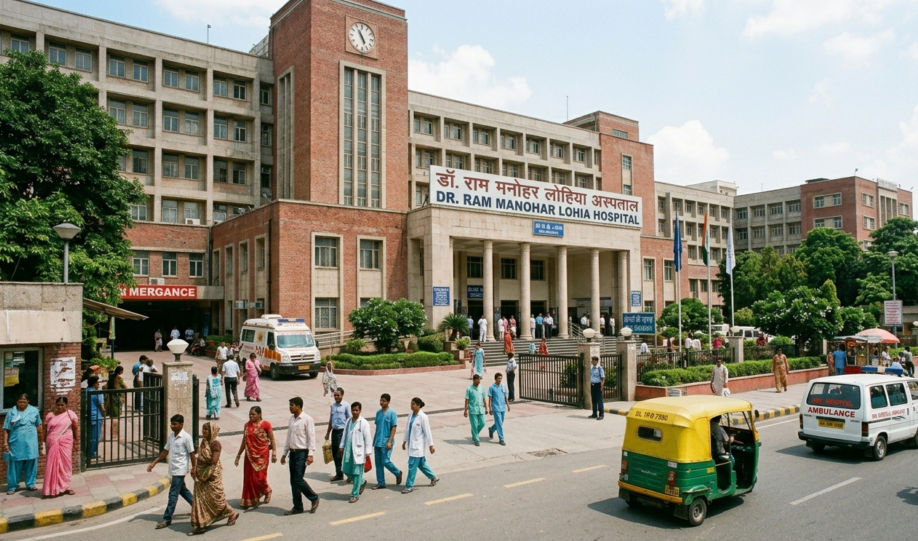
Dr. Ram Manohar Lohia Hospital (RML), Delhi :- Elite Central Government Medical Institute and Historic Healthcare Pillar
Detailed History
Situated on Baba Kharak Singh Marg near Connaught Place in the imperial heart of New Delhi, Dr. Ram Manohar Lohia Hospital, widely known to the public as RML Hospital or by its historical moniker ‘Willingdon Hospital’, is a highly prestigious and historic central government medical institution. The history of this hospital’s inception is deeply rooted in the British colonial era.
The British government established this medical facility in the year 1932. It was named ‘Willingdon Hospital’ after the then Viceroy of India, Lord Willingdon. Initially, the hospital commenced operations on a very modest scale with just 54 beds, primarily aimed at serving the healthcare needs of British staff, their families, and the government officials residing in the Lutyens’ Delhi zone.
Following India’s independence, the Ministry of Health assumed direct control of the hospital and spearheaded its rapid infrastructure expansion. During 1975-76, the hospital was formally renamed ‘Dr. Ram Manohar Lohia Hospital’ to honor the legacy of the legendary Indian freedom fighter and socialist leader. In 2019, the central government achieved another milestone by establishing the ‘Atal Bihari Vajpayee Institute of Medical Sciences’ (ABVIMS) within its premises to cultivate top-tier medical talent. Due to its strategic proximity to Rashtrapati Bhavan, the Parliament of India, and the Central Secretariat, RML serves as a critical nodal center for VVIP medical security while concurrently acting as a vital lifeline offering free, world-class healthcare to millions of ordinary citizens traveling from across India.
Detailed Architecture
Exterior Architecture :-
Sprawling across a prime land area of over 30 acres, Dr. Ram Manohar Lohia Hospital’s exterior layout showcases a brilliant architectural evolution, blending British colonial heritage with contemporary multi-story skyscrapers. The oldest heritage blocks feature classic structures built with red and cream sandstone, highlighted by stately semi-circular arches and vintage colonial windows. Over the years, the campus has undergone a major face-lift. The contemporary additions, such as the dedicated ‘Trauma Centre’ and the multi-story ‘Super Specialty Block’, are characterized by modern engineering, utilizing extensive curtain glass facades and robust structural concrete pillars that project a highly sophisticated, state-of-the-art look.
Interior Architecture :-
The internal layout of RML Hospital is meticulously mapped and divided into specialized independent wings to handle high volumes of patient flow. Stepping inside the main building reveals a cavernous Outpatient Department (OPD) registration lobby, fitted with organized queue management counters. The corridors are exceptionally wide, spotlessly clean, and well-ventilated, featuring premium marble and polished granite flooring designed for durability under heavy foot traffic. The interiors house cutting-edge Intensive Care Units (ICUs), modular operation theatres, and advanced diagnostic hubs equipped with ultra-modern MRI and CT scan machinery. Spacious waiting lounges are seamlessly integrated across every floor for patient relatives. The Emergency and Trauma wings are scientifically laid out to ensure that critical casualties brought in by ambulances are smoothly transitioned onto advanced life-support systems without any architectural or logistical delays.
Travel Guide & Routes
For outpatients, relatives, and heritage visitors planning to travel to Dr. Ram Manohar Lohia Hospital, the detailed logistical guide below outlines all vital information.
- Ticket and Registration Fee :– General entry into the hospital compound is completely Free. Being a premier central government facility, the outpatient consultation card (OPD Parcha) is issued entirely free of cost, and major diagnostic services, as well as essential medicines, are provided with zero charges under government welfare schemes.
- Timings (OPD & Emergency) :–
- General OPD Registration Hours :– From 08:30 AM to 11:30 AM (Daily slot allocation hours).
- Emergency & Casualty Services :– Fully operational 24 hours a day, 7 days a week.
- Opening and Closing Days :– Main outpatient services run from Monday to Saturday. Regular OPD clinics remain closed on Sundays and central government gazetted holidays, while all emergency units and the Trauma Centre continue running uninterrupted.
- How to Reach :–
- By Metro :– The absolute closest metro station is the ‘Shivaji Stadium’ Metro Station (Airport Express Line), which sits within comfortable walking distance. Alternatively, the ‘Rajiv Chowk’ (Connaught Place) Interchange Station (Blue and Yellow Lines) and ‘Ramakrishna Ashram Marg’ Station (Blue Line) are located just 1.5 to 2 km away, from where auto-rickshaws are readily available.
- By Bus :– The Gole Dak Khana and RML Hospital bus stops are major transit points in Central Delhi. Buses heading towards Central Secretariat or Connaught Place from any part of the capital (such as Kashmiri Gate, Anand Vihar, or Uttam Nagar) drop you right outside the hospital gates.
- By Auto/Taxi/Cab :– Located roughly 3 km from New Delhi Railway Station, you can seamlessly hail an auto-rickshaw, e-rickshaw, or book an app-based cab to arrive directly at the primary entrance plaza of the hospital.
Photography Spots, Local Food, and Famous Markets
Photography Spots :-
- The Main Entrance Plaza & Dr. Lohia Statue :– The official landmark entrance board accompanied by the beautifully sculpted statue of Dr. Ram Manohar Lohia stands as a prominent and proud landmark photograph.
- ABVIMS Medical College Building :– The sleek, towering architectural facade of the newly established Atal Bihari Vajpayee Institute of Medical Sciences offers a brilliant perspective highlighting India’s modern medical academic infrastructure.
- The Historic Gole Dak Khana (GPO) :– Located right next to the hospital perimeter, the majestic circular structure of the colonial-era General Post Office offers an incredible vintage frame for heritage photography enthusiasts. (Note: Photography or video recording inside clinical consultation rooms, active treatment zones, ICU wings, and of patients is strictly prohibited by law due to privacy and legal safety guidelines.)
Local Food :-
The proximity to Connaught Place ensures an excellent mix of pocket-friendly and premium dining options around the hospital.
- The In-house Jan-Aahar Canteen :– Situated inside the hospital complex, this facility serves freshly prepared, highly subsidized, and deeply hygienic vegetarian meals, quick breakfasts, and hot tea/coffee for patient relatives.
- Baba Kharak Singh Marg Street Food :– The food kiosks just outside the hospital perimeter are immensely popular for iconic local street lunches like steaming Rajma-Chawal, Kadhi-Chawal, spicy Chole-Bhature, and fresh seasonal fruit juices.
- Connaught Place Restaurants :– For fine dining, a quick 5-minute drive takes you into the heart of CP, which houses the world’s finest premium cafés, multi-cuisine legacy restaurants, and global fast-food chains.
Famous Markets Nearby :-
- Connaught Place (CP) :– India’s premier high-street open-air commercial arcade, showcasing international brands, lifestyle showrooms, luxury boutiques, and flagship stores.
- State Emporia Complex :– Situated directly opposite the hospital on Baba Kharak Singh Marg, this row of state-run emporiums allows you to shop for authentic traditional Indian handicrafts, ethnic handlooms, hand-woven sarees, and indigenous artifacts from different states.
- Janpath Market :– A highly popular, vibrant street market famous among youngsters and tourists for budget-friendly casual western wear, traditional Tibetan handicrafts, ethnic silver jewelry, and souvenirs.
Interesting Facts
- From 54 Beds to a Medical Giant :– Starting on a highly localized scale with a mere 54 beds in 1932, this colonial facility has expanded over the decades into a massive medical giant housing more than 1,500 active inpatient beds.
- The Nodal VVIP Hospital :– RML Hospital is strategically designated as the primary nodal medical facility responsible for managing the emergency healthcare protocols and medical safety parameters for India’s top dignitaries, including the President and the Prime Minister.
- Advanced Burns Unit & Nursing College :– The complex proudly manages a highly advanced, specialized Burns Care Department along with hosting one of Delhi’s premier nursing colleges.
- Named After an Academic Stalwart :– In 2019, to honor the memory of the former Prime Minister of India, the Post Graduate Institute of Medical Education and Research (PGIMER) inside the campus was upgraded and renamed the ‘ABVIMS’ Medical College.
Important Questions and Answer :-
Question 1:- What was the original colonial name of Dr. Ram Manohar Lohia Hospital?
Answer:- The hospital was originally named ‘Willingdon Hospital’ when it was established by the British colonial administration back in 1932.
Question 2:– Where exactly is RML Hospital located in Delhi?
Answer:- RML Hospital is centrally located on Baba Kharak Singh Marg, right next to the iconic Gole Dak Khana and very close to Connaught Place in New Delhi.
Question 3:– When was the hospital renamed after Dr. Ram Manohar Lohia?
Answer:- The hospital was renamed during 1975-76 in honor of the prominent Indian socialist leader and freedom fighter, Dr. Ram Manohar Lohia.
Question 4:– Which is the closest metro station to access RML Hospital?
Answer:- The closest metro station is ‘Shivaji Stadium’ on the Airport Express Line. Additionally, the ‘Rajiv Chowk’ (Connaught Place) interchange station is also located very close by.
Question 5:– Are general OPD services operational on Sundays at RML Hospital?
Answer:- No, routine outpatient departments are closed on Sundays and central government holidays. However, the Emergency wards and the Trauma Centre function continuously 24/7.
“Transitioning from a highly restricted colonial clinic to becoming the monumental shield of health for millions of everyday citizens, RML Hospital stands tall in the very heart of Delhi as an enduring pillar of medical excellence and selfless service.”