
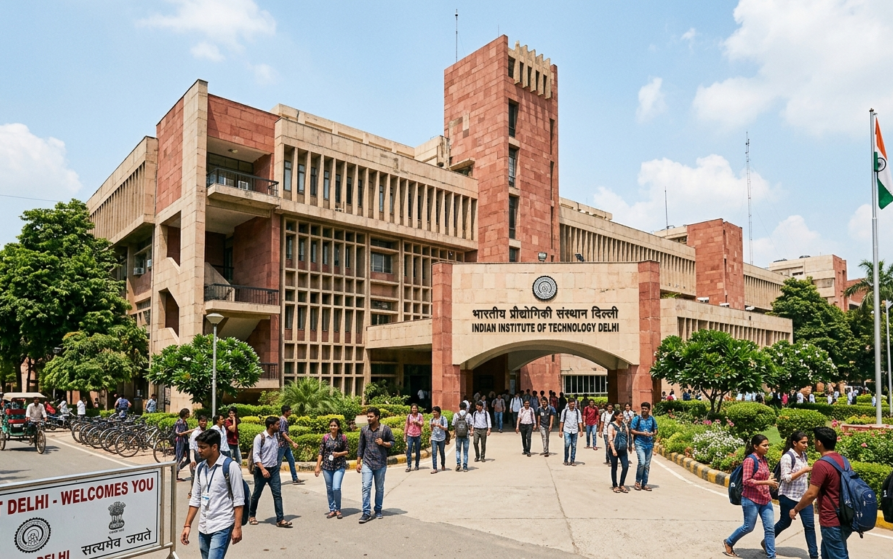
Indian Institute of Technology Delhi (IIT Delhi) :- The Pinnacle of Technological Innovation and Global Excellence
Detailed History
The Indian Institute of Technology Delhi (IIT Delhi) is globally recognized as one of the most premier and illustrious destinations for technological education and advanced research. Established in 1961 as the ‘College of Engineering & Technology‘, it was later declared an Institution of National Importance under the ‘Institutes of Technology (Amendment) Act’ and renamed as ‘IIT Delhi’.
The institute was developed in close academic and financial collaboration with the Government of the United Kingdom and a consortium of British universities. Since its inception, IIT Delhi has acted as a critical catalyst for the technological, industrial, and scientific growth of modern India. Its stellar community of alumni includes global pioneers in technology, corporate business, and entrepreneurship—featuring stalwarts like NR Narayana Murthy (Co-founder of Infosys), Sachin Bansal and Binny Bansal (Founders of Flipkart), and Deepinder Goyal (Founder of Zomato).
Detailed Architecture :-
Nestled in the prime locality of Hauz Khas in South Delhi, the lush green and highly organized campus of IIT Delhi spans across a massive 320 acres. The structural layout of the institute stands as a landmark specimen of modern functionalist design and Brutalist Architecture.
- Exterior Architecture :– The iconic Main Building is renowned for its exposed concrete texture, symmetric grid-patterned glass windows, and massive linear geometric wings. This robust aesthetic pays homage to post-independence India’s vision of structural and industrial progress. The vast campus grounds smoothly blend these colossal concrete modules with wide tree-lined boulevards and manicured lawns.
- Interior Architecture :– The indoors feature high-reaching corridors, expansive exhibition foyers, and massive high-tech engineering laboratories. The Lecture Hall Complexes (LHC) and the multi-story Central Library are equipped with state-of-the-art audiovisual aids and ergonomic designs. The layout of the research centers is crafted intentionally to provide scholars with extensive spaces for focused innovation, experimentation, and collective brainstorming.
Travel Guide & Routes :-
If you wish to catch a glimpse of the inspiring, tech-driven, and green avenues of this premier institute, here is your essential visitor guide.
- Entry Ticket :– There is no entry fee to access the outer campus. (It is completely free, though access inside institutional buildings, departments, and hostels is strictly limited to students, staff, and visitors with official clearance due to security protocols).
- Visiting Timings :– The best window to tour the accessible campus walkways and open green spaces is between 09:00 AM and 05:00 PM on weekdays. Administrative buildings and centers are closed on Sundays and gazetted holidays.
- How to Reach :–
- By Metro :– The campus is exceptionally connected via the ‘IIT’ Metro Station located on the Magenta Line of the Delhi Metro network, with exit gates leading right to the outer perimeter. The ‘Hauz Khas’ Metro Station (Yellow/Magenta Line interchange) is also a short distance away.
- By Bus :– Multiple DTC buses plying through the Outer Ring Road route stop directly at the designated ‘IIT Gate‘ bus stop.
- By Auto/Cab :– Given its central location in South Delhi, app-based cabs and local auto-rickshaws are readily available from all parts of the national capital.
Nearby Attractions :-
- Hauz Khas Village & Fort :– Located right next to the campus, this famous hub features medieval ruins, a serene lake, a deer park, and an eclectic mix of upscale cafes and art galleries.
- Qutub Minar :– This majestic UNESCO World Heritage Site and centuries-old brick minaret is located just a brief drive away in Mehrauli.
- Sanjay Van :– A massive, sprawling urban forest reserve bordering the local area, popular for morning jogs, bird watching, and nature trails.
- Siri Fort Auditorium :– A premier cultural complex near the institute that hosts national film screenings, theatrical acts, and musical concerts.
- Saket Mall District :– For premier lifestyle shopping and dining, the commercial hub featuring Select Citywalk and DLF Avenue is located in close proximity.
Photography Spots, Local Taste, and Famous Markets :-
- Photography Spots :– The striking geometric facade of the Main Building, the scenic wind tunnel avenue, the sweeping central sports ground, and the shaded walkways near the residential zones offer great frames for architectural photography.
- Local Taste :– The central staff canteen and various night-canteens near the student hostels serve incredibly popular, budget-friendly south Indian snacks, paranthas, and tea. The adjoining Hauz Khas Village offers premium global culinary options.
- Famous Markets :– Located just opposite the main entrance is the vibrant ‘SDA Market’ (Sri Aurobindo Marg), famed for its student-friendly student cafes, book shops, and open-air seating. The nearby Kalu Sarai market is also known for extensive educational bookstores.
Interesting Facts :-
- IIT Delhi has been officially designated as an ‘Institution of Eminence‘ (IoE) by the Government of India, unlocking greater operational and academic freedom.
- A large share of India’s multi-billion dollar tech startups and unicorns trace their humble origin back to the incubation cells (TBIU) and hostel wings of IIT Delhi.
- The institute houses a world-class Supercomputing Facility that enables cutting-edge complex simulations for advanced global research in diverse scientific fields.
- Expanding its global footprints, IIT Delhi has established its first international campus in Abu Dhabi, United Arab Emirates (UAE).
Important Questions and Answer :-
Question 1:– When was IIT Delhi established and what was its original name?
Answer:- IIT Delhi was established in the year 1961, and it was originally named the ‘College of Engineering & Technology’.
Question 2:– Which metro station provides the fastest access to the campus?
Answer:- The ‘IIT’ Metro Station on the Magenta Line is the closest, as its exit steps out directly by the institute’s outer perimeter.
Question 3:- Can a regular tourist explore the inside of labs and departments at IIT Delhi?
Answer:- No, entry inside academic blocks, laboratories, and specialized research centers is strictly prohibited for the general public to maintain research confidentiality and safety.
Author’s Thoughts :-
IIT Delhi is not merely an elite center for churning out textbook engineers; it stands as a living testament to independent India’s grand vision for self-reliance and technological leadership. Walking down its organized grid of avenues, one can clearly sense an air heavy with ambition, critical problem-solving, and the tireless pursuit of innovation. This campus proves that when rigorous intellectual discipline meets unbounded creative freedom, groundbreaking changes happen on a global scale.
“IIT Delhi is not just a collection of concrete buildings; it is the engine room of India’s technological future.”