
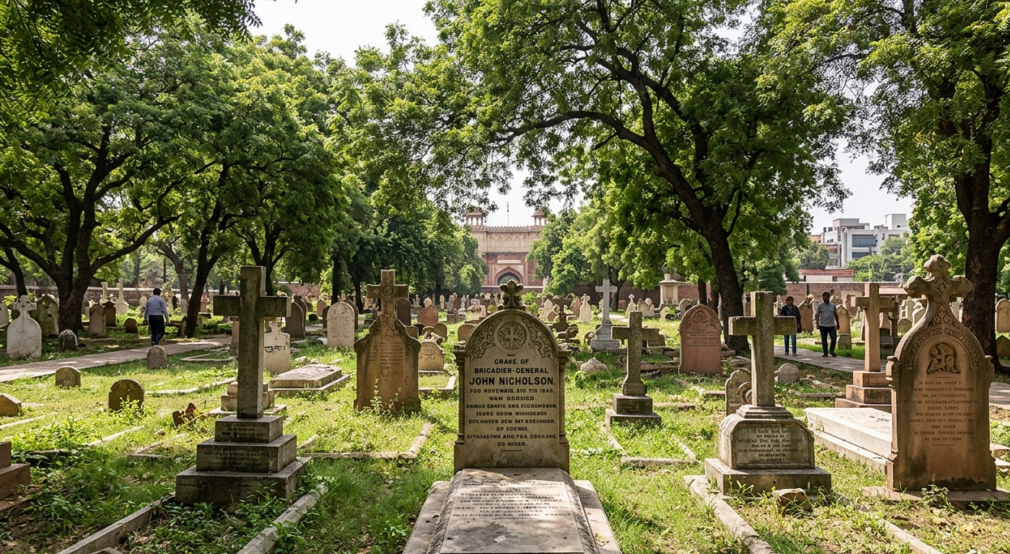
Nicholson Cemetery, Delhi :- The Silence of History and Silent Witness to the 1857 Uprising
Detailed History
The Nicholson Cemetery, positioned at the historic intersection of Old and New Delhi, stands as the oldest and historically most significant Christian burial ground in the national capital. Established during the tumultuous colonial era in 1857, the cemetery was named in honor of Brigadier General John Nicholson, a fiercely charismatic and notoriously ruthless British military commander. During the First War of Indian Independence (1857 Uprising), Nicholson led the British assault forces to recapture Delhi from Indian sepoys and was mortally wounded near Kashmiri Gate. He was subsequently laid to rest within these grounds.
This sanctuary is far more than a resting place; it serves as a raw, tangible archive of the bloody conflict of 1857. Beyond John Nicholson, the cemetery houses the graves of hundreds of British soldiers, officers, their families, young children, and early European residents of Delhi. The weather-beaten tombstones and poignant epitaphs carved into the stones offer a deep, haunting narrative of war, fatal tropical epidemics, and the personal cost behind the expansion of the British Empire in India.
Detailed Architecture :-
The architectural profile of the Nicholson Cemetery is an evocative specimen of Victorian Gothic and classic British Colonial styles, transporting visitors directly back into the mid-19th century.
- Exterior Architecture :– The historic cemetery is enclosed by high, weathered perimeter walls constructed from old colonial red bricks and local stone. The main entrance features a massive, heavy iron gateway that sets a solemn tone for the space. Upon entering, one is greeted by a dense canopy of ancient trees, unpaved pathways blanketed by dry leaves, and hundreds of closely packed vintage graves. The design layout is heavy with quietude and rustic decay, contrasting sharply with the manicured city parks outside.
- Interior Architecture :– The design of individual graves is remarkably artistic and diverse. Many tombstones feature soaring marble crosses, intricately sculpted weeping angels, and vaulted stone plinths reflecting Gothic revival sensibilities. The grave of Brigadier General John Nicholson is secured inside a protective iron railing, marked by an imposing, unadorned white marble slab. The epitaphs are carved in elegant Victorian typography, detailing the names, ranks, regiments, and tragic circumstances surrounding the deaths of those interred.
Travel Guide & Routes :-
If you wish to explore this untouched, peaceful, and deeply historic heritage site in Delhi, here is your comprehensive travel guide.
- Entry Ticket :– There is no admission fee or entry ticket required to visit the cemetery. (It is completely free, though it is standard courtesy to notify the caretaker or security guard at the gate upon arrival).
- Visiting Timings :– The cemetery is generally accessible from 09:00 AM to 05:00 PM daily. The cooler winter months between October and March offer the most comfortable atmosphere for walking through the grounds.
- How to Reach :–
- By Metro :– The absolute closest metro gateway is the ‘Kashmiri Gate’ Metro Station, a major interchange hub for the Red, Yellow, and Violet Lines. The cemetery is situated just a 2-minute walk from Exit Gate No. 1 of the station.
- By Bus :– As Kashmiri Gate houses the largest Inter-State Bus Terminus (ISBT) in Delhi, frequent public and interstate buses drop commuters directly near the cemetery vicinity.
- By Auto/Cab :– Due to its central location next to the historic city walls, app-based cabs and local auto-rickshaws can easily drop you right outside the main gate on Shamnath Marg.
Nearby Attractions :-
- Kashmiri Gate & St. James’ Church :– The historic, battle-scarred Kashmiri Gate structure and St. James’ Church—the oldest church in Delhi—are located just a brief walk away from the cemetery.
- The Red Fort :– Located less than 2 kilometers away, this iconic 17th-century Mughal palace and UNESCO World Heritage Site is an absolute must-visit.
- Chandni Chowk :– The historic core of Old Delhi, globally renowned for its bustling wholesale markets, heritage spice lanes, and legendary street food.
- Yamuna Ghats :– Situated nearby along the riverbank, offering breathtaking morning views of migratory birds arriving in the capital during winters.
- Qudsia Bagh :– The ruins of an 18th-century Mughal palace and formal charbagh garden, located just a short distance up the road.
Photography, Serenity, and Lifestyle Guide :-
- Photography Spots :– The sunbeams filtering through the thick tree canopy, the moss-covered Gothic stone crosses, the sculpted marble angels, and the historic iron-railed grave of John Nicholson provide incredibly moody, melancholic frames for heritage and architectural photographers. (Note :- Given the sensitive nature of the site, professional or commercial shoots require prior clearance).
- Local Taste :– Right outside the cemetery gates, you can dive into the culinary treasures of Kashmiri Gate and Chandni Chowk, sampling world-famous Chole Bhature, stuffed paranthas, crispy kachoris, and local masala chai.
- Famous Markets :– The adjoining Mori Gate and Kashmiri Gate auto-parts market are highly famous commercial hubs, while the Sunday Daryaganj Book Market is easily accessible nearby.
Interesting Facts :-
- John Nicholson was such a terrifying and larger-than-life figure during his time that a group of Indian devotees actually started a cult called ‘Nicholsains’ during his lifetime, worshiping him as a fierce deity.
- The cemetery is frequently featured in local urban legends as one of Delhi’s most haunted spots; folklore claims that the headless ghost of General Nicholson can sometimes be seen pacing the trails at night, though these are mere tales.
- The high concentration of infants’ and children’s graves from the 1800s bears silent testimony to how devastating the scorching Delhi summers, cholera, and malaria outbreaks were for the early European settlers.
- While many graves have suffered from weathering and neglect over the past century, the site remains an invaluable, protected pocket of Anglo-Indian history.
Important Questions and Answer :-
Question 1:– Who was John Nicholson and why is the cemetery named after him?
Answer:- John Nicholson was a Brigadier General of the British East India Company forces who led the recapture of Delhi during the 1857 Uprising. He was buried here after dying of battle wounds, giving the cemetery its name.
Question 2:– Which is the nearest metro station to reach Nicholson Cemetery?
Answer:- The ‘Kashmiri Gate’ Metro Station (Red/Yellow/Violet Lines) is the closest station, located just a stone’s throw away from the entrance.
Question 3:– Is it safe for solo travelers to visit and explore the cemetery?
Answer:- Yes, the cemetery is completely safe and open to the public during daytime hours, offering a highly enriching and peaceful sanctuary for history buffs, writers, and photographers.
Author’s Thoughts :-
Stepping through the heavy iron gates of Nicholson Cemetery, the deafening roar of Kashmiri Gate’s chaotic traffic instantly fades into an surreal, absolute silence. The air here feels heavy with the weight of unwritten history and the quiet rustle of old trees. Standing before the simple marble slab of John Nicholson, one cannot help but ponder the transience of power—an empire that once ruled the subcontinent now lies forgotten under a blanket of dry autumn leaves. This space doesn’t frighten; rather, it invites you to touch the contours of a bygone era and appreciate the profound stillness that time leaves in its wake.
“Nicholson Cemetery is that silent page of Delhi’s history, where the fiery echoes of 1857 have permanently dissolved into absolute peace.”