
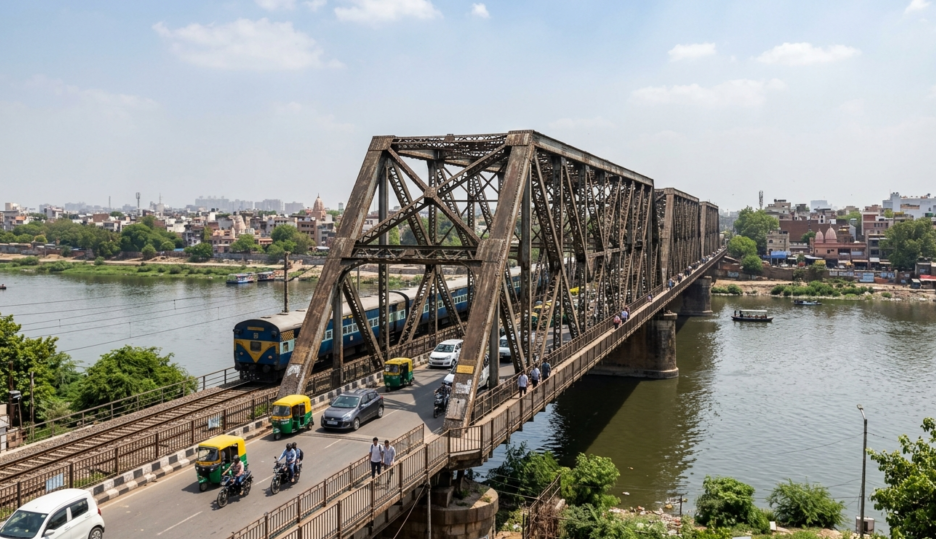
Old Iron Bridge (Loha Pul), Delhi :- An Engineering Marvel and Bridge Across History
Detailed History
Delhi’s ‘Old Iron Bridge‘ (Loha Pul), officially designated as Bridge No. 249, stands as one of the oldest and most iconic historical engineering structures in the national capital. It is not merely a transport conduit but a living chronicle of Delhi’s industrial era, modern development, and transport evolution. The construction of this monumental truss bridge was initiated by the East Indian Railway Company during the British Raj in 1863 and was successfully opened to traffic in 1866.
The primary historical objective of constructing this bridge was to establish a direct, uninterrupted rail link between Calcutta (now Kolkata)—the then capital of British India—and Delhi. When the first train steamed across the bridge in 1867, it completely transformed Delhi into a strategic commercial hub, linking it dynamically with the rest of the subcontinent. Built shortly after the Uprising of 1857, it also served a vital military purpose for the swift movement of British troops and supplies. It was further strengthened in 1913 to accommodate heavier locomotives. Defying its age, this legendary bridge remains operational today, standing as a stellar testament to Victorian industrial engineering.
Detailed Architecture
The architectural layout of the Old Iron Bridge is a spectacular specimen of 19th-century British industrial design, specifically showcasing classic Victorian Truss Architecture.
- Exterior Architecture :– The structure is engineered as a Double-Decker Truss Bridge, a rarity for its era. The upper deck features dual railway tracks where trains still crawl at regulated, cautious speeds. Directly underneath, the lower deck is dedicated to a narrow roadway accommodating light vehicular traffic, auto-rickshaws, cyclists, and pedestrians. The entire superstructure is a complex latticework of massive wrought-iron girders bound together structurally by millions of heavy rivets rather than modern welding, capturing the raw aesthetic of the industrial age.
- Interior Architecture :– The structural integrity of the bridge relies entirely on its massive stone piers anchored deep into the riverbed of the Yamuna. These monumental piers are constructed from heavy, dressed red sandstones bound with traditional lime mortar, beautifully surviving dozens of catastrophic seasonal floods over the past 160 years. Walking through the lower deck provides an intense sensory experience; the deafening rhythmic clatter and metallic vibrations generated when a train rumbles overhead highlight the bridge’s remarkable built flexibility and age-old design principles.
Travel Guide & Routes :-
The Old Iron Bridge spans the Yamuna River, connecting the historical core of Old Delhi with Shahdara and East Delhi. For heritage enthusiasts wishing to witness this engineering marvel, here is the essential visitor guide.
- Entry Ticket :– There is no fee or entry ticket required to access or cross this operational public bridge. It is entirely free. (Note: For safety and high-voltage security reasons, walking on the upper railway tracks is strictly prohibited and a punishable offense; visitors must stick to the pedestrian walkways on the lower deck).
- Visiting Timings :– The ideal window to experience the bridge is between 06:00 AM and 09:00 AM or late in the evening during sunset. The early morning hours offer a highly serene, cinematic view of the river and the structure.
- How to Reach :–
- By Metro :– The nearest metro stations are ‘Chandni Chowk’ (Yellow Line) and ‘Kashmiri Gate’ (Red/Yellow/Violet Lines). From either station, you can hire a local e-rickshaw or auto-rickshaw heading toward Yamuna Bazar or the Salimgarh Fort area.
- By Rail :– The bridge is located right behind the Old Delhi Railway Station (DLI), roughly 1.5 kilometers away, making it easily accessible for rail commuters.
- By Auto/Cab :– Positioned close to the Inter-State Bus Terminus (ISBT) Kashmiri Gate and the main Ring Road, app-based cabs and autos can drop you directly near the western approach of the bridge.
Nearby Attractions :-
- The Red Fort :– Situated just a short distance from the western flank of the bridge, this grand 17th-century Mughal palace is a world-renowned UNESCO World Heritage Site.
- Salimgarh Fort :– The western approach of the iron bridge slices directly past the rugged walls of this ancient 16th-century fortress, which later served as a high-security prison during the colonial era.
- Marghat Wale Baba Hanuman Temple :– An exceptionally ancient and revered riverside temple dedicated to Lord Hanuman, located right near the foot of the bridge, drawing vast crowds of devotees.
- Yamuna Bazar Ghats :– The historic river banks adjacent to the bridge, offering peaceful morning views, boat rides, and opportunities to feed thousands of migratory birds during winters.
- Jama Masjid & Chandni Chowk :– The historic vibrant core of Old Delhi, world-famous for its classical architecture, wholesale markets, and legacy culinary joints.
Photography Spots, Local Taste, and Famous Markets :-
- Photography Spots :– Capturing the stark geometric silhouette of the iron bridge reflected in the waters of the Yamuna from the Yamuna Bazar ghats is a dream frame for travel photographers. Shooting a passing passenger train framed perfectly against the morning fog or sunset sky provides incredible industrial-heritage shots.
- Local Taste :– The lanes around Yamuna Bazar are famous for traditional, piping-hot breakfast staples like Bedmi Poori with spicy Alu Sabzi, sweet Moong Dal Halwa, and kulhad masala chai. The legendary eateries of Chandni Chowk are also just a brief ride away.
- Famous Markets :– The adjoining Kashmiri Gate market (the city’s largest hub for automotive spares) and the bustling bazaars of Chandni Chowk are prime surrounding retail destinations.
Interesting Facts :-
- The construction of this monumental project cost the British exchequer over ₹16 Lakhs in the 1860s, an astronomical fortune for that period in history.
- The Old Iron Bridge serves as Delhi’s ultimate hydrological yardstick. Every monsoon, the water level gauge painted on its stone piers dictates the official flood alerts for the city administration; crossing the ‘danger mark’ here triggers evacuations.
- Although a brand-new, modern concrete railway bridge has been constructed parallel to it, the sheer structural resilience of this old iron titan has kept it partially operational for light traffic.
- The bridge has been iconic in Indian cinema, featured heavily in acclaimed Bollywood films like ‘Delhi-6’ and numerous international documentaries to capture the vintage, raw, and soulful texture of the capital.
Important Questions and Answer :-
Question 1:– Which river does the Old Iron Bridge cross and how old is it?
Answer:- The Old Iron Bridge is built across the Yamuna River in Delhi. Completed in 1866, this historic structure is approximately 160 years old.
Question 2:– Why is this structure classified as a ‘Double-Decker’ bridge?
Answer:- It is classified as double-decker because it features two distinct operational levels: the top tier is reserved exclusively for trains, while the bottom tier accommodates a roadway for light vehicles and pedestrians.
Question 3:– Is it safe and legal for tourists to walk across the bridge?
Answer:- Yes, walking across the dedicated pedestrian pathways on the lower deck is completely legal and safe. It offers an immersive way for heritage lovers to cross the river.
Author’s Thoughts
Standing on the lower deck of the Old Iron Bridge while a heavy train rumbles directly overhead is an experience that makes you feel the literal pulse of history. This bridge is far more than an old structure of riveted steel; it is an unbroken umbilical cord bridging Delhi’s deep imperial past with its relentless modern present. For nearly 160 years, it has stood firm against political shifts and turbulent monsoon floods, silently reminding us that while urban landscapes evolve overnight, true strength lies in a deep, unyielding foundation.
“The Old Iron Bridge remains Delhi’s timeless steel spine, echoing the thunderous march of history with every passing train.”