
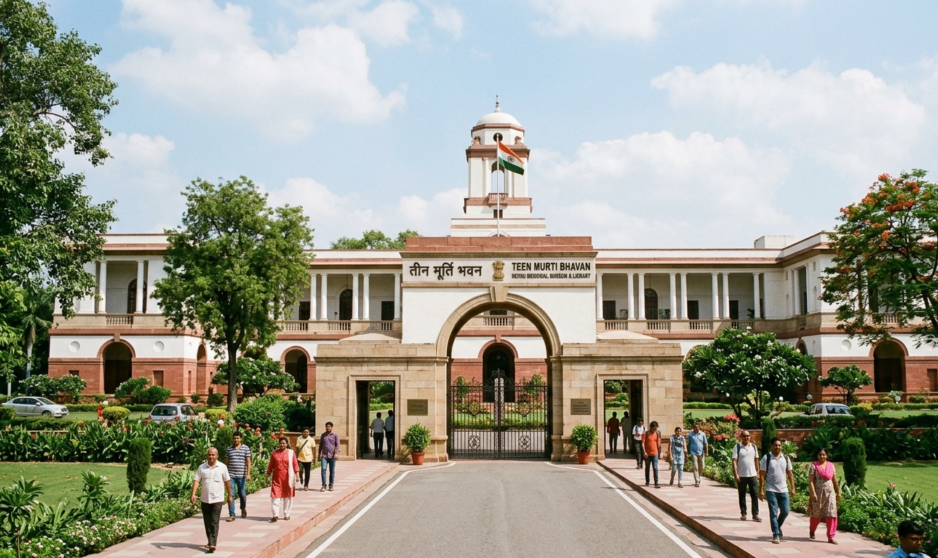
Teen Murti Bhavan, Delhi :- The Gateway to Modern India and Nehru’s Historic Abode
Detailed History
Situated in the geographical heart of New Delhi, ‘Teen Murti Bhavan’ stands as one of the most significant and historically profound landmarks in India. Far more than a mere structure, it is a living chronicle of the birth of modern India, its foreign policy, and its democratic evolution. Constructed in the year 1930 during the British colonial era, this magnificent mansion was originally known as the ‘Flagstaff House‘ and served as the official winter residence of the Commander-in-Chief of the British Indian Army. It was masterfully designed by Robert Tor Russell, one of the principal architects of New Delhi.
Following India’s independence in 1947, this stately mansion was chosen as the official residence of the country’s first Prime Minister, Pandit Jawaharlal Nehru. Nehru occupied this house for nearly 16 years, from August 1948 until his passing on May 27, 1964. After his demise, the entire estate was dedicated to the nation in his memory and transformed into the ‘Nehru Memorial Museum and Library’ (NMML). In recent years, to reflect India’s comprehensive democratic journey, the campus was expanded to house the state-of-the-art ‘Pradhanmantri Sangrahalaya’ (Prime Ministers’ Museum), dedicated to the contributions of all former Prime Ministers of India.
Detailed Architecture
The architectural layout of Teen Murti Bhavan reflects the grandeur of Lutyens’ Delhi, displaying a seamless blend of Classical European institutional geometry and subtle Indian design undertones.
- Exterior Architecture :– The majestic two-story building is predominantly constructed from deep red and warm yellow sandstone. It is framed by expansive, manicured front lawns. Directly facing the entrance at the main traffic circle stands the iconic ‘Teen Murti’ (Three Statues) Memorial. Sculpted in 1922 by the renowned British artist Leonard Jennings, this monument features life-sized bronze statues of three cavalry soldiers. These represent the Jodhpur, Mysore, and Hyderabad Lancers who fought heroically and sacrificed their lives during World War I in Haifa, Gaza, and Palestine. It is from this poignant tri-soldier sculpture that the estate derives its name.
- Interior Architecture :– Upon entering the mansion, visitors are greeted by a grand central staircase and soaring corridors. Inside, Pandit Nehru’s bedroom, his personal drawing-room, and his spectacular private study library have been meticulously preserved exactly as they were on the day he passed away. The interior design boasts rich teak-wood wall panelling, expansive windows, and polished marble flooring that mirrors its stately heritage. Within the same estate, the modern addition of the Nehru Planetarium and the highly interactive, digital Pradhanmantri Sangrahalaya introduces cutting-edge contemporary architecture to the site.
Travel Guide & Routes :-
Teen Murti Bhavan is located in the high-security, lush green Lutyens’ zone along Teen Murti Marg in New Delhi. Here is your essential transit and visitor layout.
- Entry Ticket :– General admission into the historical Nehru Memorial Museum and the outer gardens is completely free. However, separate entry tickets are required to access the newly built ‘Pradhanmantri Sangrahalaya’ and the ‘Nehru Planetarium’, with prices ranging from approximately ₹50 to ₹100, which can be booked online or at the venue counters.
- Visiting Timings :– The entire complex remains open to the public from Tuesday to Sunday, between 09:00 AM and 06:00 PM. Please note that the entire complex is strictly closed on Mondays.
- How to Reach :–
- By Metro :– The closest and most practical metro terminal is the ‘Lok Kalyan Marg’ Metro Station, located on the Yellow Line. Alternatively, the ‘Khan Market’ Metro Station on the Violet Line is also nearby. From either station, local auto-rickshaws or e-rickshaws can drop you at the complex gates within 5 to 10 minutes.
- By Bus :– Central Delhi buses moving toward Rashtrapati Bhavan or Chanakyapuri stop directly at the ‘Teen Murti’ bus bay located right outside the main gates.
- By Auto/Cab :– Positioned in Central Delhi, the venue is barely a 10-minute drive from Connaught Place, India Gate, or the New Delhi Railway Station (NDLS).
Nearby Attractions :-
- Rashtrapati Bhavan :– The official residence of the President of India, showcasing iconic architecture, located just 2 kilometers away.
- India Gate :– The legendary national war memorial surrounded by sprawling lawns, making it a must-visit for every traveler in Delhi.
- National Rail Museum :– Located close by in Chanakyapuri, this museum displays an incredible outdoor collection of India’s royal and heritage train engines.
- Khan Market :– One of Delhi’s most famous upscale retail and dining markets, highly popular for its global multi-cuisine cafes and bookshops.
- Lodhi Garden :– A gorgeous, tranquil historical park containing structural tombs from the Sayyid and Lodhi dynasties—ideal for a relaxing walk.
Photography Spots, Local Taste, and Famous Markets :-
- Photography Spots :– Capturing the bronze soldier statues framed against the sky at the Teen Murti circle, the majestic red sandstone facade of the mansion, and the vibrant roses in the estate gardens offer the best frames for travel photographers. (Note :- Interior photography inside specific exhibition galleries and museum sections might be restricted; ensure adherence to local safety signs).
- Local Taste :– The estate houses a very clean, well-managed cafeteria for quick refreshments. For a larger meal, food enthusiasts can head to the adjacent Yashwant Place in Chanakyapuri for local street-style momos or explore premium fine-dining choices at Khan Market.
- Famous Markets :– For purchasing traditional Indian textiles, handlooms, and artifacts, the vibrant street stalls of Janpath Market and the cultural complex of Dilli Haat (INA) are easily accessible from this location.
Interesting Facts :-
- The three statues at the roundabout specifically commemorate the Battle of Haifa (1918), where Indian cavalry lancers successfully liberated the Israeli city of Haifa from Ottoman forces in a daring charge. To honor this deep military connection, the circle was officially renamed ‘Teen Murti Haifa Chowk’.
- Pandit Jawaharlal Nehru had a profound love for fresh roses. Reflecting his personal passion, the sprawling botanical gardens of Teen Murti Bhavan were cultivated with rare and beautiful rose varieties from across the globe, a tradition that is maintained to this day.
- The museum houses an exceptional collection of unique state gifts presented to Nehru by global leaders, alongside a beautifully preserved historic original copy of the Constitution of India.
- The institutional library located inside the complex is globally revered by researchers, authors, and historians as one of the richest repositories of literature on modern Indian history.
Important Questions and Answer :-
Question 1:– Why is this historic mansion named ‘Teen Murti Bhavan’?
Answer:- The name ‘Teen Murti‘ translates to ‘Three Statues’. It refers directly to the historic tri-soldier bronze memorial standing at the roundabout outside the mansion gates, honoring Indian cavalry regiments of World War I.
Question 2:– Can visitors explore Teen Murti Bhavan on a Monday?
Answer:- No, the entire complex (including the museums, libraries, and the Nehru Planetarium) remains weekly closed on Mondays. Visitors should plan their trips between Tuesday and Sunday.
Question 3:- How much time is ideally required to tour the entire estate?
Answer:- To comfortably explore the main Nehru Museum, the expansive Pradhanmantri Sangrahalaya, and the surrounding heritage lawns, you should ideally dedicate around 2 to 3 hours.
Author’s Thoughts :-
Teen Murti Bhavan is one of those rare urban sanctuaries in Delhi where a profound silence and dignity envelop you the moment you step past its gates. Nestled within the wide, tree-lined boulevards of Lutyens’ Delhi, this estate transports you back to the defining decades when the blueprint of independent India was being drafted under this very roof. Looking out of the wide windows of Nehru’s preserved study or tracking the country’s modern growth at the Prime Ministers’ museum invokes a deep sense of connection to history. This space isn’t just a repository of the past; it stands as an enduring reminder of the collective struggles, vision, and democratic foundations required to build a resilient nation.
“Teen Murti Bhavan is Delhi’s ultimate historical corridor, where the echoes of a newly independent nation gracefully converge with the grand dreams of tomorrow.”