
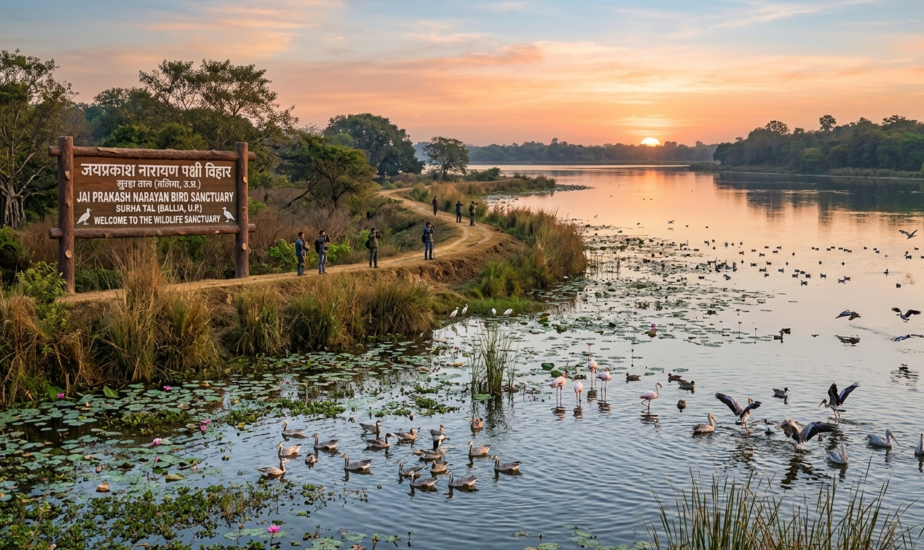
Jayaprakash Narayan Bird Sanctuary (Surha Tal) :- A Pristine Haven for Nature and Bird Lovers
Nestled in the Ballia district of Uttar Pradesh, India, the ‘Jayaprakash Narayan Bird Sanctuary‘- traditionally and popularly known as Surha Tal – is a magnificent natural wetland and a paradise for birdwatchers and nature enthusiasts. Spread across a sprawling area near the Ganges-Saryu doab, this massive natural lake is celebrated for its scenic landscapes and serves as a vital winter home for thousands of migratory birds flying in from colder regions like Siberia and Central Asia. Let’s explore the comprehensive history, architecture, and complete visitor guide of this beautiful sanctuary.
Detailed History
Surha Tal possesses a deep-rooted historical and cultural significance in the folklore of the Purvanchal region. Originally known just as Surha Tal, the sanctuary was later renamed ‘Jayaprakash Narayan Bird Sanctuary’ by the government to honor the legendary freedom fighter and political leader, Loknayak Jayaprakash Narayan, who hailed from Ballia. Recognizing its immense ecological importance, the area was officially declared a protected bird sanctuary in the year 1991. Spanning over an area of nearly 34 square kilometers, this perennial lake expands beautifully during the monsoon season and acts as a primary source of sustenance and fishing for the surrounding rural communities.
Detailed Architecture
Being an entirely natural ecosystem and riverine wetland, the structural layout of this sanctuary is shaped beautifully by nature itself.
- Exterior Architecture :– The periphery of the bird sanctuary is characterized by vast stretches of marshy banks, lush green agricultural fields, and floating aquatic vegetation like lotus leaves and water hyacinths. To facilitate eco-tourism without disturbing the wildlife, the forest department has constructed elevated wooden watchtowers and well-paved walking trails along the vantage points of the lake.
- Interior Architecture :– The interior structure of the lake consists of a shallow water bed and expansive mudflats. This specialized wetland topography creates a rich breeding ground for small fish, mollusks, and aquatic insects. During the peak winter months, the vast water surface transforms into a lively canvas dotted with thousands of vibrant avian species.
Travel Guide & Routes
If you are planning an eco-trip to experience the raw wilderness of this bird sanctuary, here is your essential travel guide.
- Entry Ticket :– The Forest Department charges a nominal entry fee to access the sanctuary grounds (usually ranging between ₹20 to ₹50 per person). Boat hiring charges for lake safaris are managed separately by local boatmen.
- Timings :– The best windows for bird sighting are from 6:00 AM to 10:00 AM in the morning and from 4:00 PM until sunset (around 6:30 PM).
- Best Time to Visit :– The ideal season to visit is from November to March, which coincides with the arrival of spectacular migratory birds.
- How to Reach :–
- By Road :– The sanctuary is situated about 12 to 15 kilometers from Ballia city headquarters. Visitors can easily hire local auto-rickshaws, e-rickshaws, or private taxis from anywhere in Ballia. Ballia is well-connected via highways to Varanasi, Ghazipur, and Patna.
- By Rail :– Ballia Railway Station (BUI) is the nearest railhead, which is well-connected to major junctions across India including Delhi, Kolkata, Patna, and Varanasi.
- By Air :– The nearest airport is Lal Bahadur Shastri International Airport in Babatpur, Varanasi, located approximately 150 km away. Taxis and trains are readily available from Varanasi to Ballia.
Photography Spots, Local Flavors & Famous Markets
- Photography Spots :– Capturing migratory birds in mid-flight against the backdrop of a golden sunrise from a traditional rowboat is an unparalleled experience for wildlife photographers. The top floors of the watchtowers also offer vast panoramic landscape shots of the entire lake.
- Local Flavors :– Travelers can relish authentic regional Bhojpuri cuisine. The iconic ‘Bati-Chokha’ (roasted flour balls stuffed with sattu, served with mashed spiced potatoes and eggplant) is a must-try local specialty. Hot Jalebis and fresh Rabri are popular winter sweets found in the vicinity.
- Famous Markets :– For a local shopping experience, the central ‘Chowk Bazar’ and ‘Station Road Market’ in Ballia city are highly recommended. Ballia is famous for its traditional handmade Bindi (cosmetic forehead dots) and local handloom items.
Interesting Facts
- International Avian Guests :– Every winter, the lake hosts exotic avian species including Pin-tailed Ducks, Common Teals, Northern Shovellers, Gadwalls, and Eurasian Wigeons that migrate across the Himalayas from Siberia and China.
- Named After a Legend :– The sanctuary pays homage to Loknayak Jayaprakash Narayan, the pioneer of the ‘Total Revolution’ movement in India, whose birthplace Sitab Diara is located in the same district.
- An Ecological Lifeline :– Surha Tal is one of the largest natural perennial lakes in Eastern Uttar Pradesh, acting as a crucial carbon sink and maintaining the groundwater tables of the entire region.
Important Questions and Answer :-
Question 1:– What is the local or original name of Jayaprakash Narayan Bird Sanctuary?
Answer:- The sanctuary is historically and locally famous by the name ‘Surha Tal’.
Question 2:– Which is the closest city and railway station to reach this bird sanctuary?
Answer:- Ballia city is the closest urban center, and Ballia Railway Station (BUI) is the nearest railhead, located about 12-15 km from the lake.
Question 3:– Why do birds migrate to Surha Tal during the winters?
Answer:- Severe freezing winters in Siberia and Central Asia temporarily destroy food sources for these birds. The shallow, fish-rich, and warm waters of Surha Tal offer an ideal feeding and nesting environment during those harsh months.
“Where the horizon melts into tranquil waters and migratory wings paint the sky, Surha Tal stands as nature’s timeless poetry.”