
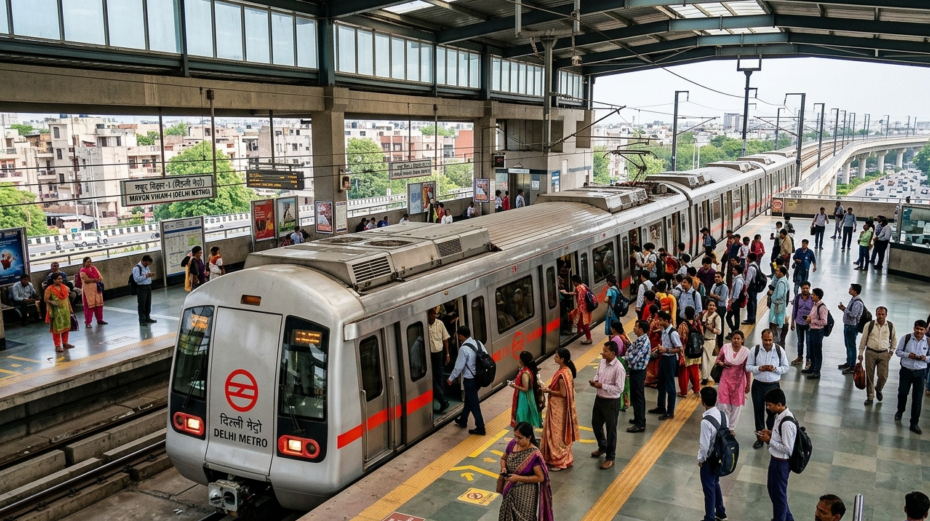
Delhi Metro :- The Dynamic Lifeline of India’s Capital
Detailed History
The Delhi Metro is far more than a mass rapid transit system; it is the definitive lifeline of India’s capital, New Delhi, and the wider National Capital Region (NCR). When its first commercial wheels rolled between Shahdara and Tis Hazari on December 24, 2002, it marked the dawn of a revolutionary chapter in the history of Indian public transportation. Operated by the Delhi Metro Rail Corporation (DMRC), this colossal network has grown exponentially to become one of the largest, most advanced, and highly successful metro systems in the entire world.
The credit for the spectacular evolution of the Delhi Metro goes primarily to E. Sreedharan, popularly known as the ‘Metro Man‘ of India. His exemplary leadership, institutional discipline, and meticulous planning ensured that Phases I and II of this massive project were completed ahead of deadlines and within budgets. Before the advent of the metro, Delhi’s roads were choked with severe air pollution, endless traffic bottlenecks, and an unorganized public bus system. The metro slashed commuting times, mitigated environmental damage, and seamlessly bridged Delhi with satellite cities like Noida, Ghaziabad, Gurugram, Faridabad, and Bahadurgarh. Today, it securely serves millions of commuters daily with absolute comfort and reliability.
Detailed Architecture :-
The engineering prowess, structural layouts, and technological systems of the Delhi Metro reflect a brilliant blend of modern civil architecture and sustainable development practices.
- Network Tiers and Layout :– The entire operational network functions across three distinct spatial planes—Underground, Elevated, and At-Grade (surface level). The intricate underground stations were carved beneath densely populated and historically sensitive zones of Old Delhi using state-of-the-art Tunnel Boring Machines (TBMs) without disturbing the surface monuments.
- Artistic and Cultural Heritage Exhibits :– DMRC has transformed several transit hubs (such as Mandi House, INA, Kashmere Gate, and Welcome) into public art galleries. The platform walls are adorned with rich murals, ethnic handicrafts, terracotta panels, and historical photographic archives, making daily commutes an intellectually engaging visual experience.
- Driverless Technology and Safety Infrastructure :– The Magenta and Pink lines feature cutting-edge Driverless Train Operations (DTO), utilizing advanced Unattended Train Operation (UTO) technology. To enhance commuter safety, heavy-duty Platform Screen Doors (PSDs) are integrated at all high-density stations to prevent accidental track access.
- Photography Spots :– The elevated sections of the network offer stunning panoramic views of Delhi’s evolving skyline. The immense height of the Pink Line near Dhaula Kuan, the vibrant artistic concourses of Mandi House, and the scenic view of trains crossing the Yamuna bank near Mayur Vihar serve as highly popular backdrops for modern travel vlogging and urban photography.
Travel Guide & Routes :-
- Tickets and Smart Cards :– Commuters can easily purchase single-journey tokens from automated vending machines or use the highly efficient ‘DMRC Smart Card’. For a fully digital check-in, app-based QR code ticketing is available via the ‘DMRC Travel’ app along with integrated WhatsApp ticketing facilities. Unlimited 1-day and 3-day tourist cards are also available for visitors.
- Operating Time :– Delhi Metro services run actively throughout the week, commencing at 05:30 AM and terminating at 11:30 PM (with slight variations across peripheral terminals).
- How to Reach :–
- Navigating the Network :– The Delhi Metro features a massive web of over 10 color-coded lines (Red, Yellow, Blue, Green, Violet, Pink, Magenta, Grey, Airport Orange Line, and the Rapid Metro). Commuters can easily step out from any corner of the NCR, board a local e-rickshaw or auto, and reach their nearest station. Major interchange hubs like Rajiv Chowk, Kashmere Gate, and Central Secretariat allow seamless transitions between lines under one roof.
- Last Mile Connectivity :– Well-organized fleets of electric feeder buses, e-autos, and app-based rental cycles are readily accessible outside the exit gates of almost all metro stations.
- Nearby Attractions :– Major historical landmarks of Delhi are situated right outside designated metro doors. This includes Rajiv Chowk (Connaught Place), Chandni Chowk (Red Fort, Jama Masjid), Central Secretariat (India Gate, Rashtrapati Bhavan), and Qutub Minar Station (Qutub Minar Complex).
- Local Flavors & Famous Markets :– Premium food courts and retail ‘Metro Walks’ are integrated within major stations. For shoppers, Chandni Chowk Station (ethnic fabrics and silver), Sarojini Nagar Station (budget-friendly street fashion), and Karol Bagh Station (electronics and gold hubs) are directly accessible via the metro entrances.
Interesting Facts :-
- Delhi Metro is the world’s first rail-based transit system to receive formal Carbon Credits from the United Nations (UN) for significantly reducing greenhouse gas emissions across the metropolitan area.
- Kashmere Gate stands as the largest interchange station within the network, uniquely acting as the convergence point for three distinct lines—Red, Yellow, and Violet.
- Hauz Khas Metro Station holds the record for being the deepest station in the entire network, plunging to a depth of nearly 29 meters (equivalent to a 10-story building) beneath the surface.
Important Questions and Answer :-
Question 1:- What is the most seamless method to travel across the Delhi Metro network?
Answer:- Utilizing the ‘DMRC Smart Card‘ is the most convenient method as it bypasses ticketing queues and offers a standard fare discount ranging from 10% to 20%. Alternatively, booking a digital QR ticket on your mobile phone is highly efficient.
Question 2:– Are there dedicated security measures or coaches for solo female travelers?
Answer:- Yes, the very first coach of every train is exclusively reserved for female commuters. Additionally, dedicated female security personnel and quick-reaction teams patrol the stations and trains constantly.
Question 3:– How does the Airport Express Line differ from the regular passenger lines?
Answer:- The Airport Express Line (Orange Line) is a premium high-speed corridor connecting New Delhi Railway Station directly to Terminal 3 of the IGI Airport. It operates at much higher speeds and features customized luggage racks inside the coaches for international travelers.
Author’s Thoughts :-
The Delhi Metro is not just an architectural marvel of steel and concrete; it is a magnificent mirror showcasing the civic pride, discipline, and progressive spirit of modern India. Stepping out of the intense, sweltering Delhi heat into the cool, air-conditioned comfort of a metro coach makes urban life feel remarkably effortless. It has bridged social divides, giving everyone an equal, dignified space to travel together. The spotlessness of the stations and the punctuality of the trains evoke immense national pride, proving that India is fully capable of building and sustaining infrastructure of a global standard.
“The uninterrupted speed and world-class management of the Delhi Metro stand as a shining proof that with unwavering vision and execution, India can deliver public infrastructure that rivals the best in the world.”