
Detailed History
Khari Baoli, nestled deep within the historic corridors of Old Delhi (formerly known as Shahjahanabad), holds the prestigious distinction of being Asia’s largest and oldest wholesale spice market. Situated at the western terminus of the iconic Chandni Chowk thoroughfare, adjacent to the historic Fatehpuri Masjid, this sprawling marketplace has functioned as the nerve center of the global spice trade for over four centuries.
The nomenclature ‘Khari Baoli‘ is derived from two distinct vernacular terms—’Khari‘, translating to salty or brackish water, and ‘Baoli‘, meaning a stepped architectural well (stepwell). The origins of this marketplace are inextricably linked to the Mughal era. In the year 1650, Fatehpuri Begum, one of the influential consorts of the Mughal Emperor Shah Jahan, commissioned the construction of the Fatehpuri Masjid, alongside which a strategic stepwell and market complex were laid out to bolster regional commerce. During that epoch, the well yielded water high in salinity, rendering it ideal for livestock and commercial washings rather than domestic consumption. While the physical stepwell faded into structural obscurity due to the intensive urbanization of Old Delhi over the centuries, the historic name remains permanently etched into the cultural and commercial identity of the capital. From the heights of the Mughal Empire through the British Raj to contemporary India, Khari Baoli has remained an uninterrupted global hub for pure spices, condiments, dry fruits, and exotic herbs.
Detailed Architecture :-
The architectural layout of Khari Baoli reflects the traditional ‘Katra’ style of design, a distinctive feature of Mughal urban planning. The area is characterized by dense, multi-tiered structural complexes connected by tight, labyrinthine alleyways.
- The Traditional Katra Layout :– The entirety of Khari Baoli is organized into specialized commercial sub-sections known as ‘Katras’ (fortified market enclosures). Among these, ‘Katra Ishwar Dev’ and ‘Katra Tambaku‘ are highly celebrated. Structurally, these complexes feature ground-floor shopfronts transitioning into deep, expansive basements utilized as spice storehouses (warehouses), while the upper balconies traditionally house the merchant administrative offices or residential quarters.
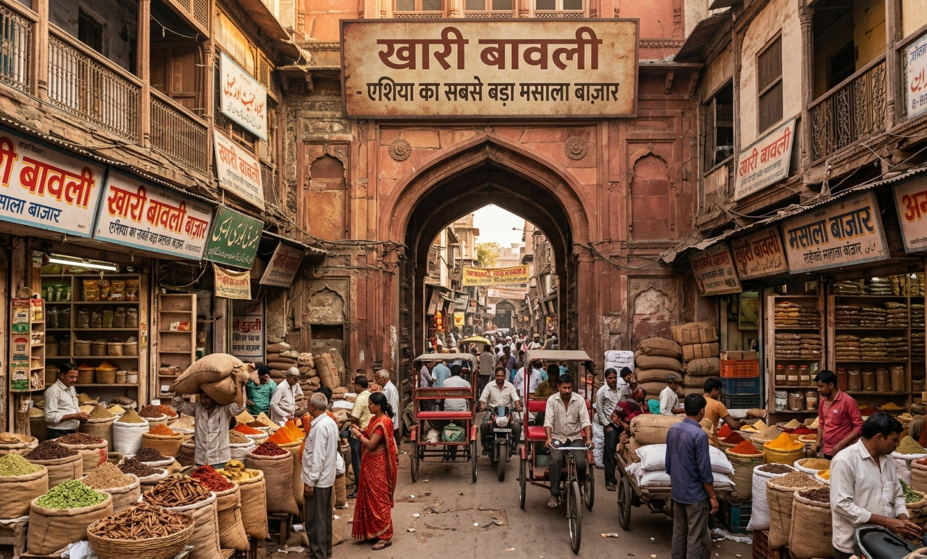
- Centuries-Old Structural Facades :– The historic buildings flanking the narrow alleys still retain structural echoes of Mughal and British colonial architecture. Visitors can observe weathered archways, intricately carved wooden jharokhas (overhanging balconies), and heavy wrought-iron railings. The individual shops open up like vintage vaults, inside of which multi-million-rupee commodities are traded daily amidst a vibrant, overflowing display of burlap sacks filled with brightly colored powdered spices.
- Photography Spots :– The visual contrast of Khari Baoli—featuring laborers navigating heavy spice sacks overhead, historical brick masonry, and towering pyramids of crimson chilies, turmeric, and dry fruits—makes it a world-renowned destination for street photography. The absolute premier vantage point is the rooftop of the historic Gadodia Market. Ascending to this high terrace awards photographers an unobstructed, spectacular bird’s-eye view of the entirety of Old Delhi, the domes of Fatehpuri Masjid, and the bustling human tapestry below.
Travel Guide & Routes :-
- Ticket :– As Khari Baoli is an active, open-air public commercial district, there is absolutely no entry fee or ticket requirement. Access is entirely free for everyone.
- Visiting Time :– The market operates at peak capacity from 10:00 AM to 08:00 PM. Khari Baoli remains officially closed on Sundays. To enjoy optimal sightseeing and comfortable photography before the heavy evening crowds set in, the window between 11:00 AM and 03:00 PM is highly recommended.
- How to Reach :–
- By Metro :– The most efficient transit routes are via the Chandni Chowk Metro Station on the Yellow Line or the Red Fort Metro Station on the Violet Line. Additionally, travelers can access the market from the Chawri Bazar Metro Station. From any of these exits, you can easily hire a cycle-rickshaw directly to Fatehpuri Masjid.
- By Rickshaw/Foot :– Due to extreme vehicular congestion and narrow pathways, cars and large automobiles are completely impractical. Walking down the main heritage stretch of Chandni Chowk towards the Fatehpuri Mosque or taking a traditional non-motorized cycle-rickshaw is the most authentic and viable way to navigate.
- Nearby Attractions :– Fatehpuri Masjid, Chandni Chowk Bazaar, Gurudwara Sis Ganj Sahib, The Red Fort, Jama Masjid, and the iconic Paranthe Wali Gali.
- Local Flavors & Famous Markets :– Immediately outside the market periphery near the Fatehpuri steps, travelers can relish classic culinary staples including legendary Chole Bhature (at Giani di Hatti), crisp kachoris, Badam Katli, and creamy Rabri-Faluda. A brief stroll leads directly to Paranthe Wali Gali for an array of traditional deep-fried flatbreads. For shoppers, Khari Baoli is an unbeatable destination to purchase premium Iranian saffron, green cardamom, organic almonds, walnuts, fine teas, and therapeutic Ayurvedic herbs at unmatched wholesale rates.
Interesting Facts :-
- Khari Baoli stands globally recognized as Asia’s largest wholesale spice market. The commodities traded here are distributed not just across the Indian subcontinent, but exported directly to the Americas, Europe, and the Middle East.
- The ambient air inside the market is heavily saturated with volatile spice oils and airborne dust from crushed red chilies and black pepper. First-time visitors are universally greeted with involuntary sneezing and coughing, an experience affectionately referred to by local merchants as the ‘traditional welcome’ of Khari Baoli.
- The market houses highly specialized heritage pharmacies (Pansari shops) that deal in ancient organic formulations, roots, and minerals that are nearly impossible to track down anywhere else in Northern India.
Important Questions and Answer :-
Question 1:– What are the primary products that one should look to buy at Khari Baoli?
Answer:- Khari Baoli is the ultimate destination for premium quality spices (such as unadulterated saffron, cinnamon, pods of cardamom), high-grade dry fruits (cashews, almonds, pistachios, figs), specialized loose-leaf teas, and authentic raw Ayurvedic herbs.
Question 2:- Which day of the week is best suited for an unhurried exploration of the spice market?
Answer:- Weekdays from Monday to Thursday are optimal for exploring. It is crucial to remember that the entire market district remains completely shut on Sundays. Visiting during the pre-noon hours allows you to beat the peak commercial rush.
Question 3:- Can individual retail consumers purchase items in small quantities from wholesale merchants?
Answer:- Yes. Despite its primary classification as a bulk wholesale market, almost all traders happily accommodate retail shoppers looking to buy smaller, standardized amounts like 500 grams or 1 kilogram.
Author’s Thoughts :-
Exploring Khari Baoli is far more than a routine shopping excursion; it is an intense, multi-sensory immersion into a bygone era. The precise moment you step beyond the shadows of Fatehpuri Masjid, the rich, intoxicating aroma of roasted spices instantly transports you straight into the opulent Mughal past of Shahjahanabad. Witnessing the chaotic harmony of the narrow alleyways, the centuries-old architectural frames of the Katras, and the sheer industriousness of the merchants provides a deep appreciation for India’s enduring trading traditions. An exploration of New Delhi’s heritage remains incomplete without experiencing the fragrant, timeless pathways of Khari Baoli.
“Preserving its aromatic legacy from the golden days of the Mughal Empire to the fast-paced modern era, the rich scent of spices drifting through Khari Baoli remains the true, beating soul of Old Delhi’s commercial heritage.”