
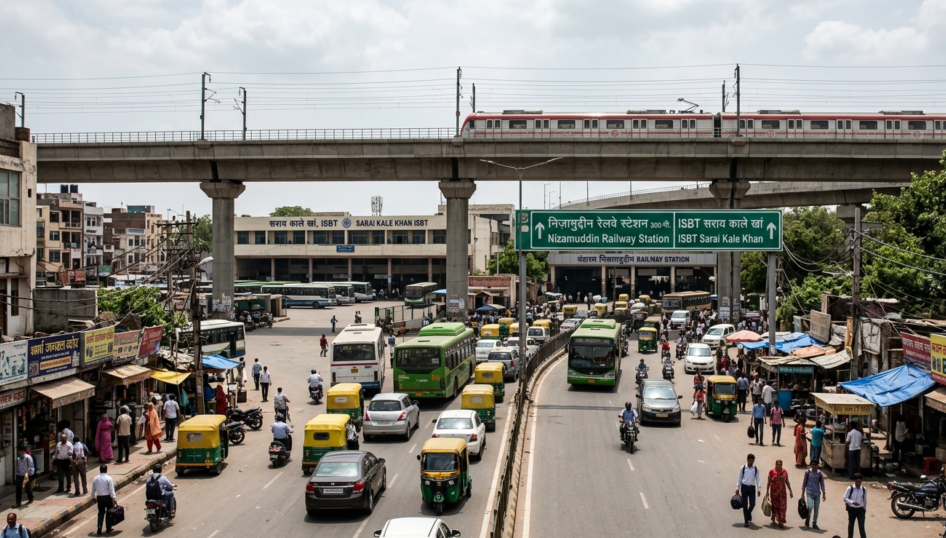
Sarai Kale Khan, Delhi :- From a Medieval Royal Inn to an Ultra-Modern Multi-Modal Transit Hub
Detailed History
Sarai Kale Khan, situated on the western banks of the Yamuna River in South-East Delhi, is globally recognized today as a sprawling, state-of-the-art mega transportation hub. However, beneath its concrete flyovers and high-speed rail tracks lies a profound history rooted in the medieval ‘Sarai Culture’ (Inn Culture) that flourished during the Suri and Mughal dynasties.
The etymology of ‘Sarai Kale Khan‘ traces back directly to a revered 14th-to-15th-century Sufi saint, Kale Khan, who established his spiritual hermitage on this site. During the medieval resurgence under Sultan Sher Shah Suri—who systematically rebuilt the historic Grand Trunk Road (GT Road)—and subsequent Mughal emperors, ‘Sarais‘ (imperial rest houses) were established at uniform geographical intervals to accommodate royal messengers, merchant caravans, soldiers, and traveling ascetics. Because Saint Kale Khan’s sanctuary was positioned precisely at this strategic junction, the rest house, and eventually the entire territorial region, came to be permanently designated as Sarai Kale Khan.
Geographically adjacent to the grand fortresses of Purana Qila (Old Fort) and the magnificent Humayun’s Tomb, this estate functioned as a mandatory staging post for imperial entourages marching into Delhi from Agra and the eastern provinces. While the heavy stone fortifications of the original medieval inn have largely eroded under the footprint of contemporary urbanization, the site’s historical and strategic transit value remains unaltered. Today, it hosts the capital’s premier Interstate Bus Terminus (ISBT), the Hazrat Nizamuddin Railway Station, and India’s maiden Regional Rapid Transit System (RRTS – RapidX), creating an extraordinary structural continuum where medieval hospitality layout transitions seamlessly into 21st-century hyper-connectivity.
Detailed Architecture :-
As the original architectural remnants of the medieval Mughal inn have succumbed to centuries of structural modifications, the contemporary landscape of Sarai Kale Khan stands as a bold testament to ultra-modern public utility and infrastructure design.
- The Medieval Spatial Context :– Historically, the original Sarai was engineered as a classical defensive square enclosure bounded by thick stone masonry walls. It featured a massive central courtyard, uniform lines of arched residential chambers, deep water wells, and large stables for horses and camels. The perimeter was secured by towering arched gateways (Darwazas) built out of local quartzite stones.
- The Ultra-Modern Multi-Modal Nexus :– In stark contrast to its historical stone masonry, the newly developed Sarai Kale Khan – Nizamuddin RRTS Station and the upgraded ISBT terminal reflect cutting-edge international transit architecture. Utilizing aerodynamic structural steel frameworks, massive spans of reinforced polymer composites, and expansive sheets of toughened structural glass, the hub is engineered for maximum fluid movement. The layout features high-capacity multi-level escalators, advanced climate-controlled commuter decks, and vast integrated skywalks linking separate transport mediums.
- Photography Spots :– For urban landscape, architectural, and high-motion street photographers, Sarai Kale Khan offers an unparalleled canvas of light and motion. Capturing wide-angle exposures of the RRTS station’s sweeping glass and steel facade against the twilight sky provides spectacular futuristic frames. Furthermore, executing long-exposure night photography from the nearby flyovers captures complex ‘light trails’ generated by the intersecting city traffic. For heritage enthusiasts, the structural stone arches of the nearby medieval Barapullah Bridge offer exceptional depth-of-field opportunities that contrast beautifully with the surrounding modern city infrastructure.
Travel Guide & Routes :-
- Ticket :– As a major public transit hub and metropolitan zone, there is no entry fee or ticket required to enter the Sarai Kale Khan terminal areas. Commuters only pay standard applicable fares for utilizing the respective bus, metro, or rapid rail services.
- Visiting Time :– Serving as an international-standard transit nexus, the complex remains fully operational 24 hours a day, 7 days a week (24/7). However, for tourists wishing to explore the modern architecture or the adjacent parks comfortably, the optimal viewing hours are between 07:00 AM and 10:00 AM or late afternoons after 05:00 PM.
- How to Reach :–
- By Metro :– The immediate urban rail gateway is the Hazrat Nizamuddin Metro Station on the Pink Line. Dedicated station exit tunnels lead directly into the primary foyer of the Sarai Kale Khan ISBT.
- By Regional Rapid Transit System (RRTS) :– Commuters traveling from regional hubs like Meerut, Modinagar, or Ghaziabad can board India’s fastest high-speed commuter trains to arrive directly at the integrated Sarai Kale Khan RRTS terminal.
- By Indian Railways :– One of the nation’s premier rail terminals, Hazrat Nizamuddin Railway Station (NZM), is positioned immediately adjacent to the complex, easily accessible via a short pedestrian skywalk.
- By Bus :– The Sarai Kale Khan ISBT operates as a monumental transit station running round-the-clock interstate bus fleets heading towards Uttar Pradesh (including Agra, Mathura, and Aligarh), Haryana, Rajasthan, and Uttarakhand. Local DTC buses link the terminal to all four quadrants of Delhi.
- By Road :– Situated right on the primary Ring Road artery and flanking the DND Flyway terminus, the hub is flawlessly accessible via private cars, motorcycles, or local auto-rickshaws from New Delhi, Noida, and Gurugram. The complex features a massive, automated multi-level paid vehicle parking facility.
- Nearby Attractions :– The grand World Heritage Site of Humayun’s Tomb, the historic Hazrat Nizamuddin Auliya Dargah, the exquisite Sunder Nursery (Delhi’s award-winning heritage botanical park), and the highly popular Waste to Wonder Theme Park (showcasing eco-friendly industrial-waste replicas of the Seven Wonders of the World, located directly adjacent to the station).
- Local Flavors & Famous Markets :– The nearby historic lanes of Nizamuddin Basti host a globally celebrated culinary landscape specializing in authentic Mughlai cuisine. Food enthusiasts can frequent historic institutions like ‘Karim’s’ or ‘Ghalib Kabab Corner’ to experience authentic spiced mutton seekh kababs, rich Mughlai korma, and paper-thin rumali rotis. For a premium retail shopping experience, the nearby Bhogal Market and the world-famous Lajpat Nagar Central Market offer endless avenues for high-quality textiles, traditional footwear, and cultural artifacts.
Interesting Facts :-
- According to regional oral folklore, it was widely believed that the mystical spiritual aura of the resident Sufi saint, Kale Khan, possessed restorative properties, instantly curing the deep physical exhaustion of medieval travelers who crossed into his inn.
- Sarai Kale Khan represents a historic engineering milestone as the exclusive geographic point in India where five distinct public transit infrastructures—Local Buses (DTC), Inter-State Express Buses (ISBT), Indian Railways, Delhi Metro, and High-Speed Regional Rail (RRTS)—converge into a single integrated multi-modal terminal.
- The adjacent Barapullah elevated corridor traces the exact historical imperial highway used routinely by Mughal emperors and royal cavalries traveling from the southern capital of Agra into the palaces of Shahjahanabad.
Important Questions and Answer :-
Question 1:– What historical figure inspired the naming of Sarai Kale Khan?
Answer:- The area is named in honor of a prominent medieval Sufi saint, Baba Kale Khan, whose spiritual rest house and hermitage formed the nucleus of the imperial roadside inn constructed during the Suri/Mughal era.
Question 2:– Is the Waste to Wonder Park easily accessible from the Sarai Kale Khan transit terminal?
Answer:- Yes, the Waste to Wonder Theme Park is located directly opposite the Sarai Kale Khan RRTS and ISBT complex, making it easily accessible via a brief pedestrian walk for travelers transiting through the station.
Question 3:- Which long-distance tourist destinations are directly connected via the Sarai Kale Khan ISBT express buses?
Answer:- The terminal manages high-frequency interstate express bus fleets heading directly to major heritage and spiritual tourism hubs across North India, most notably Agra, Mathura, Vrindavan, and Gwalior.
Author’s Thoughts :-
Observing the relentless, high-velocity human wave navigating the flyovers and glass corridors of Sarai Kale Khan today evokes a profound appreciation for Delhi’s layers of history. Centurial cycles have completely transformed the landscape from the slow thud of camel caravans and royal cavalry hooves into the silent, high-tech hum of rapid transit bullet trains. Yet, at its core, the true socio-geographic character of this site remains flawlessly preserved: it continues to be the grand gateway that welcomes travelers into the heart of Delhi. For any true urban explorer or history enthusiast, taking a moment to view this futuristic transit marvel against the backdrop of the surrounding Mughal monuments reveals the real, beating soul of a changing India.
“Tracing its evolutionary arc from a medieval sanctuary for weary camel caravans to a towering hyper-connected multi-modal terminal, Sarai Kale Khan stands as the ultimate living monument to Delhi’s timeless demographic momentum.”