
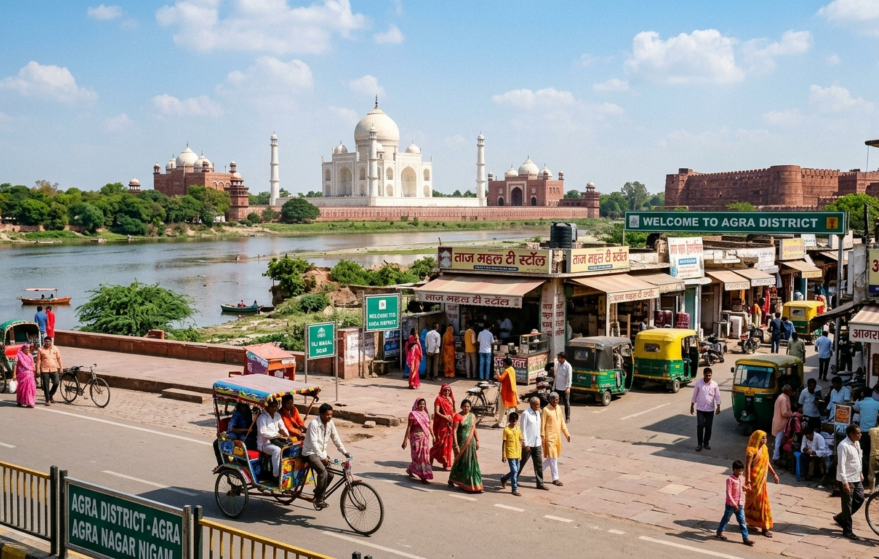
Agra :- A Confluence of History, Architecture, and Culture
Detailed History
Agra is a living witness to the golden era of Indian history. Ancient texts refer to it as ‘Agravan‘, meaning the ‘forward forest‘. The modern city of Agra was founded in 1504 by Sultan Sikandar Lodi of the Delhi Sultanate. After the Battle of Panipat in 1526, the Mughals made it their primary capital. For nearly a century and a half, the city was one of the most powerful and wealthiest in the world, blending the ambition of emperors with the skill of master craftsmen.
Detailed Architecture
Exterior Architecture :–
The exterior of Agra’s structures is based on the use of ‘Red Sandstone’ and ‘Milky White Marble’. Key features include massive gateways, soaring domes, and symmetrical ‘Charbagh‘ style gardens. The calligraphy of Quranic verses and floral carvings remain pristine even after centuries.
Interior Architecture :–
The world inside the monuments is even more grand. The unparalleled use of ‘Pietra Dura‘—inlaying precious stones into marble—is a highlight. Carved ceilings, stone patterns mimicking carpets on the floors, and hidden water drainage systems reflect advanced engineering and artistic brilliance.
Travel Guide & Routes
- Tickets :– ₹50 for Indians (additional ₹200 for Taj main dome). ₹1100-1300 for foreigners. Free entry for children below 15 years.
- Timing :– Sunrise to Sunset. (Taj Mahal is closed on Fridays).
- How to Reach :–
- By Road :– 3-4 hours via Yamuna Expressway from Delhi.
- By Rail :– Agra Cantt is the main station, served by premium trains like Gatiman and Shatabdi.
- Local Transport :– E-buses, auto-rickshaws, and traditional tongas are widely available.
- Photography Spots :– Mehtab Bagh (rear view of Taj), Jahangir Mahal in Agra Fort, and the main fountain path of the Taj Mahal.
- Local Flavors :– Famous ‘Panchi Petha’, Bedai-Sabzi, Dalmoth, and Mughlai cuisine.
- Famous Markets :– Sadar Bazaar, Kinari Bazaar, and Shahganj Bazaar.
Detailed Nearby Attractions
- Fatehpur Sikri :– Founded by Akbar, 40 km from Agra. The ‘Buland Darwaza’ and ‘Salim Chishti Dargah‘ are major attractions, showcasing a blend of Persian and Indian styles.
- Itmad-ud-Daulah (Baby Taj) :– The first monument in India built entirely of white marble, commissioned by Nur Jahan for her father.
- Sikandra :– The tomb of Emperor Akbar, located in a vast garden where deer roam freely. Its design blends Hindu, Christian, Islamic, and Buddhist styles.
- Mehtab Bagh :– Known as the ‘Moonlight Garden‘, it offers a stunning view of the Taj Mahal from across the Yamuna River, especially at night.
- Keetham Lake :– A haven for nature lovers, home to the ‘Sur Sarovar Bird Sanctuary’, featuring various migratory birds.
Interesting Facts
- The four minarets of the Taj Mahal lean outwards to protect the main structure from earthquakes.
- Agra Fort is vast enough to have housed an entire division of the Mughal army.
- Agra is called the ‘Petha City’ because it produces the world’s finest ash gourd sweets.
Important Questions and Answer :-
Question 1:- Is online ticket booking mandatory for the Taj Mahal?
Answer:- Yes, most tickets are now issued online. Booking in advance via the ‘ASI’ website is recommended to avoid crowds.
Question 2:- Which is the best area to stay in Agra?
Answer:- ‘Fatehabad Road‘ is the best location due to its proximity to the Taj Mahal and a wide range of hotel options.
Question 3:- Can we visit Agra Fort and the Taj Mahal on the same day?
Answer:- Yes, they are only 2.5 km apart and can be easily covered in a single day.
Question 4:- How many varieties of Agra Petha are there?
Answer:- There are over 50 varieties, including Angoori, Kesar, Pan, and Chocolate flavors.
Question 5:- Are there specific photography rules in Agra?
Answer:- Photography and tripods are prohibited inside the main mausoleums. Permission is required for commercial shoots.
Author’s Thoughts :-
History still breathes in the lanes of Agra. When you touch the stones of these ancient buildings, it feels as if they are talking to you. My advice is not to see Agra just as a ‘tourist destination’, but to deeply feel its art and culture. This city teaches you that love and art are immortal.
“A glorious history of centuries is imprisoned in the stones of Agra.”