
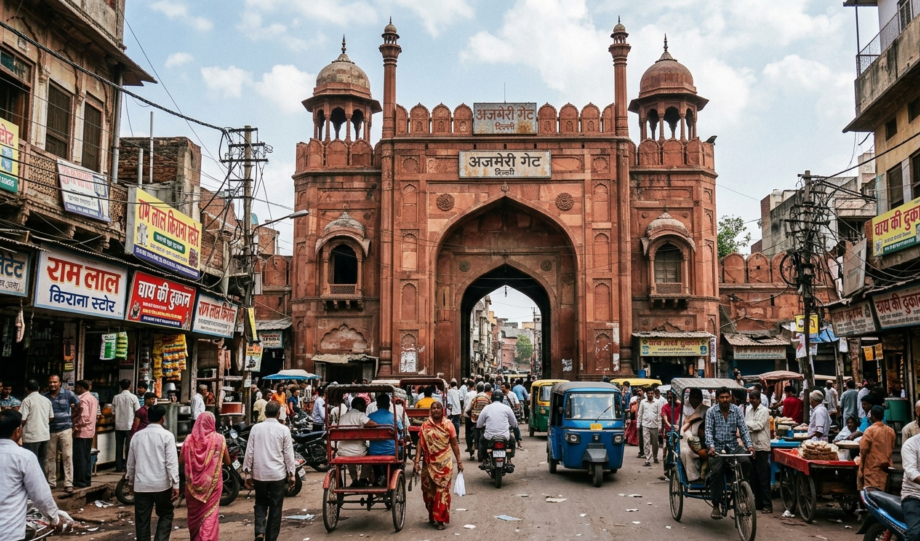
Ajmeri Gate, Delhi :- Complete History and Travel Guide of Shahjahanabad’s Historic Gateway
Delhi, a city that cradles centuries of history within its embrace, tells a historical tale through every nook and corner. To secure ‘Shahjahanabad’ (Old Delhi), the new capital city founded by the Mughal Emperor Shah Jahan, several massive gateways were constructed along the city walls. Among those famous and historic gateways stands Ajmeri Gate. It was not only a vital entry point to Old Delhi during the Mughal era but remains one of the busiest and most prominent hubs of Delhi today. Through this blog, let us closely explore the detailed history, unique architecture, and travel-related insights of Ajmeri Gate.
Detailed History
Ajmeri Gate was constructed in the 17th century (around 1644 AD) during the reign of the Mughal Emperor Shah Jahan. When Shah Jahan decided to shift his capital from Agra to Delhi, he laid the foundation of a new walled city named ‘Shahjahanabad‘. To secure this entire city, it was enclosed by a massive wall made of red sandstone and rubble masonry (known as Shahjahani Shahrpanah), featuring 14 main entry gates. Ajmeri Gate is one of those historic gateways that still stands preserved in its original form today.
The gateway was named ‘Ajmeri Gate‘ because the main highway passing through it led directly toward ‘Ajmer‘, the historic city in Rajasthan renowned for the shrine of the Sufi saint Khwaja Moinuddin Chishti. During the Mughal period, royal caravans, merchants, and pilgrims bound for Ajmer commenced their journeys through this very gate.
Ajmeri Gate has witnessed many ups and downs of history. During the First War of Indian Independence (the Uprising of 1857), this gate served as a crucial strategic site. Fierce battles were fought here between the British forces and Indian freedom fighters. After recapturing Old Delhi, the British took control of several areas around this gate. Over time, parts of the surrounding defensive walls were demolished to facilitate the modern development of Delhi, but this historical gate was preserved due to its immense heritage value. Today, it stands as a protected monument under the care of the Archaeological Survey of India (ASI).
Detailed Architecture
The architectural design of Ajmeri Gate is an excellent specimen of Mughal military architecture. The gateway was primarily built using local yellow and red sandstones combined with a sturdy rubble-lime mortar mix, which lends it exceptional durability.
Exterior Architecture :–
Viewed from the outside, Ajmeri Gate resembles the entrance of an impregnable fort. It is flanked by tall, robust bastions on both sides, which were utilized by Mughal soldiers for sentry duty and keeping watch for enemies. These bastions feature specialized slits designed for archers and musketeers. The upper crest of the gateway showcases beautiful battlemented carvings in the classic Mughal style, giving it a regal appearance. The central archway is remarkably tall and wide, designed to easily allow elephants and large royal chariots to pass through in that era.
Interior Architecture :–
Upon stepping inside the gateway, a large arched passageway is revealed. Small guard rooms intended for the soldiers’ stay and rest are built within its inner flanks. The interior walls and ceilings of the gate are plain yet display remarkable structural strength. A beautifully landscaped green park has been developed right in front of the gate, enhancing its historical charm. Situated just adjacent to it is the historic ‘Madrasa of Ghaziuddin Khan’ (now known as Zakir Husain Delhi College), whose architecture mirrors the distinct aesthetics of the same era.
Travel Guide & Routes
If you plan to visit Ajmeri Gate, all the important and practical travel details are compiled below to ensure a hassle-free experience.
- Tickets and Entry Fee :– There is no ticket required to view Ajmeri Gate from the outside or from the park. Entry here is completely Free for all visitors.
- Visiting Time :– The monument is located in a public area, meaning it can be viewed at any time of the day. However, the ideal time to explore the park and its surroundings is from 6:00 AM to 7:00 PM.
- Photography Spots :–
- The park facing the gateway offers a spectacular front view of Ajmeri Gate, allowing you to capture both the imposing bastions in a single frame.
- Evening hours, when the soft light of the setting sun hits the sandstones, offer a beautiful golden hour glow for photography.
- Local Taste :– Being an integral part of Old Delhi, Ajmeri Gate is a paradise for food lovers. Nearby areas like Chawri Bazar and Jama Masjid are world-famous for Mughlai kebabs, biryani, kulfi, and the seasonal delicacy ‘Daulat ki Chaat’.
- Famous Markets :– Located in close proximity to Ajmeri Gate are Chawri Bazar (renowned for wedding cards and brassware) and Shraddhanand Bazar (famous for hardware and tools). Here, you can immerse yourself in the traditional shopping experience of Old Delhi.
How to Reach :–
- By Metro :– The easiest and most convenient way to reach Ajmeri Gate is via the Delhi Metro. New Delhi Metro Station (Yellow Line and Airport Express Line) is the nearest metro station. The historic gate is just a 5-minute walk from the Ajmeri Gate exit of the station.
- By Road/Bus :– Due to its location right next to the New Delhi Railway Station, Ajmeri Gate is exceptionally well-connected by buses from all corners of Delhi. You can easily reach here using DTC buses, auto-rickshaws, or e-rickshaws.
Interesting Facts
- The Ajmer Connection :– The gate derived its name ‘Ajmeri Gate’ because it marked the starting point of the historical highway leading to Ajmer, the city of the revered Sufi saint Khwaja Moinuddin Chishti.
- Ghaziuddin’s Madrasa :– Right next to this gate lies the 17th-century historic Madrasa of Ghaziuddin Khan, currently known as ‘Zakir Husain Delhi College’. It is one of the oldest educational institutions in Delhi.
- Witness to 1857 Uprising :– During the rebellion of 1857 against British rule, fierce combat took place around this gateway between freedom fighters and British troops, leaving an indelible mark on the pages of history.
- Proximity to the Railway Station :– In modern times, an entire bustling side of the New Delhi Railway Station is officially designated as the ‘Ajmeri Gate Side’, through which millions of commuters pass daily.
Important Questions and Answer :-
Question 1:- Where is Ajmeri Gate located?
Answer:– Ajmeri Gate is located in the capital city of New Delhi, right next to the New Delhi Railway Station, on the border of the walled city of Old Delhi (Shahjahanabad).
Question 2:- Who built Ajmeri Gate and when?
Answer:– Ajmeri Gate was built by the Mughal Emperor Shah Jahan around 1644 AD as part of the defensive fortifications for his new capital city, Shahjahanabad.
Question 3:– Is there an entry fee to visit Ajmeri Gate?
Answer:– No, there is no entry fee to visit Ajmeri Gate. It is completely free for all tourists and visitors.
Question 4:– Which is the nearest metro station to reach Ajmeri Gate?
Answer:– The nearest metro station is the ‘New Delhi Metro Station’ (Yellow Line), from where Ajmeri Gate is located at a short walking distance.
Question 5:– Why was Ajmeri Gate named so?
Answer:– During the Mughal era, the road passing through this gateway led straight toward the city of Ajmer in Rajasthan, which is why it was named Ajmeri Gate.
S “Standing tall between the resilient walls of history and the frantic pace of modern Delhi, Ajmeri Gate remains a living, unbroken chronicle of Shahjahanabad’s glorious Mughal grandeur.”