
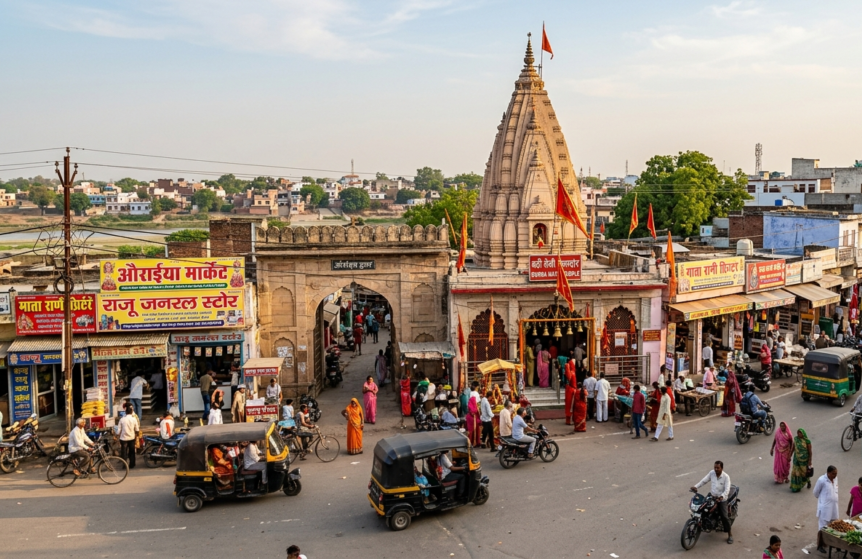
Auraiya :- The Land of Mythological Pride and Fragrant Desi Ghee
Detailed History
Auraiya is a significant district in Uttar Pradesh, carved out of Etawah on September 17, 1997. Historically, it was part of the ancient ‘Panchala‘ kingdom, with deep ties to the Mahabharata era. It is believed that the Pandavas spent time here during their exile. In the medieval era, it was ruled by Sengar Rajputs and later became part of the Mughal Empire. Today, Auraiya is famous not only for its mythology but also for its flourishing trade in Asia’s finest ‘Desi Ghee‘.
Detailed Architecture
Exterior Architecture :–
Auraiya’s architecture features ancient temple designs and remnants of Mughal influence. The Devkali Temple showcases the North Indian Nagara style with tall spires. The riverfront structures along the Yamuna and Kwari exhibit medieval brickwork, while the industrial townships in Dibiyapur reflect modern functional design.
Interior Architecture :–
The interiors of the temples are serene, featuring marble and black stone idols. Historic havelis in the town have large courtyards and ventilated windows. The industrial complexes like GAIL and NTPC are designed with state-of-the-art modern architecture, emphasizing safety and productivity.
Travel Guide & Routes :-
- Tickets :– Entry to all major temples, riverfronts, and public sites is free.
- Timing :– Generally 5:30 AM to 12:30 PM and 4:30 PM to 9:00 PM.
- How to Reach :–
- By Road :– Located on NH-19, it is well-connected to Delhi (380 km), Kanpur (100 km), and Agra (160 km).
- By Rail :– The primary railway station is Phaphund (PHD), located 20 km from the main city on the Delhi-Howrah line.
- By Air :– Nearest airports are Kanpur (Chakeri) and Agra Airport.
- Photography Spots :– Banks of Yamuna, the spire of Devkali Temple, and the lit-up industrial township of Dibiyapur at night.
- Local Flavors :– Pure Desi Ghee is a must-buy. Local specialties include Bedai, Jalebi, and fresh milk-based sweets.
- Famous Markets :– Auraiya Main Market (for Ghee wholesale) and Dibiyapur Market.
Detailed Nearby Attractions
- Devkali Temple :– The most significant religious site in the district, linked to King Parikshit and Janamejaya’s mythological legends.
- Sangam (Yamuna & Kwari Rivers) :– A beautiful natural confluence offering peaceful surroundings and breathtaking sunset views.
- Dibiyapur Industrial Town :– Known as ‘Urja Nagari‘ (Energy City), it houses massive units of GAIL and NTPC and features well-planned parks and residential areas.
- Kanchan Mahal :– An old historical building showcasing fine brickwork and the architectural glory of the district’s past.
- Panchnada :– A rare geographical spot near the district boundary where five rivers (Yamuna, Chambal, Kwari, Sind, and Pahuj) converge.
Interesting Facts
- Auraiya is known as the ‘City of Ghee’, exporting high-quality Desi Ghee across the country.
- Dibiyapur is a major hub for gas and power production in India.
- The ravines and forests of this region are believed to have sheltered the Pandavas during their exile.
Important Questions and Answer :-
Question 1:- From which district was Auraiya carved out?
Answer:- Auraiya was separated from Etawah district in 1997.
Question 2:- What is the nearest railway station to Auraiya?
Answer:- Phaphund (PHD) is the main railway station, about 20 km from the city.
Question 3:- Why is Auraiya famous across Asia?
Answer:- It is renowned for its production of high-quality ‘Pure Desi Ghee‘.
Question 4:- Best time to visit?
Answer:- October to March is the most pleasant time for a visit.
Question 5:- Is there any mythological significance to the city?
Answer:- Yes, it is deeply linked to the Mahabharata and the legends of the Pandavas and King Janamejaya.
Author’s Thoughts :-
Auraiya is a district where mythological peace meets industrial modernity. The silence of the Yamuna ghats and the hum of Dibiyapur’s machines tell the story of a diverse land. If you want to experience the true roots and legends of Uttar Pradesh, a trip to Auraiya will be a delightful experience.
“Auraiya holds the essence of mythological pride and the fragrance of purity.”