
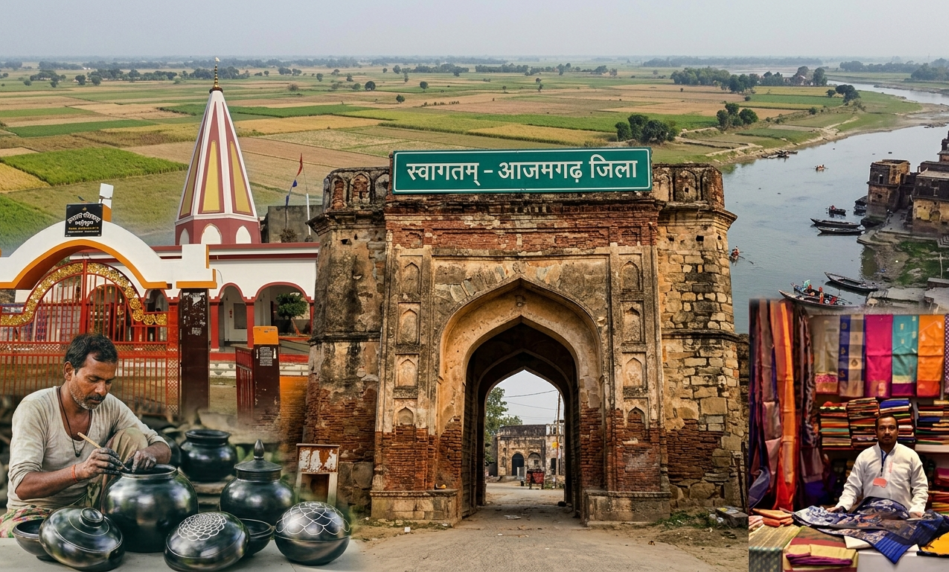
Azamgarh :- A Confluence of Art, Literature, and Spirituality
Detailed History
The history of Azamgarh is steeped in tales of courage and wisdom. Founded in 1665 by Azam Khan, this city witnessed the political upheavals of medieval India. According to ancient beliefs, this region was the penance ground for sages like Durvasa and Dattatreya, giving it deep spiritual significance. In the 1857 struggle for independence, local warriors gave a tough fight to the British. The district is known not just for wars, but for its literary fertility, producing scholars like ‘Mahapandit‘ Rahul Sankrityayan.
Detailed Architecture
- Exterior :– The historical buildings feature a mix of simplicity and strength. Old fort remains and mosques are built with Lakhori bricks and lime plaster, reflecting the late Mughal architectural style. The temple spires are high and ornate in the traditional North Indian style.
- Interior :– The inner portions show a distinct influence of clay art. The silver-like engravings on black pottery in Nizamabad’s workshops are unmatched. Inside mosques, geometric patterns and floral motifs are carved on the arches.
Travel Guide & Routes :-
- Ticket :– Entry is free at most locations. Some museums may charge a nominal fee of ₹5-10.
- Timing :– Suitable for visiting between 6:00 AM and 6:30 PM.
- How to Reach :–
- By Air :– Varanasi Airport is the nearest.
- By Rail :– Azamgarh (AMH) station is directly connected to Delhi, Mumbai, and Kolkata.
- By Road :– Accessible from Lucknow via the Purvanchal Expressway in a few hours.
- Photography Spots :– Pottery lanes of Nizamabad, sunset at Tamsa River, and Durvasa Ashram.
- Local Taste :– Must try the local ‘Dum Pukht‘ Biryani and Black Carrot Halwa (in winters).
- Famous Markets :– Takiya Bazaar and Purani Bazaar.
Interesting Facts
- Azamgarh is considered the ‘Mecca of Hindi Literature‘.
- The Black Pottery of Nizamabad holds international recognition (GI Tag).
- The Tamsa River is the lifeline of the city, mentioned in ancient scriptures.
Important Questions and Answer :-
- Question :- After whom was Azamgarh named?
- Answer:- The city was named after its founder, Azam Khan.
- Question :- What is unique about Nizamabad’s Black Pottery?
- Answer:- It features silver-like engravings that become permanent after firing the clay.
- Question :- Which major ashrams are located in Azamgarh?
- Answer:– Famous ancient ashrams of Sages Durvasa, Dattatreya, and Chandrama are located here.
- Question :- What is the main festival here?
- Answer:- Along with Holi and Diwali, Eid and local fairs are celebrated with great enthusiasm.
- Question :- Is there a university in Azamgarh?
- Answer:- Yes, Maharaja Suheldev State University is a prominent educational institution here.
Author’s Perspective :-
In my view, Azamgarh is a gem of Uttar Pradesh that hasn’t yet received the tourism recognition it deserves. The ‘Black Pottery’ here is not just a vessel; it represents centuries of hard work. If you are a lover of history and literature, you will find a new story at every corner of this city’s streets. It remains firmly rooted in its heritage even in the race for modernity.
“The soil of Azamgarh carries a fragrance that encapsulates literature and art within itself.”