
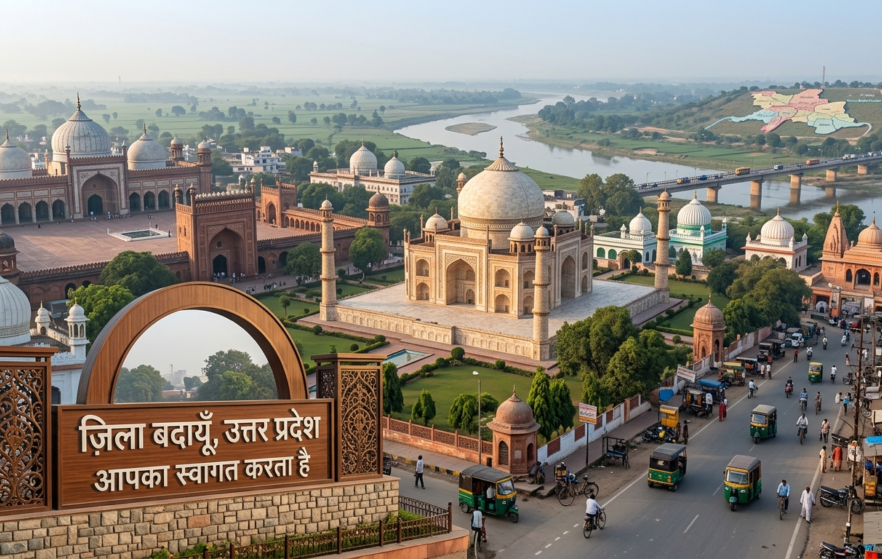
Badaun :- The Abode of Sufi Saints and Confluence of Ancient Architecture
Detailed History :-
Located in the Rohilkhand region of Uttar Pradesh, Badaun is not just an administrative center but one of the oldest and culturally richest cities in India. Historically, it has been known by names like ‘Adholok’ and ‘Vedamau‘. During the medieval period, Badaun’s importance was such that it served as the capital of the Delhi Sultanate and was called the ‘City of Domes‘. Being the birthplace of the great Sufi saint Hazrat Nizamuddin Auliya, it is considered the land of ‘Peers and Walis‘. Great rulers like Iltutmish governed from here, the influence of which is still reflected in the city’s structures.
Detailed Architecture :-
- Exterior :– The architecture of Badaun is deeply influenced by the Delhi Sultanate and Mughal periods. The Jama Masjid (Shamsi Jama Masjid) is one of the largest and oldest mosques in India. Its exterior design features large domes and the use of Lakhori bricks, showcasing its strength and historical grandeur.
- Interior :– Inside the structures, high arches, massive pillars, and intricate carvings on stone are worth seeing. The courtyard of the Jama Masjid is so vast that thousands can offer prayers simultaneously. Additionally, the interiors of Sufi shrines offer a blend of spiritual peace and ancient craftsmanship.
Travel Guide & Routes :-
- Ticket :– Entry to Jama Masjid and all major shrines is completely Free.
- Timing :– Open from 5:00 AM to 9:00 PM. Daytime is best for historical sites, while evenings are ideal for visiting shrines.
- How to Reach :–
- By Air :– The nearest airport is Bareilly (BEK), about 50-60 km away. Lucknow Airport is around 250 km away.
- By Rail :– Badaun Railway Station (BEM) is connected via the Kasganj and Bareilly rail route.
- By Road :– Badaun is well-connected by road to Delhi, Agra, and Lucknow. It takes about 5-6 hours from Delhi.
- Photography Spots :– The main gate of Shamsi Jama Masjid, Sondh Ghat (Ganges bank), and historical tombs.
- Local Taste :– The ‘Soan Papdi’, ‘Peda’, and ‘Kababs’ of Badaun are famous throughout the region.
- Famous Markets :– Main Market (Chowk) and Chhah Sadka.
Nearby Attractions
- Shamsi Jama Masjid :– A specimen of historical architecture built by Iltutmish.
- Dargah Hazrat Bade Sarkar :– People come from far and wide to offer prayers and seek blessings.
- Kachla Ghat (Ganges River) :– A holy bank of the Ganges where devotees flock for baths and rituals.
- Tomb of Ikhlas Khan (Roza) :– Also known as the ‘Red Tomb‘, famous for its beautiful structure.
- Kakrala :– An important center of historical and Sufi culture.
Interesting Facts
- Badaun was the most important Iqta (administrative center) of North India during the Delhi Sultanate.
- The Jama Masjid here was built in 1223 AD, placing it among the oldest mosques in the country.
- The famous Sufi saint Hazrat Nizamuddin Auliya was born on this sacred land.
Important Questions and Answer :-
- Question 1:- Why is Badaun called the ‘Land of Peers’?
- Answer:- Because it houses the shrines of hundreds of Sufi saints, with Hazrat Nizamuddin Auliya being the most prominent.
- Question 2:- Who built the Jama Masjid of Badaun?
- Answer:- It was built by Sultan Shamsuddin Iltutmish.
- Question 3:- On which river bank is Badaun situated?
- Answer:- The district is located near the holy Ganges River and the Sot River.
- Question 4:- What is the most famous sweet of Badaun?
- Answer:- The ‘Peda’ and ‘Soan Papdi’ of Badaun are known for their purity and taste.
- Question 5:- What is the Tomb of Ikhlas Khan called locally?
- Answer:- It is locally referred to as ‘Roza’ or the Red Tomb.
Author’s Perspective :-
Badaun is a city where time seems to have stood still. Walking through its lanes, you can catch the scent of old India and the Sultanate era. Seeing the vastness of the Jama Masjid up close is a spiritual experience. This district is perfect for those interested in the depths of history and the peace of Sufism. The culture and history of Badaun leave a lasting impression on every traveler.
“In the atmosphere of Badaun, Sufi devotion and centuries-old history still breathe today.”