
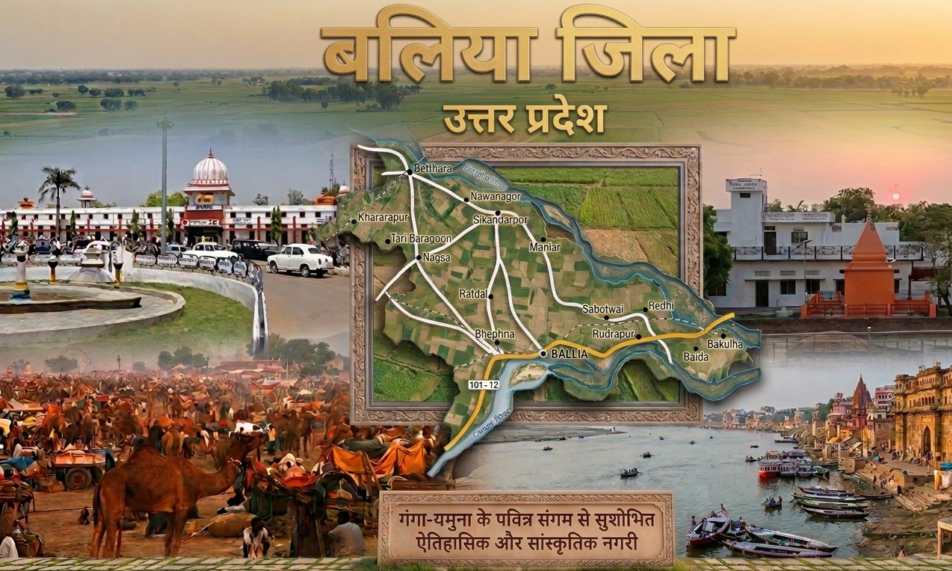
Ballia :- The Torch of Revolution and the Sacred Land of ‘Baghi’ Spirits
Detailed History
Located at the easternmost tip of Uttar Pradesh, Ballia district is immortalized in Indian history as ‘Baghi Ballia’ (Rebel Ballia). The history of this land is filled with sagas of sacrifice and bravery. In mythological times, this place was the abode of Sage Bhrigu, where he composed the famous ‘Bhrigu Samhita‘. In modern history, Ballia’s name was written in golden letters when, during the ‘Quit India Movement’ of 1942, it declared itself independent under the leadership of the great revolutionary Chittu Pandey. This district is also the birthplace of Mangal Pandey, the hero of the 1857 First War of Independence. Situated near the confluence of the Ganga and Sarayu rivers, it is a hub of spiritual and political energy.
Detailed Architecture
- Exterior :– The architecture of Ballia showcases a blend of simple ancient temples and British-era administrative buildings. The Bhrigu Temple is built in the traditional North Indian style, with religious scenes depicted on its outer walls. The paved ghats on the banks of the Ganga add to the city’s exterior charm.
- Interior :– The use of marble inside the temples and the silence of the sanctum sanctorum offer a distinct spiritual experience. The carvings and idols within the Bhrigu Temple are fine examples of ancient craftsmanship. The traditional houses with high porches and heavy wooden doors reflect the heritage lifestyle.
Travel Guide & Routes :-
- Ticket :– Entry to Bhrigu Temple and Surha Tal is free. Nominal fees may apply for rides and exhibitions during local fairs like the Dadri Mela.
- Timing :– 5:00 AM to 8:30 PM. The winter season is the most pleasant time to visit.
- How to Reach :–
- By Air :– The nearest airports are Varanasi (150 km) and Patna (135 km).
- By Rail :– Ballia Railway Station (BUI) is directly connected to major cities like Delhi, Kolkata, and Varanasi.
- By Road :– The district is well-connected to major cities of UP and Bihar via National Highway 31.
- Photography Spots :– Migratory birds at Surha Tal, the main gate of Bhrigu Temple, and the confluence of Ganga and Sarayu.
- Local Taste :– Ballia’s ‘Litti-Chokha‘ and its famous ‘Sweets‘ are renowned throughout the state.
- Famous Markets :– Chowk Bazaar and Vishunipur Market.
Nearby Attractions
- Bhrigu Temple :– Dedicated to Sage Bhrigu, it is the identity of Ballia.
- Surha Tal :– A vast and beautiful natural lake for bird lovers.
- Dadri Mela :– India’s second-largest cattle fair, held on Kartik Purnima.
- Shaheed Smarak :– A glorious memorial built in memory of freedom fighters.
- Janeshwar Mishra Park :– A beautiful public park located in the heart of the city.
Interesting Facts
- Ballia is called the ‘District of Revolutionaries‘ as it gave heroes like Mangal Pandey and Chittu Pandey to India.
- The former Prime Minister of India, Chandra Shekhar, also hailed from this glorious land.
- The ‘Bindi‘ (Tikuli) industry here is quite famous locally.
Important Questions and Answer :-
- Question 1:- Why is Ballia called ‘Baghi Ballia’?
- Answer:- It is called so because it was the first to reject British rule in 1942 and form its own independent government.
- Question 2:- Which is the most famous fair in Ballia?
- Answer:- The historic ‘Dadri Mela‘, held on Kartik Purnima, is the main event.
- Question 3:- Which two major rivers influence this district?
- Answer:- Ballia is located in the Doab region of the Ganga and Sarayu (Ghaghara) rivers.
- Question 4:- What is the connection of Sage Bhrigu with this district?
- Answer:- Ballia is his land of penance, where he is believed to have written the Bhrigu Samhita.
- Question 5:- Who were the famous revolutionaries of Ballia?
- Answer:- Mangal Pandey and Chittu Pandey were the most prominent revolutionary heroes.
Author’s Perspective :-
The soil of Ballia is a mixture of patriotism and self-respect. Sitting on the banks of the Ganga or hearing the bells of the Bhrigu temple gives a profound sense of mental peace. This district is not just a geographical location but a symbol of the thousands of sacrifices that laid the foundation of India’s freedom. The Dadri Mela is the best way to witness its cultural diversity. If you want to understand the true roots of India and its revolutionary history, a visit to Ballia is a must.
“The blood of revolution flows in Ballia’s veins, and the blessings of Sage Bhrigu linger in its air.”