
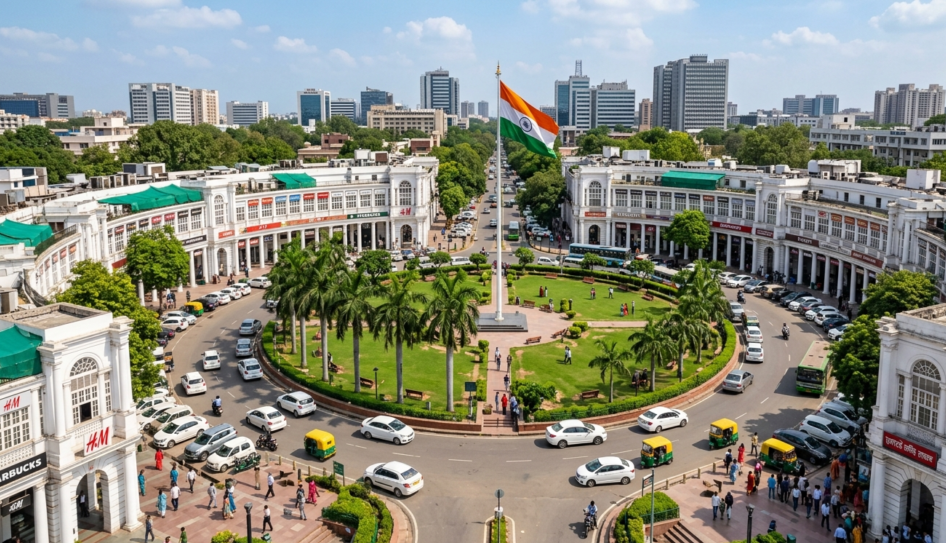
Connaught Place, Delhi :- The Historic Heart and Vibrant Core of the Capital
Affectionately known as ‘CP’ by locals, Connaught Place is the definitive commercial, cultural, and historic financial hub of New Delhi. Renowned globally for its unique, whitewashed Georgian architecture and massive concentric circular layout, this iconic landmark serves as a bustling corporate nerve center by day and seamlessly transitions into Delhi’s most glittering nightlife and culinary destination by night. Let’s delve deep into the structure, story, and soul of Delhi’s favorite hangout spot.
Detailed History
The inception of Connaught Place is deeply intertwined with the twilight of the British Raj and the birth of New Delhi as India’s imperial capital.
- Establishment and Conception :– When the British Empire decided to move the capital of India from Calcutta to Delhi in 1911, the need arose for a premier commercial district to serve the newly planned Lutyens’ city. Chief Architect to the Government of India, Robert Tor Russell, designed this grand plaza, building upon preliminary concepts by W.H. Nicholls. Construction commenced in 1929 and was completed in 1933. It was named after Prince Arthur, the 1st Duke of Connaught, a member of the British Royal Family.
- The Official Renaming :– In 1995, the Government of India officially renamed the inner and outer circles as ‘Rajiv Chowk’ and ‘Indira Chowk’ respectively, after the nation’s former Prime Ministers. However, it continues to be universally recognized and addressed by its legacy moniker, ‘Connaught Place‘.
- Historical Evolution :– Long before the colonnaded structures were raised, the site was a dense woody patch where villagers from surrounding settlements hunted wild fauna. It was systematically cleared and curated to offer an ultra-premium, elite lifestyle and retail experience for British aristocrats and wealthy princely states of India.
Detailed Architecture
The architectural layout of Connaught Place is a brilliant structural marvel inspired by the Royal Crescent in Bath, England, adapted into a complete circle.
- Concentric Circular Layout :– The architecture is structured into two primary concentric rings—the Inner Circle and the Outer Circle, separated by a transit ring called the Middle Circle. These circles are systematically bisected by 7 radial roads acting as transit capillaries. The entire commercial marketplace is organized alphabetically into 12 distinct structural Blocks (Blocks A to F in the Inner Circle and G to P in the Outer Circle).
- Georgian Colonnaded Facade :– The buildings exhibit classic Anglo-Palladian Georgian styling. Striking, monumental white pillars (colonnades), soaring ceilings, arched fanlights, and continuous covered verandas form the arcade network. This structural design enables pedestrians to walk through the entire marketplace shielded from Delhi’s intense summer sun and seasonal monsoons.
- The Central Park :– Sitting dead-center within the Inner Circle is the lush, expansive Central Park. This meticulously manicured green space features water fountains and holds a majestic, 207-feet-high Indian National Flag that flutters proudly, serving as a defining visual anchor of CP. Below this park lies Rajiv Chowk, the ultimate subterranean transit node of the city.
Travel Guide & Routes
To plan an unhindered and deeply immersive excursion through Connaught Place, follow this organized sequential guide.
- Visiting & Market Timings :–
- As an open downtown commercial district, CP remains accessible 24/7.
- Retail showrooms and flagship brand stores operate from 11:00 AM to 10:00 PM.
- Fine-dining restaurants, gastropubs, and lounges stay lively until 12:30 AM.
- Important Note:– The majority of formal retail showrooms remain closed on Sundays, although Central Park, multiplex cinemas, street markets, and restaurants operate at full capacity.
- Ticket Prices :– Exploring Connaught Place, its arcades, and entering Central Park is entirely Free for all visitors.
- How to Reach :–
- By Metro (The Absolute Best Route) :– The plaza sits directly above Rajiv Chowk Metro Station, the busiest and most massive interchange junction connecting the Delhi Metro Yellow Line and Blue Line. Exit gates emerge straight into the inner circle blocks. For the outer rim, Barakhamba Road or Janpath metro stations can also be comfortably used.
- By Road/Bus :– Being the geographical focal point of Delhi, it is connected via a robust bus network. Major stops include the Shivaji Stadium Bus Terminal and Palika Kendra. App-based cabs and local auto-rickshaws offer direct drop-offs.
- Photography Spots :–
- The National Flag at Central Park :– Capturing the monumental tricolor flag silhouetted against the open sky is a classic Delhi frame.
- The White Arcades :– The symmetric white pillars of the Inner Circle provide perfect vanishing points for architectural photography, fashion portraiture, and cinematic reels.
- The Giant Steel Charkha :– Located near the Khadi Gramodyog Bhavan on the outer ring, this massive gleaming installation offers a striking backdrop.
- Local Flavors (Culinary Highlights) :– CP is a gastronomic wonderland housing generational heritage eateries alongside modern global dining concepts:
- Wenger’s :– Located in A-Block, Delhi’s oldest surviving Swiss confectionery bakery, legendary for its savory mutton patties, chicken baguettes, and artisanal pastries.
- Keventers :– Famous for its iconic glass bottles serving thick, legendary classic milkshakes since the colonial era.
- Jain Chawal Wale :– Situated near Shivaji Stadium, an iconic late-night street food savior celebrated across Delhi for its piping hot plates of Rajma Chawal and Kadhi Chawal.
- Heritage Dining Rooms :– Establishments like Kwality and United Coffee House feature mid-century vintage interiors and serve legendary culinary classics.
- Famous Specialized Markets Inside CP :–
- Palika Bazar :– A massive, fully air-conditioned underground subterranean flea market located beneath the inner circle, famous for budget garments, footwear, and consumer electronics.
- Janpath Market :– An outdoor street bazaar running perpendicular to CP, universally loved for ethnic silver jewelry, brass artifacts, Tibetan curios, and bohemian cotton wear.
Nearby Attractions
Thanks to its strategic central location, you can easily access these prominent tourist destinations within minutes of leaving CP:
- Jantar Mantar :– A UNESCO-protected historical astronomical observatory built by Maharaja Jai Singh II of Jaipur, located just a 5-minute walk from the outer circle.
- Agrasen ki Baoli :– Tucked away on Hailey Road, this highly cinematic, beautifully sculpted ancient stepwell is famous for its unique architecture and serene, deep stone steps.
- Gurudwara Bangla Sahib :– One of the most prominent Sikh shrines in India, featuring a massive golden dome, a sacred structural pool (Sarovar), and a mega-kitchen serving free community meals (Langar) around the clock.
- Prachin Hanuman Mandir :– Located on Baba Kharak Singh Marg, this ancient temple dates back to the Mahabharata era, widely popular for its traditional lac bangle market and intricate henna artists.
- State Emporia Complex :– A dedicated row of state-run emporiums on Baba Kharak Singh Marg showcasing authentic, certified regional handicrafts, handlooms, and arts from across India.
Interesting Facts
- A Premium Global Real Estate :– Connaught Place consistently ranks among the top 10 most expensive and premium commercial office locations globally, commanding massive rental values.
- The Aerial Mirage :– From an aerial view or satellite map, the perfect concentric layout of CP resembles a massive aircraft wheel or a modern Roman Colosseum nestled in greenery.
- The Subterranean Hub :– Apart from hosting the deepest multi-level transit rail network, its underground core seamlessly holds hundreds of retail stalls inside Palika Bazar without altering the heritage facade above ground.
- An Open Cultural Canvas :– Central Park serves as Delhi’s open-air cultural arena, hosting massive music concerts, political gatherings, public theater, and periodic art exhibitions.
Important Questions and Answer :-
Question 1:– Is there a proper parking system for personal vehicles in Connaught Place?
Answer:– Yes, CP features extensive structured paid surface parking spaces along the Inner, Middle, and Outer circles. For a completely hassle-free experience, visitors can utilize the automated, state-of-the-art multi-level underground parking facilities at Palika Bazar and Shivaji Stadium.
Question 2:- When is the best time to visit CP for high-end retail shopping?
Answer:– For retail shopping, the ideal window is Monday to Saturday between 12:00 PM and 07:00 PM when all establishments are operational. For social gatherings, casual strolls, and experiencing the thriving nightlife, weekend evenings are unbeatable.
Question 3:– Is bargaining necessary while shopping in Palika Bazar?
Answer:– Absolutely. Palika Bazar operates strictly on hard bargaining dynamics. Shopkeepers initially quote heavily inflated prices. Astute shoppers can comfortably negotiate the final price down to half or even one-third of the initial quote.
Author’s Thoughts
In my perspective, Connaught Place is not merely a central business district or a commercial market grid; it is the ultimate living bridge connecting Delhi’s colonial history with its vibrant, high-tech future. While the stark white Georgian columns stand as silent storytellers of Lutyens’ imperial past, the energetic strums of a guitar in Central Park and the neon lights of modern lounges reflect the unbound spirit of today’s India. The true magic of CP lies in its absolute democratic inclusivity—it seamlessly accommodates a corporate executive dining at an upscale lounge and a student enjoying budget street food at Janpath within the exact same block. Walking through its arcades as the evening sun bathes the white pillars in amber light is an irreplaceable Delhi experience. It is the timeless soul of the capital.
“Draped in the architectural elegance of vintage white colonnades and fueled by the relentless pulse of modern life, Connaught Place remains the immortal soul of New Delhi.”