
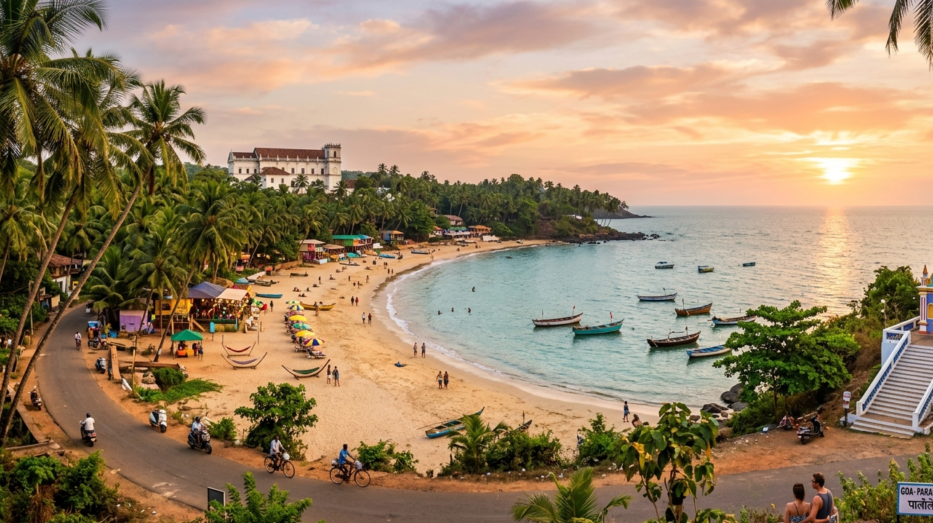
Goa :- A Grand Confluence of Indian Culture and Portuguese Heritage
Detailed History
The history of Goa is not just the story of a state but a testimony to the rise and fall of ancient civilizations. In ancient texts and the Mahabharata, it was referred to as ‘Goparashtra‘ or ‘Gomantak‘, meaning ‘the land of cowherds‘. During the medieval period, it witnessed the grandeur of Hindu kings from the Maurya, Satavahana, Chalukya, and Vijayanagara empires. However, in 1510, the Portuguese General Afonso de Albuquerque established supremacy here by defeating the Sultan of Bijapur. Portuguese rule lasted for 451 years, longer than British rule in any other part of India. On December 19, 1961, the Indian Army liberated it through ‘Operation Vijay‘, and it was granted the status of India’s 25th state on May 30, 1987.
Detailed Architecture
- Exterior Design :- The architecture of Goa is dominated by the ‘Indo-Portuguese‘ style. Churches like the ‘Basilica of Bom Jesus‘ reflect Late Renaissance and Baroque influences. The outer walls are whitewashed with lime, a practice made mandatory during the Portuguese era for cleanliness and protection against sea salt. Forts like ‘Aguada‘ utilize red laterite stone, which is capable of withstanding heavy monsoon rains and sea erosion.
- Interior Design :- The interior views are the pinnacle of grandeur. Ceilings were kept high to allow air circulation amidst sea humidity. The altars inside churches feature extremely intricate carvings with gold plating. In old houses, polished oyster shells were used instead of glass for windows to allow natural light, a feature still visible in the homes of the ‘Fontainhas’ area in Panaji.
Travel Guide & Routes
- Timings and Tickets :- Most historical sites remain open from 9:00 AM to 6:30 PM. Entry to churches is free, but forts and museums charge a fee ranging from ₹20 to ₹100.
- How to Reach :-
- Air :- Mopa Airport serves North Goa, while Dabolim Airport is the gateway to South Goa.
- Rail :- Madgaon and Vasco-da-Gama are major stations directly connected to Mumbai, Delhi, and Bengaluru.
- Local Transport :- E-rickshaws, yellow-black taxis, and rented scooters are the most popular choices in Goa.
- Photography Spots :- The lighthouse at ‘Aguada Fort‘, the colorful Portuguese lanes of Panaji, and the railway bridge at Dudhsagar Falls.
- Local Taste & Markets :- Do try the local ‘Fish Curry Rice‘ and ‘Bebinca‘ (a multi-layered dessert). For shopping, ‘Anjuna Flea Market’ and ‘Mapusa Market’ are famous for handicrafts and spices.
Interesting Facts
- Goa is India’s smallest state by area, but its per capita income is about two and a half times the national average.
- The ‘Se Cathedral‘ in Goa is one of the largest churches in Asia, and its ‘Golden Bell‘ is world-famous for its sound.
- India’s first printing press was set up at ‘St. Paul’s College’ in Goa in 1556.
- Goa has the highest number of vehicles per 100 people in India.
- The ‘Bhagwan Mahavir Sanctuary‘ is located in Goa’s forests, serving as a hub of biodiversity.
Important Questions and Answer :-
Question 1:- Is Goa only famous for its beaches?
Answer:- No, Goa is equally famous for its UNESCO World Heritage churches, forts, wildlife sanctuaries, and stunning spice plantations.
Question 2:- What is the correct way to visit Dudhsagar Falls?
Answer:- To reach Dudhsagar, one must take a jeep safari from Kulem. It is in its full glory during the monsoon, although some routes might be limited for safety reasons.
Question 3:- Is Portuguese culture still alive in Goa?
Answer:- Yes, the Portuguese influence can be clearly seen in the old architecture, food, and language, especially in ‘Old Goa’ and ‘Fontainhas’.
Question 4:- What is special for tourists in local markets?
Answer:- Cashew nuts, Feni (local drink), handicrafts, and colorful boho clothes are very popular in local markets.
Question 5:- Which is the biggest festival in Goa?
Answer:- The ‘Goa Carnival‘ is the largest festival, featuring parades, dances, and musical performances on the streets.
Author’s Perspective :-
In my view, the true beauty of Goa lies not in its crowded beaches, but in its serene hinterlands and ancient villages. Goa is an experience that teaches you how modernity and tradition can coexist. The ‘Susegad’ lifestyle—meaning living life with peace and contentment—is something every person living a hectic life should experience at least once. This state is not just a place to visit; it is a feeling that provides solace to the soul.
“A priceless confluence of historical fragrance and sea waves – Welcome to the lanes of Goa.”