
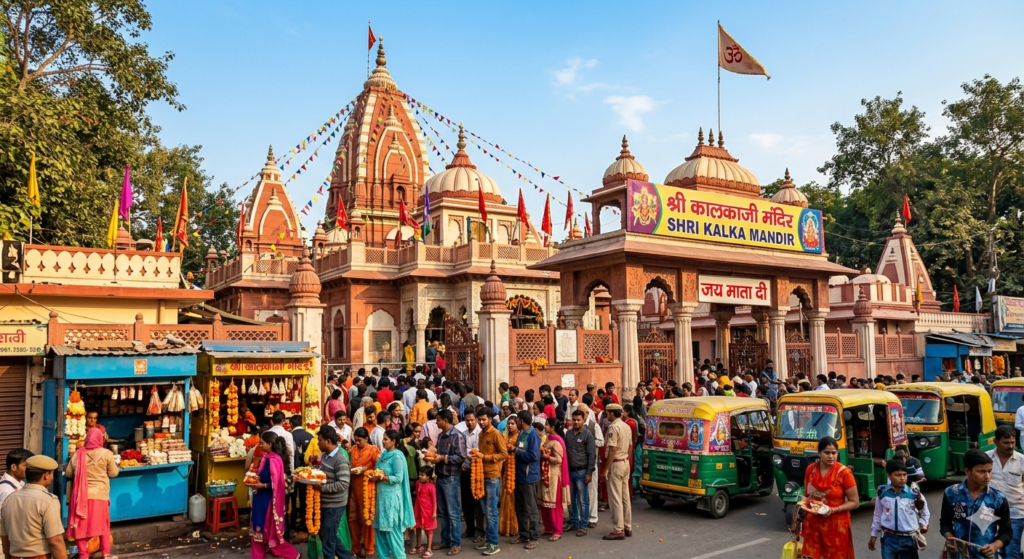
Kalkaji Temple, Delhi :- The Historic Epicenter of Power, Faith, and the Supreme Siddhopeeth
Detailed History
Perched majestically atop the Surya Koot hill (Kalkaji hill) in the southern sector of New Delhi, the Kalkaji Temple stands as one of the oldest, most revered, and historically significant Siddhopeeths (shrines of cosmic power) in India. This sacred shrine is dedicated to Goddess Mahakali, an incarnation of Shakti, and is universally celebrated as the ‘Manokamna Siddha Peeth’ (the shrine where all heart desires are fulfilled) and ‘Jayanti Peeth’.
The history of this temple is deeply rooted in ancient Puranic legends and the grand epic of the Mahabharata. According to sacred texts, during the Satya Yuga, when Lord Indra and other deities were heavily tormented by the terrifying demons Shumbha-Nishumbha and Raktabija, they gathered to pray for divine intervention. Responding to their intense prayers, Goddess Kaushiki (Parvati) emerged from the mind of Lord Brahma. During the fierce cosmic battle that ensued, whenever a drop of Raktabija’s blood touched the earth, thousands of new demons manifested. To halt this, Goddess Mahakali emerged from the furrowed brow of Goddess Kaushiki. She slaughtered the demons and drank Raktabija’s blood before it could touch the ground. Following the annihilation of the demonic forces, at the loving request of the deities, the Goddess established herself on this very hilltop in the form of a self-manifested rock (Swayambhu Shila).
In the Dwapara Yuga, Lord Krishna and the Pandavas visited this very Siddhopeeth to perform elaborate rituals and seek the blessings of Maa Kalka before marching into the battlefield of Kurukshetra. The architectural core of the main temple structure seen today was constructed in 1764 by the Maratha forces, and later updated and expanded in the subsequent centuries by Raja Kedarnath and devout local citizens. Today, the temple serves as an unyielding pillar of spiritual solace for millions of pilgrims visiting from across the nation.
Detailed Architecture
Exterior Architecture :-
Kalkaji Temple is beautifully positioned on the crest of the Surya Koot hill, giving its exterior architecture a highly imposing, prominent, and majestic look. The primary temple structure exhibits a unique octagonal (eight-sided) architectural blueprint, which in Tantric philosophy symbolizes the eight directions and the eight primordial dimensions of cosmic energy (Ashta Shakti). The central dome (Shikhara) rises grandly into the skyline, crafted meticulously in the traditional North-Indian Hindu temple style. The front facade features a beautiful contrast of red sandstones and pristine white materials. A wide circumambulation path (Parikrama Marg) and robust structural barricades enclose the courtyard. The primary entrance archways are lined with intricately carved white marble frames and flanked by massive, lifelike sculptures of lions (the sacred mount of the Goddess), accentuating the temple’s imperial grandeur.
Interior Architecture :-
Internally, the sanctum sanctorum (Garbhagriha) of the Kalkaji Temple is intensely divine, radiating profound spiritual vibrations. At the structural center of the sanctum sits the self-manifested stone deity of Maa Kalka, elegantly adorned in rich silk vestments, a golden crown, and multi-layered precious jewelry. The interior walls and ceiling of the inner sanctum are crafted entirely using premium polished white marble, extensively overlaid with ornate silver plates offered by generations of devotees. Directly outside the inner chamber lies a vast central congregational hall (Mandapa), engineered to comfortably accommodate hundreds of pilgrims for devotional chants and community prayers. A historic, perennial flame (Akhand Jyoti) burns brilliantly inside the inner hall, having been kept continuously lit for centuries. Lined along the outer perimeter of the complex are beautifully carved independent subsidiary shrines dedicated to Lord Shiva, Hanuman Ji, and Bhairav Baba.
Travel Guide & Routes
For pilgrims, cultural travelers, and heritage enthusiasts planning a visit to the historic Kalkaji Temple, the detailed logistical guide below outlines all essential parameters.
- Ticket and Entry Fee :– Entry into the temple complex and divine darshan is absolutely Free. The temple administration does not levy any mandatory ticketing fees. During major festive periods, specialized fast-track routing lines are managed smoothly by the temple trust.
- Timings (Temple Hours) :–
- General Operational Hours :– The temple remains open for devotees daily from 04:00 AM to 11:30 PM.
- Morning Aarti (Prabhat Aarti) :– From 05:00 AM to 06:00 AM daily.
- Evening Aarti :– From 07:00 PM to 08:00 PM daily. (Note: The inner sanctum briefly closes its doors for short durations in the afternoon for holy food offerings (Bhog) and ritual cleaning.)
- Opening and Closing Days :– The temple operates seamlessly all seven days of the week, throughout the year. During the biannual Navratri festivals, the temple remains open continuously round-the-clock (24/7) to manage the massive influx of pilgrims.
- How to Reach :–
- By Metro :– The absolute most efficient and seamless transit option is the Delhi Metro network. The dedicated ‘Kalkaji Mandir’ Metro Station is located right at the foot of the temple hill. It serves as a major intersection point, seamlessly connecting the Violet Line and the Magenta Line. Exiting the station leads you directly onto the pedestrian approach walkway of the temple.
- By Bus :– Positioned adjacent to the Outer Ring Road transit corridor, the temple is heavily accessible via public DTC buses. Commuters can hop onto any bus heading toward Nehru Place or Kalkaji Mandir, which drops passengers a brief walk away from the primary steps.
- By Auto/Taxi/Cab :– Located roughly 12 km from New Delhi Railway Station, the temple is highly accessible. Visitors can seamlessly hail local auto-rickshaws, e-rickshaws, or book app-based cabs to arrive straight at the primary entry gates.
Photography Spots, Local Food, and Famous Markets
Photography Spots :-
- The Octagonal Shikhara Facade :– Capturing a wide-angle shot from the primary courtyard highlights the unique eight-sided architecture of the central dome rising into the central sky.
- The Imperial Gate Lions :– The grand, majestic lion sculptures guarding the primary entrance thresholds provide a spectacular and powerful frame for cultural photography.
- Hilltop Panoramas :– Since the temple is situated at an elevated altitude, the outer Parikrama walkways offer sweeping panoramic views of the South Delhi greenery and the sleek commercial towers of Nehru Place. (Note: To respect religious traditions and preserve security protocols, photography or digital video recording inside the inner sanctum sanctorum of the stone deity is strictly prohibited.)
Local Food :-
The proximity to the temple and the commercial hub of Nehru Place offers an incredible array of traditional street snacks and multi-cuisine dining options.
- The Sacred ‘Bhandara’ Feast :– The approach lanes of the temple frequently host community kitchens (Bhandaras) managed by devotees, serving delicious traditional Poori-Aloo curry and sweet semolina halwa (Prasad) to all visitors.
- Kalkaji Street Snacks :– The local kiosks directly outside the temple parameters are legendary for crisp, piping hot samosas, Bedmi-Kachoris, tangy potato chaat, and freshly fried, syrup-oozing hot Jalebis.
- Nehru Place Food Plazas :– For a comfortable sit-down meal, a quick 5-minute walk takes you to Nehru Place’s commercial food complexes, home to famous local sweet houses (like Sona Sweets), iconic Chole-Bhature spots, and international fast-food chains.
Famous Markets Nearby
- Kalkaji Main Market :– A bustling, traditional high-street neighborhood marketplace right next to the temple, highly popular for ethnic apparel, cosmetic shopping, traditional jewelry, and ceremonial prayer items.
- Nehru Place Market :– Located just 500 meters away, this is universally celebrated as Asia’s largest commercial hub for IT hardware, computers, mobile electronics, and software retail.
- The Lotus Temple Complex :– Situated within brief walking distance of the temple, this world-renowned Baha’i House of Worship shaped like a blooming lotus offers vast manicured lawns and a serene meditative atmosphere.
Interesting Facts
- The Mahabharata Connection :– According to regional folklore, before commencing the epic war of Kurukshetra, Lord Krishna guided the Pandava brothers here, and King Yudhishthira personally performed intensive rituals to seek Maa Kali’s blessings for ultimate victory.
- Tantric Octagonal Geometry :– The specific eight-sided structural layout of the core temple building is deeply intentional, designed carefully in accordance with ancient Tantric architecture to map out the eight cardinal directions and balance the cosmic energies.
- The Navratri Congregation :– During the auspicious nine days of Navratri, the temple transforms into a grand spiritual carnival, registering a staggering footfall of over 100,000 devotees daily, with the entire hill illuminated by brilliant multi-colored lights.
- The Self-Manifested Idol :– The central deity of Goddess Kali inside the sanctum is believed to be a ‘Swayambhu’ rock formation, meaning it was not sculpted by human hands but manifested naturally out of the earth on this hill.
Important Questions and Answer :-
Question 1:– To which deity is the Kalkaji Temple dedicated and where is it located?
Answer:- The temple is dedicated to Goddess Mahakali (Maa Kalka), a supreme incarnation of Shakti, and is located on a historic hilltop in the Kalkaji area of South Delhi.
Question 2:- Which is the closest metro station to reach Kalkaji Temple?
Answer:- The closest station is the ‘Kalkaji Mandir’ Metro Station, an interchange node sitting directly on both the Violet Line and the Magenta Line of the Delhi Metro.
Question 3:– Is there a historical connection between the Pandavas and Kalkaji Temple?
Answer:- Yes, ancient traditions hold that the Pandavas, along with Lord Krishna, offered intense prayers at this exact spot to secure blessings of victory before the Mahabharata war.
Question 4:– What are the daily operating hours of Kalkaji Temple?
Answer:- The temple remains open daily from 04:00 AM to 11:30 PM, closing briefly for short intervals in the afternoon for holy food offerings and maintenance.
Question 5:– Is the temple open through the night during the Navratri festival?
Answer:- Yes, to accommodate the immense surge of pilgrims arriving during the nine days of Chaitra and Sharad Navratri, the temple remains open continuously round-the-clock (24/7).
“Spanning from the glorious legends of the Mahabharata to the bustling life of modern Delhi, the Kalkaji Temple stands tall on its historic hill as an immortal, unyielding beacon of divine power, intense faith, and cosmic energy.”