
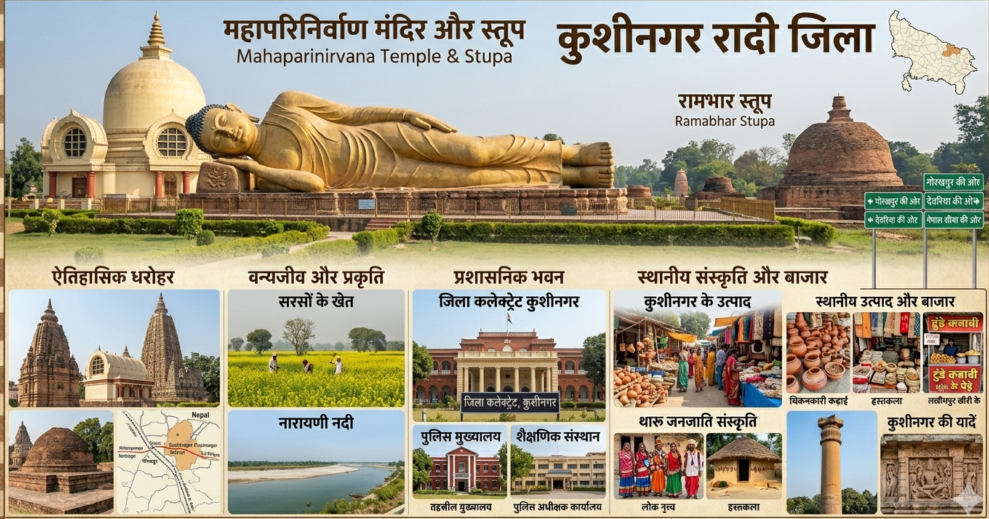
Kushinagar District :- The Land of Buddha’s Mahaparinirvana and Symbol of Peace
Detailed History
Kushinagar, located on the eastern edge of Uttar Pradesh, is one of the most vital Buddhist pilgrimage sites globally. Historically, it was the capital of the ‘Malla Republic’, one of the 16 Mahajanapadas. Its global fame stems from the fact that Lord Buddha attained ‘Mahaparinirvana’ (liberation from the cycle of birth and death) here in 483 BC. After being lost in the pages of time during the medieval era, it was rediscovered in the 19th century through excavations led by Alexander Cunningham.
Detailed Architecture
Exterior Description :–
The exterior of Kushinagar features a grand blend of international Buddhist styles. The Mahaparinirvana Temple, built on a high brick plinth, is a white cylindrical structure. Behind it, the massive Parinirvana Stupa made of terracotta bricks dominates the landscape. Various international monasteries—Thai, Japanese, and Burmese—reflect their respective traditional architectures.
Interior Description :–
The interior of the main temple is serene, housing a 6.10-meter-long reclining statue of Lord Buddha, carved from a single piece of golden sandstone. The Thai temple’s interior is adorned with gold leaf work and exquisite ceiling paintings. Ancient ruins of monasteries reveal the systematic layout of monks’ cells and assembly halls from the era of Emperor Ashoka.
Nearby Attractions :-
- Mahaparinirvana Temple :– Houses the divine reclining statue of Buddha.
- Ramabhar Stupa :– The site where Lord Buddha was cremated; it is a massive brick structure.
- Matha Kuar Shrine :– Features a colossal statue of Buddha in the ‘Bhumi Sparsha‘ mudra.
- Thai Monastery :– Known for its stunning golden architecture and lush gardens.
- Kushinagar Museum :– Displays ancient coins, sculptures, and relics found during excavations.
Travel Guide & Routes
- How to Reach :–
- By Rail :– Nearest major stations are Deoria Sadar (35 km) and Gorakhpur (50 km).
- By Road :– Located on NH-28; well-connected via bus and taxi from Gorakhpur.
- By Air :– Kushinagar International Airport (KBK) now provides direct flight connectivity.
- Tickets & Timings :– Entry to temples is free. Monuments are open from 6:00 AM to 6:00 PM.
- Photography Spots :– The massive Ramabhar Stupa, the white facade of the main temple, and the ornate Thai temple gates.
- Local Taste :– Famous for ‘Litti-Chokha’, ‘Sattu’, and traditional eastern UP sweets.
- Famous Markets :– ‘Kasaya Bazaar‘ for Buddhist artifacts, souvenirs, and local crafts.
Interesting Facts
- Kushinagar is part of the ‘Four Main Buddhist Pilgrimages’ along with Lumbini, Bodhgaya, and Sarnath.
- The reclining Buddha statue, dating back to the 5th century, appears extremely lifelike, as if sleeping.
- Padrauna is the administrative headquarters of the district.
Important Questions and Answer :-
Question No 1:– Why is Kushinagar famous?
Answer:- It is world-famous as the place where Lord Buddha attained Mahaparinirvana (death).
Question No 2:– What is the significance of Ramabhar Stupa?
Answer:- It marks the spot where the mortal remains of Lord Buddha were cremated.
Question No 3:– Where is the district headquarters of Kushinagar?
Answer:- The administrative headquarters is located in Padrauna.
Question No 4:– How long is the Buddha statue in the main temple?
Answer:- The reclining statue is approximately 6.10 meters (20 feet) long.
Question No 5:– Of which ancient kingdom was Kushinagar the capital?
Answer:- It was the capital of the Malla Republic.
Author’s Thoughts
Kushinagar is not just a tourist destination; it is a sanctuary for the soul. The silence at the Parinirvana site teaches more than any book on philosophy. In my view, if you seek peace and a moment of deep self-reflection, the soil of Kushinagar will offer you exactly that.
“Fragrant with the essence of peace and non-violence, the soil of Kushinagar remains an eternal witness to Buddha’s Nirvana.”