
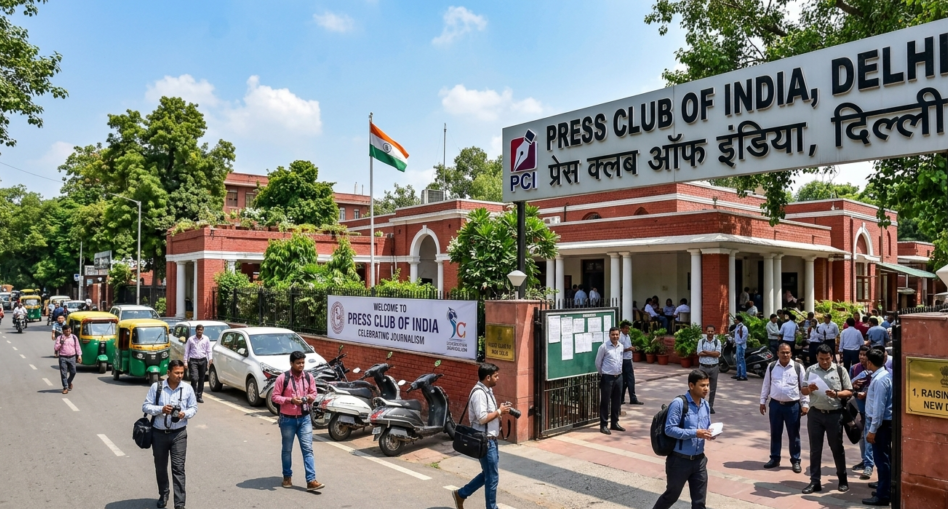
Press Club of India, Delhi :- The Heart of Indian Journalism and Forum of Ideas
Detailed History
The Press Club of India (PCI), located in New Delhi, stands as the historical anchor and most significant congregation point for the fourth estate of Indian democracy—Journalism. Founded in 1958, shortly after India’s independence, the club was envisioned by a cohort of the country’s most eminent and pioneering journalists. Prominent editor Durga Das served as its inaugural president, steering the institution toward its core purpose: providing a unified, independent platform where media professionals could exchange ideas, debate policies, and connect without corporate or political duress.
Over the decades, the Press Club has transcended its identity as a social club to become a living archive of contemporary Indian political and social history. It is the premier venue where national and international political leaders, union ministers, foreign diplomats, and grassroots activists host press conferences, make historic announcements, and issue media briefings. From weathering the storms of the Emergency era to adapting to the modern digital revolution, the PCI has remained a fierce guardian of the freedom of speech and expression in India.
Detailed Architecture :-
Situated on Raisina Road within the secure parameters of Lutyens’ Delhi, the architecture of the Press Club of India favors functional simplicity and colonial charm over high-rise grandeur.
- Exterior Architecture :– The structure is a modest, single-story bungalow-style pavilion typical of mid-20th century Lutyens’ layouts. It is bordered by a beautiful, expansive front lawn shaded by legacy trees and outfitted with large patio umbrellas. This outdoor seating zone is legendary for its calm, leafy ambiance, offering journalists a tranquil escape from the chaotic newsrooms of the capital.
- Interior Architecture :– The interiors house a main dining hall, a well-stocked vintage bar area, a dedicated press conference hall with advanced audio-visual routing, and quieter lounges tailored for senior editors. The walls are wrapped in a rich tapestry of archival photographs, historical political cartoons, and portraits honoring the titans of Indian journalism. The design philosophy remains deliberately informal and comfortable, fostering uninhibited conversations and camaraderie.
Travel Guide & Routes :-
The Press Club of India is nestled within the high-security, elite VIP zone of Central Delhi. If you plan to visit, here is an essential guide.
- Entry Ticket :– There is no commercial ticket or entry fee. However, admission is strictly restricted to registered PCI members or guests accompanied by a valid member. The general public cannot gain direct access, and membership cards or official guest entries are verified at the gateway.
- Visiting Timings :– The club generally operates from 12:30 PM to 11:00 PM daily. Official media briefings and press conferences are mostly scheduled during the morning and afternoon hours.
- How to Reach :–
- By Metro :– The closest metro stations are ‘Patel Chowk’ Metro Station (Yellow Line) and ‘Central Secretariat’ Metro Station (Yellow/Violet Line interchange). The club is a short, comfortable walk from either station.
- By Bus :– Any central Delhi DTC bus routing toward Krishi Bhawan, Parliament Street, or Shastri Bhawan drops commuters within walking distance of Raisina Road.
- By Auto/Cab :– App-based cabs and local auto-rickshaws can drop you directly at the main gate on Raisina Road from any quadrant of Delhi.
Nearby Attractions :-
- India Gate :– The majestic national war memorial and the sprawling lawns of the central vista are located just a short distance from the club.
- The Parliament House & Kartavya Path :– The striking new Parliament building, historical secretariats, and the iconic boulevard leading up to Rashtrapati Bhavan sit in close proximity.
- Connaught Place (CP) :– The ultimate heritage shopping, commercial, and dining district of New Delhi, located just a few minutes away.
- Jantar Mantar :– The historic 18th-century equinoctial sundial observatory and a focal point for civic assemblies in the capital.
- National Museum :– A treasure trove housing thousands of years of Indian art, historical antiquities, and cultural relics, located nearby.
Photography Spots, Local Taste, and Famous Markets :-
- Photography Spots :– The ‘Memory Wall’ featuring historic front pages, the collection of original cartoons by legendary artists like R.K. Laxman, and the sun-dappled lawns make for exceptional frames (though indoor photography is subject to internal club guidelines).
- Local Taste :– The PCI is celebrated for its highly curated, classic, and pocket-friendly menu. Its signature Mutton Curry, Mughlai Fish Fry, minced kebabs, and traditional evening masala chai served with hot samosas are staples of the Delhi media fraternity.
- Famous Markets :– The adjoining Connaught Place grid and the vibrant Janpath Market are prime destinations for sourcing ethnic apparel, silver jewelry, handicrafts, and rare books.
Interesting Facts :-
- The Press Club of India boasts a massive network comprising thousands of active journalists, editors, photojournalists, and foreign correspondents stationed across India.
- The interiors feature rare, original political caricatures hand-drawn by India’s finest cartoonists, encapsulating decades of electoral and social shifts.
- The annual PCI managing committee elections are fiercely contested and widely followed, mirroring miniature national elections within the Indian media ecosystem.
- It remains one of the rare non-partisan neutral grounds in Lutyens’ Delhi where powerful cabinet ministers and rookie beat reporters sit at the same table for off-the-record chats.
Important Questions and Answer :-
Question 1:– When was the Press Club of India founded?
Answer:- The Press Club of India was established in the year 1958 to give journalists a safe, autonomous, and democratic space to interact and work.
Question 2:– Is the Press Club of India open to the general public for dining?
Answer:- No, the facility is private and reserved exclusively for institutional members and their authorized guests to maintain professional decorum and security.
Question 3:– Which is the most convenient metro station to reach the Press Club?
Answer:- ‘Patel Chowk’ Metro Station on the Yellow Line is the most convenient, located just a stone’s throw away from the premises.
Author’s Thoughts :-
The Press Club of India on Raisina Road is far more than bricks, mortar, and dining tables; it is the living, breathing conscience of Indian democracy. Stepping into this space connects you instantly to the raw energy of the national discourse, where breaking news is analyzed, debates are settled, and headlines are born over endless cups of tea. In an era of digital isolation, this club stands as a timeless reminder of the power of face-to-face dialogue, camaraderie, and unyielding free speech.
“The Press Club of India is that timeless corner where headlines simmer over a cup of tea before rushing to print.”