
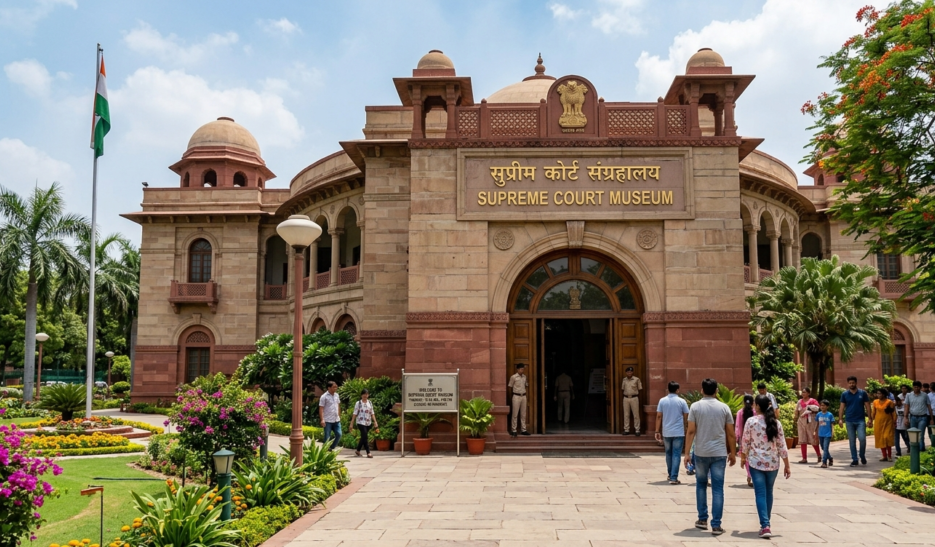
The Chronicle of Indian Justice :- Supreme Court Museum, Delhi
While monuments like the Red Fort, Qutub Minar, and Humayun’s Tomb beautifully narrate the tales of dynasties and emperors, Delhi also houses spaces that document the birth of modern democratic India. If you wish to understand the foundational roots of Indian democracy, its constitution, and the evolution of its legal framework, the Supreme Court Museum on Tilak Marg, New Delhi, is an absolute goldmine. Tucked neatly within the high-security lawns of the Supreme Court of India, this museum is a hidden sanctuary for history buffs, law students, and curious minds. In this detailed blog, let us explore the profound history, structural exhibits, and complete travel guide for this unique institutional museum.
Detailed History :-
The Supreme Court Museum beautifully encapsulates the long journey of the concept of justice in the Indian subcontinent, tracing it from ancient righteousness (Dharma) to modern constitutional law.
- The Genesis :– The conceptualization of this specialized museum was spearheaded under the guidance of successive Chief Justices of India. It was formally inaugurated on August 4, 2004, by the then Chief Justice of India, Hon’ble Mr. Justice R.C. Lahoti.
- The Core Objective :– The museum was established to educate citizens, international scholars, and law professionals about India’s indigenous ancient legal systems, colonial modifications, and the post-independence glorious achievements of the highest court of the land.
- Historical Transition :– The exhibits vividly remind us how the ‘Federal Court of India’ (established in 1937 under the Government of India Act 1935) transitioned and bloomed into the sovereign ‘Supreme Court of India’ on January 28, 1950.
Detailed Architecture & Exhibits :-
The layout of the Supreme Court Museum is split across two masterfully curated, air-conditioned thematic levels that guide visitors chronologically through time.
- The Building Layout :– Housed within a sleek, modern architectural block inside the supreme court compound, the interior radiates an aura of quiet dignity, discipline, and intellectual depth.
- Ground Floor (Ancient & Medieval Era) :– This gallery focuses on the evolution of law in ancient and medieval India. It features scripts, records, and references to ancient legal codes like the Manusmriti, Kautilya’s Arthashastra, and the moral edicts of Emperor Ashoka, alongside the judicial systems of the Mughal courts.
- Basement Gallery (Colonial Era & Modern Supreme Court) :– This tier chronicles the arrival of British law, starting from the Mayor’s Courts of 1726, the Supreme Courts of Judicature established from 1774 onwards, and the Federal Court.
- Rare Manuscripts and Personal Relics :– On display are high-quality photographic reproductions of the original Constitution of India, original handwritten scripts of land-marking judgments, vintage judicial wigs, ceremonial robes worn by federal judges, historical pens used to sign monumental verdicts, and rare mementos gifted by supreme courts of various nations.
Travel Guide & Routes :-
Due to the extreme security protocols of the Supreme Court of India, visitors must meticulously follow these rules and guidelines.
- Tickets :– Admission to the Supreme Court Museum is completely Free. No entry fee or pass charges apply.
- Visiting Timings :– The museum welcomes visitors from 10:00 AM to 5:00 PM. Please note that it remains strictly Closed on Mondays, Sundays, and all Central Government Gazetted Holidays.
- Strict Security Mandate :– Since it rests inside a high-security institutional zone, all visitors must pass through standard metal detectors and body scans at the gate. Mobile phones, cameras, laptop bags, and electronic gadgets are strictly prohibited inside the museum. A secure, complimentary Clock Room is available at the entrance gate to deposit your belongings.
- How to Reach :–
- By Metro :– The absolute easiest route is via the Delhi Metro. The nearest station is ‘Supreme Court’ (Blue Line), formerly known as Pragati Maidan metro station. The museum is located just a short 2-minute walk from the station exit.
- By Road :– Positioned centrally on Tilak Marg, it is excellently linked to Mandi House, India Gate, and ITO. App-based cabs and public buses drop commuters right at the main service lane of the court complex.
Photography Spots :-
- Important Note :– Due to stringent institutional security laws, photography of any kind is strictly prohibited inside the museum building and court premises.
- The External Perimeter :– Visitors can take photographs outside the complex gates, featuring the magnificent ash-grey and white dome of the main Supreme Court building or the symbolic murals of Lady Justice and the scales of equity from a designated safe distance outside the security walls.
Local Food & Famous Markets :-
After enriching your mind at the legal archive, you can head out to sample the refined culinary and cultural hotspots of Lutyens’ Delhi.
- Local Food :–
- Mandi House Cafes :– Located just a kilometer away, Mandi House is the theater hub of Delhi. The open-air canteen at the Shriram Centre and the beautiful Triveni Terrace Cafe are legendary for their filter coffee, shammi kebabs, and masala shikanji amidst an artistic crowd.
- State Bhawan Canteens :– Nearby state embassies like Andhra Bhawan and Banga Bhawan offer exceptionally affordable, authentic regional culinary thalis.
- Famous Markets :–
- Connaught Place (CP) :– Located barely 2 km away, this historic white Georgian colonnade arcade is Delhi’s ultimate destination for global retail brands, dynamic bars, and multi-cuisine restaurants.
- Khan Market :– A premium lifestyle market known for its high-end independent bookstores, gourmet bakeries, and elite ambient cafes.
Nearby Attractions :-
- India Gate :– The iconic war memorial lawns, perfect for an evening walk, are just a 5-minute drive away.
- Purana Qila & Delhi Zoo :– Located down Mathura Road, perfect for exploring ancient ruins and wildlife.
- National Crafts Museum :– Positioned near Pragati Maidan, showcasing a glorious open-air display of rural Indian textiles, crafts, and vernacular architecture.
Interesting Facts :-
- Echoes of Revolutionary Trials :– The museum proudly preserves and exhibits high-fidelity historical trial papers, police records, and original charge sheets from legendary colonial cases, including the trial of Bhagat Singh and the Mahatma Gandhi assassination trial.
- Vintage Courtroom Setups :– Authentic intricately carved wooden high-back chairs, original witness stands (katgharas), and heavy brass seals from the Federal Court era are preserved structurally to recreate the atmosphere of 1930s courtrooms.
- The Global Legal Vault :– It holds an impressive collection of ceremonial gavels, ornamental swords, and constitutional texts presented to India by Chief Justices from around the globe, making it a true repository of international legal heritage.
Important Questions and Answer :-
Question 1:- Where exactly is the Supreme Court Museum located?
Answer:– It is situated inside the official compound of the Supreme Court of India on Tilak Marg, New Delhi, right near the Pragati Maidan area.
Question 2:– Is there any entry ticket for the Supreme Court Museum?
Answer:– No, entry to the museum is absolutely free for all domestic and international visitors.
Question 3:– Can I carry my camera or smartphone inside the museum?
Answer:– No, due to high-security protocols, all electronic items, including mobile phones, smartwatches, cameras, and large bags, must be deposited at the complimentary security locker counter outside the gate.
Question 4:- Which metro station provides the fastest access to the museum?
Answer:– The ‘Supreme Court’ Metro Station on the Blue Line is the closest and most convenient transit point.
Author’s Thoughts
Walking through the quiet, meticulously organized corridors of the Supreme Court Museum is a profound and grounding experience. While we frequently read about historic judicial verdicts in our daily newspapers, we rarely pause to visualize the centuries of institutional evolution that sustain our democratic rights. Standing before the ancient legal manuscripts, moving through colonial transformations, and finally gazing upon the pens that signed the destiny of modern India fills one with immense respect for the Indian judiciary. The raw history vibrating off the trial documents of our freedom fighters is enough to give you goosebumps. Though the lack of photography access prevents you from taking digital souvenirs, the deep sense of democratic pride and legal knowledge you carry out in your mind is entirely irreplaceable. Step away from the standard tourist circuits on your next Delhi visit and spend an hour discovering the historical anchor of Indian justice.
“Preserving the sacred blueprints of constitutional law and the silent echoes of historic trials, the Supreme Court Museum stands as a grand testament to the democratic soul of India and its unyielding march toward absolute justice.”