
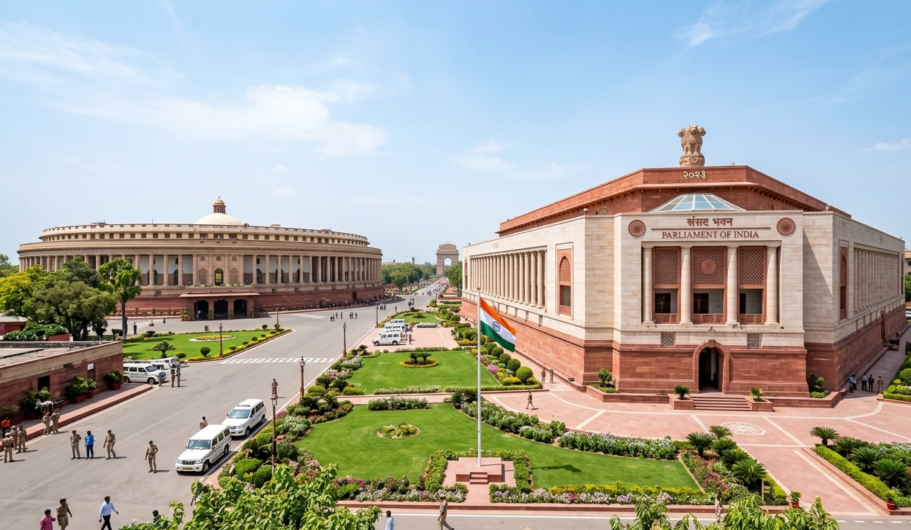
The Parliament House :- The Temple of Indian Democracy and Architectural Zenith
Situated at the absolute core of Lutyens’ Delhi, the ‘Parliament House’ (Sansad Bhavan) is far more than a government edifice; it is the beating heart of the world’s largest democracy. Standing as the supreme custodian of Indian sovereignty, democratic ideals, and legislative milestones, the parliamentary complex today showcases a magnificent bridge between historic legacy and futuristic structural engineering. In this detailed blog, we will journey through the illustrious history, deep-rooted cultural architecture, and essential travel perspectives of both the old and the new Parliament buildings.
Detailed History
The lineage of India’s legislative center is beautifully divided into two monumental chapters – our historic heritage parliament building and our newly inaugurated state-of-the-art parliament house.
- The Old Parliament House (Samvidhan Sadan) :– Designed by the legendary British architects Sir Edwin Lutyens and Herbert Baker, the construction of this iconic circular building began in 1921 and was completed in 1927. Originally opened as the ‘Council House‘, it later became the cradle of Indian democracy post-independence, hosting the historic drafting of the Constitution of India. In 2023, this legendary structure was formally renamed ‘Samvidhan Sadan’ (Constitution House) to preserve its structural immortality.
- The New Parliament House :– To meet 21st-century technological demands, advanced workplace efficiency, and the expanding spatial requirements for legislators, a new legislative building became paramount. Developed under the visionary ‘Central Vista Redevelopment Project‘, its foundation stone was laid in December 2020. Designed by India’s acclaimed architect Bimal Patel, the new Parliament House was proudly dedicated to the nation on May 28, 2023. It stands as a profound monument to a self-reliant India (‘Atmanirbhar Bharat‘), crafted entirely by indigenous artisans using materials sourced from across the subcontinent.
Detailed Architecture :-
The structural design of the new Parliament House is a masterclass in combining ancient Indian cultural symbolism, regional art forms, and cutting-edge seismic resilient engineering.
- Exterior Architecture :– Departing from the colonnaded circular silhouette of the older building, the new Parliament House features a distinct triangular geometry. This design ensures optimal land utilization and symbolizes sacred geometry found throughout Indian heritage. The exterior is wrapped in exquisite red and pink Dholpur sandstones sourced from Rajasthan, maintaining visual harmony with the historic fabric of Lutyens’ Delhi. The building features three majestic ceremonial entrances—Gyan Dwar (Gate of Knowledge), Shakti Dwar (Gate of Power), and Karma Dwar (Gate of Action)—guarded by monumental stone sculptures of national guardian icons like the Elephant, Swan, Garuda, and Lion.
- Interior Architecture :– Stepping inside reveals a breathtaking tribute to India’s diverse artistic legacy and state-of-the-art technological integrations:
- The Lok Sabha Chamber :– Meticulously styled after India’s national bird, the Peacock. It features rich green carpeting and wall motifs reminiscent of spreading peacock plumes, boasting an expanded seating capacity for 888 members.
- The Rajya Sabha Chamber :– Designed around the theme of India’s national flower, the Lotus. Dominated by regal crimson tones and lotus ceiling carvings, it comfortably accommodates 384 members with highly integrated digital interfaces.
- The Sengol :– Positioned directly adjacent to the Speaker’s dais in the Lok Sabha is the sacred ‘Sengol’ (Scepter), a majestic symbol of righteousness, justice, and the transfer of power rooted in the ancient Chola tradition of South India.
- The Constitution Hall :– Situated at the absolute center of the complex, this grand hall structurally chronicles India’s democratic evolution and elegantly houses a digitized copy of the Constitution.
Travel Guide & Routes :-
For travelers and heritage lovers planning to view this grand symbol of modern Indian statehood from the surrounding avenues, the comprehensive travel layout is structured sequentially below:
- Ticket :– Walking along the surrounding public thoroughfares, Sansad Marg, and the adjoining Kartavya Path is completely Free of charge. (Note: Due to high-level state security, entry into the inner legislative chambers is strictly restricted to authorized delegates, state officials, or visitors carrying a valid ‘Visitor’s Gallery Pass’ officially recommended by a Member of Parliament).
- Visiting Time :– The external avenues, Sansad Marg, and Vijay Chowk are accessible for walking and viewing from 06:00 AM to 09:00 PM. The evening hours are highly recommended, as the entire Parliament complex is illuminated beautifully in the colors of the national tricolor.
- Opening & Closing Time :– The administrative offices function 24/7, but the ideal window for tourists to capture the exterior grandeur under proper lighting extends from sunrise until 10:00 PM daily.
- How to Reach :–
- By Metro :– The absolute closest transit hub is the ‘Central Secretariat’ Metro Station, a major interchange for the Yellow and Violet Lines. The ‘Udyog Bhavan’ station is also within close proximity. From either station, the Parliament complex is a leisurely 5 to 10-minute walk.
- By Bus :– Numerous DTC buses connecting to ‘Central Secretariat’, ‘Krishi Bhavan‘, or ‘Sansad Marg‘ drop passengers right at the edge of the high-security perimeter.
- By Road/Cab :– Visitors can easily navigate using personal vehicles or app-based cabs directly to ‘New Parliament House, New Delhi’. As this is a highly secured government zone, stopping or parking private vehicles immediately next to the security walls is strictly prohibited. Vehicles must be parked at designated public parking zones near Connaught Place or Central Secretariat.
Photography Spots, Local Flavors, and Famous Markets
- Photography Spots :–
- The intersection near Sansad Marg and Rail Bhavan offers a legendary frame capturing both the old and new Parliament houses in a single shot.
- The sprawling symmetrical vista from Vijay Chowk, framing the Parliament House alongside the majestic North and South Blocks.
- The spectacular nocturnal frame when the architectural contours are highlighted by state-of-the-art eco-friendly LED lights.
- (Crucial Note:– Close-up photography right at the high-security barricaded gates or check-posts is strictly prohibited. Capturing wide-angle views from standard public thoroughfares is perfectly safe and permitted).
- Local Flavors :– No commercial food stalls operate directly outside the Parliament walls. However, the nearby paths of Vijay Chowk and Kartavya Path host popular evening street food vendors serving classic Delhi chaat, crispy golgappas, bhel puri, and steaming kulhad chai. For premium dining, the famous canteens at ‘Andhra Bhavan’ or the upscale restaurants of Connaught Place are just minutes away.
- Famous Market :– Located barely 1.5 to 2 kilometers away is ‘Connaught Place’ (CP) and the bustling lanes of ‘Janpath Market’. Janpath is globally renowned for an eclectic collection of handloom textiles, ethnic wear, brass curios, tribal jewelry, and unique Indian souvenirs at highly negotiable prices.
Nearby Attractions :-
You can seamlessly pair your visit to the Parliament area with these iconic administrative and historical highlights.
- Rashtrapati Bhavan :– The majestic presidential palace standing atop Raisina Hill, located just a stone’s throw away.
- India Gate & National War Memorial :– Located at the eastern terminus of Kartavya Path, dedicated to the immortal heroes of the nation.
- The National Museum :– India’s premier cultural repository, holding thousands of years of human history, sculpture, and ancient treasures.
- Jantar Mantar :– The fascinating historic open-air astronomical observatory built by Maharaja Jai Singh II, located further down Sansad Marg.
Interesting Facts :-
- The new Parliament House is built completely on green building standards, achieving a Platinum leaf rating for energy optimization and water conservation. It is engineered with advanced Zone-5 seismic resistance.
- The raw materials used in its construction represent a true mosaic of India – including rich teakwood from Nagpur, premium sandstone from Sarmathura (Rajasthan), hand-knotted carpets from Mirzapur, and custom bamboo flooring from Agartala (Tripura).
- The iconic historical circular parliament is safely preserved as a heritage asset, with its grand halls earmarked to function as a specialized museum of democracy and an archival library.
Important Questions and Answer :-
Question 1:- Can general tourists directly walk in to explore the interiors of the new Parliament House?
Answer:- No, direct walk-in exploration is strictly barred for security reasons. General citizens can only step inside the operational corridors if they possess an official gallery pass issued via the parliamentary secretariat or through a direct recommendation from a Member of Parliament.
Question 2:– Who is the principal architect behind the new Parliament building?
Answer:- The project was conceptualized and designed by the award-winning architect Bimal Patel of HCP Design, who masterfully infused modern infrastructure with deep cultural motifs.
Question 3:– What do the individual themes of the Lok Sabha and Rajya Sabha chambers signify?
Answer:- The Lok Sabha chamber embodies the vibrance of India’s national bird, the Peacock, while the Rajya Sabha chamber mirrors the purity and grace of the national flower, the Lotus.
Author’s Perspective :-
From my perspective, the new Parliament House is not merely an architectural feat of stone, glass, and steel; it is a profound declaration of a modern, self-reliant India’s rising confidence. While our ancestral parliament house beautifully echoed our transition out of colonial rule, this new triangular marvel is un-apologetically Indian in its ethos, craft, and soul. Its sharp geometric layout combined with deep regional art installations proves that India is ready to conquer the future without ever discarding its ancient cultural moorings. It stands as a living monument of inspiration for every citizen of the republic.
S“Carved in a striking triangular contour, this modern citadel stands as the timeless anchor of Indian democracy and the golden blueprint of a self-reliant future.”