North and South Block :- From the Bastion of Empire to the Apex of Indian Governance
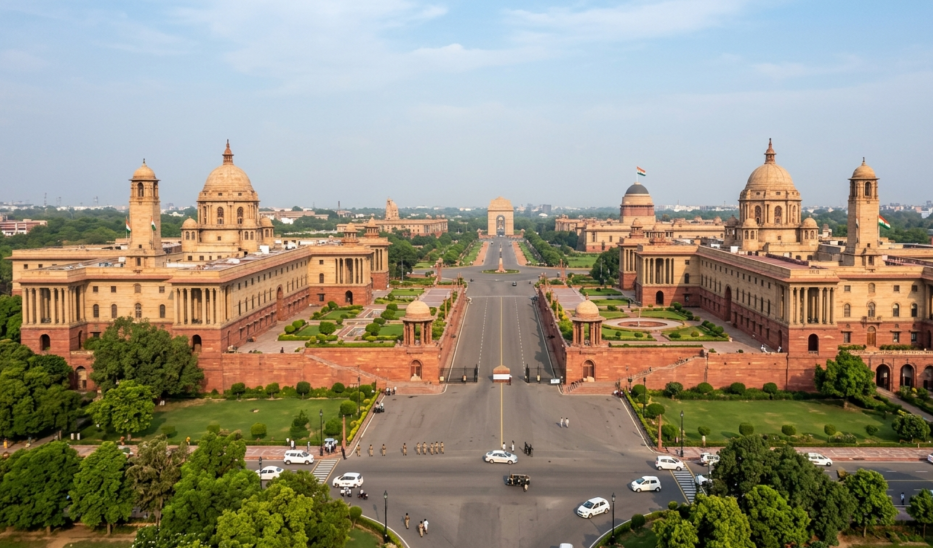
As you ascend the historic incline of Raisina Hill in the absolute heart of New Delhi, two colossal, matching sandstone edifices flank the grand approach to the Rashtrapati Bhavan. Known universally as the ‘North Block’ and the ‘South Block’, these dual structural icons constitute the core of the ‘Central Secretariat’. From within these hallowed halls of power, the most critical, sensitive, and strategic ministries of the Government of India shape the destiny of the nation. In this detailed blog, we will navigate through the illustrious history, cross-cultural architecture, and complete visitor perspectives of this administrative summit.
Detailed History
The lineage of the North and South Blocks is deeply intertwined with the relocation of the capital of the British Indian Empire from Calcutta to Delhi, officially decreed during the Delhi Durbar of 1911. To house the vast imperial secretariat and administrative councils, these twin monumental blocks were envisioned.
The monumental task of designing these twin powerhouses was entrusted to the acclaimed British architect Sir Herbert Baker, a close collaborator of Sir Edwin Lutyens. Construction began in the late 1910s and progressed meticulously, culminating in its formal completion around 1930.
- During the Colonial Era :– Termed simply as the ‘Secretariat Buildings’, these wings housed the imperial departments from which the British Viceroy’s Executive Council administered the vast territories of the Indian subcontinent.
- Post-Independence :– On August 15, 1947, the colonial emblems made way for the proud Indian Tricolor. Today, these blocks stand as the supreme symbols of sovereign Indian democracy, economic strategy, and national security execution.
Detailed Architecture
Sir Herbert Baker brilliantly integrated European Renaissance geometries and classical Greek proportions with the highly expressive and functional idioms of traditional Indian architecture.
- Exterior Architecture :– The twin structures stand facing each other in perfect symmetry across the central axis of Raisina Hill. They are wrapped in a majestic skin of red and pink Dholpur sandstone quarried from Rajasthan, creating a unified color palette across the Lutyens enclave. Towering, monolithic colonnades define the facades, echoing classical Roman aesthetics, while the center of each block is crowned by a monumental dome. To adapt to the harsh Indian summers, Baker incorporated traditional Mughal and Rajput ‘chhatris’ (domed pavilions) and intricately carved ‘jalis’ (stone screens), blending imperial grandiosity with regional artistry.
- Interior Architecture :– The interiors exude structural solemnity and historic weight. High-vaulted corridors, monumental arched entryways, and sweeping stone staircases give the wings a regal corporate character. The interiors of the South Block feature historic military emblems, murals, and diplomatic gifts chronicling India’s defense and foreign affairs. Conversely, the North Block houses invaluable archival records, portraits, and documents tracking the economic and internal security evolution of modern India.
Core Ministries & Departments
These two high-security blocks serve as the nerve center for India’s most critical governance frameworks.
- The South Block :– Acts as the primary citadel for national security and international relations, housing the Prime Minister’s Office (PMO), the Ministry of Defence, and the Ministry of External Affairs.
- The North Block :– Serves as the ultimate engine for internal security and macroeconomics, housing the Ministry of Home Affairs and the Ministry of Finance.
Travel Guide & Routes :-
For travelers and architecture enthusiasts looking to witness the majestic external facade of India’s administrative core, the essential travel blueprint is detailed sequentially below.
- Ticket :– Walking along the expansive perimeter of Vijay Chowk, Kartavya Path, and the external pathways of the Secretariat is completely Free of cost. (Note: Due to extreme state security protocols, entry inside the inner corridors and ministerial offices is strictly barred for general tourists. Only authorized personnel with valid government-issued security passes are permitted entry).
- Visiting Time :– The surrounding public areas and Vijay Chowk are ideal for visiting from 06:00 AM to 09:30 PM. The evening hours are highly recommended, particularly on weekends, when both blocks are illuminated by a spectacular display of dynamic multi-colored LED lights.
- Opening & Closing Time :– The operational ministries run from Monday through Friday (09:00 AM to 05:30 PM), but the best window for tourists to capture the exterior architectural grandeur spans from sunrise until 10:00 PM daily.
- How to Reach :–
- By Metro :– The absolute closest transit hub is the ‘Central Secretariat’ Metro Station, a major interchange point for the Yellow and Violet Lines. Upon exiting the station, the majestic structures of Raisina Hill are just a brief 2-minute walk away.
- By Bus :– Numerous DTC buses connecting to ‘Central Secretariat’ or the central bus terminuses drop passengers right at the steps of the high-security boundary lines.
- By Road/Cab :– You can drive down or hail an app-based cab directly by setting the destination to ‘Vijay Chowk’ or ‘North Block/South Block’. As this is a highest-security VVIP zone, stopping or parking private passenger vehicles on the roadside is strictly illegal. Vehicles must utilize public parking facilities located nearby.
Photography Spots, Local Flavors, and Famous Markets
- Photography Spots :–
- Vijay Chowk :– The ultimate vantage point to capture a perfectly symmetrical, wide-angle frame of both the North and South Blocks simultaneously.
- The lower stretch of Kartavya Path looking up the gradient of Raisina Hill, framing the twin blocks with the Rashtrapati Bhavan dome in the background.
- The spectacular night-time frames when the massive sandstone walls are bathed in the vibrant hues of the national tricolor.
- (Crucial Note:– Close-up photography of the main entrance gates, inner security checkpoints, and armed guard posts is strictly forbidden).
- Local Flavors :– No commercial vendor stalls operate inside the high-security perimeter. However, the nearby paths of Vijay Chowk and Kartavya Path host popular evening street food vendors selling classic Delhi chaat, crispy golgappas, bhel puri, and ice creams. For authentic meals, you can visit the legendary canteens of nearby state bhavans or the restaurants of Connaught Place.
- Famous Market :– The most iconic shopping hubs located nearby are ‘Connaught Place’ (CP) and the vibrant ‘Janpath Market’, widely celebrated for handloom garments, traditional Indian handicrafts, ethnic silver jewelry, and rare souvenirs.
Nearby Attractions
You can seamlessly pair your tour of Raisina Hill with these prominent nearby national landmarks.
- Rashtrapati Bhavan :– The sprawling presidential palace positioned directly at the crest of the hill, right between the twin blocks.
- The New Parliament House :– India’s striking new triangular architectural icon of democracy, situated immediately adjacent to the North Block.
- India Gate & National War Memorial :– Located at the far eastern terminus of Kartavya Path, standing in glorious visual alignment with Raisina Hill.
- The National Museum :– Housing one of the world’s finest collections of ancient Indian art and history, located just a short distance down Janpath.
Interesting Facts :-
- Inscribed prominently on the triumphal arches of the main entrance portals is a powerful quote by Sir Herbert Baker: “Liberty does not descend to a people, a people must raise themselves to liberty…”
- During the planning phase, a famous architectural dispute arose between Lutyens and Baker regarding the steep gradient of Raisina Hill. This calculation caused a visual anomaly where the lower portion of Rashtrapati Bhavan becomes hidden from view when approached from the base of the avenue.
- Every year on January 29th, the grand courtyards of Vijay Chowk and the twin blocks host the historic ‘Beating Retreat’ ceremony. This event marks the official conclusion of Republic Day celebrations, culminatng in a breathtaking illumination of both buildings that draws global spectators.
Important Questions and Answer :-
Question 1:– Can general international or domestic tourists tour the inside offices of the Ministries?
Answer:- No, the inner operational zones of both blocks are strictly off-limits to tourists for security reasons. Visitors can freely admire and photograph the magnificent architecture only from the designated external public spaces.
From my perspective, the North and South Blocks are far more than mere monumental office buildings of stone and mortar; they are the living repositories of modern India’s administrative soul. Standing at Vijay Chowk and looking up at these twin titans provides a profound sense of the stability and immense scale of Indian statehood. While they were originally constructed to display imperial dominance, independent India has successfully reclaimed them, turning every stone into an instrument of democratic governance and public service. Witnessing these massive structures lit up in the national tricolor at night is an unforgettable experience that evokes a deep sense of pride in the nation’s journey.
Question 2:– Who was the chief architect assigned to design the North and South Blocks?
Answer:- The twin administrative blocks were designed by the renowned British architect Sir Herbert Baker.
Question 3:– Which of the two blocks houses the Prime Minister’s Office (PMO)?
Answer:- The Prime Minister’s Office (PMO), along with the Ministry of Defence and Ministry of External Affairs, is located inside the South Block.
Author’s Perspective :-
“Standing guard along the slopes of Raisina Hill, these twin sandstone bastions serve as the administrative anchor of Indian democracy and the timeless sentinels of the republic.”