
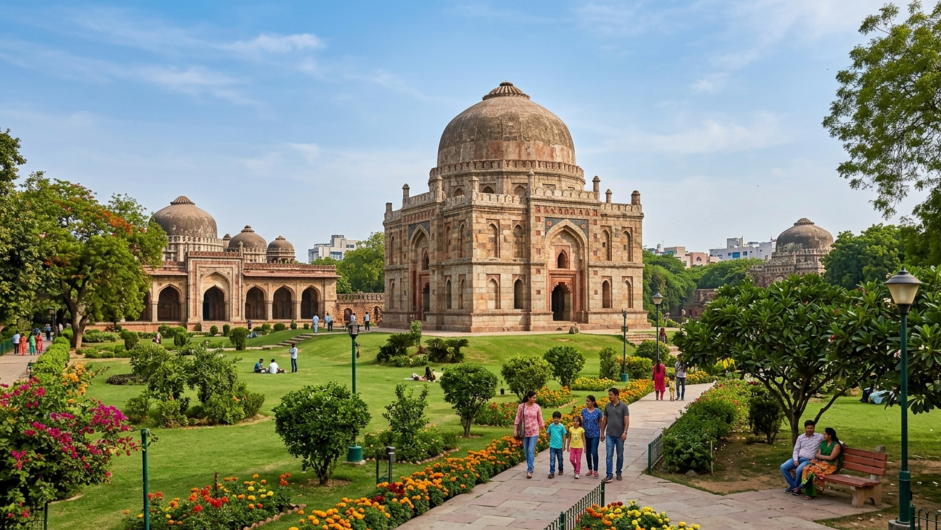
Lodhi Garden Delhi :- The Eternal Amalgam of Sultanate Architecture, Botanical Wealth, and Serene Urban Lifestyle
If you search for a sanctuary within India’s capital where the weathered stone walls of the 15th century converse gracefully with sweeping velvet lawns, where majestic medieval domes rest under the shade of rare global trees, and where the morning breeze carries the heavy scent of living history—your quest leads directly to ‘Lodhi Garden’. Positioned elegantly within the sophisticated heart of Lutyens’ Delhi near Khan Market, Lodhi Garden is far more than a simple community park or a green lung. It is the definitive cultural sanctuary, political crossroad, architectural laboratory, and lifestyle hub of New Delhi. On any given morning, the park plays host to India’s apex policymakers, supreme court justices, and international diplomats pacing down its trails, while afternoons and evenings find heritage scholars, solo backpackers, and families unwinding under its shadows. In this comprehensive profile, we will journey through its grand history, complex Indo-Islamic design, and practical visitor blueprint.
Detailed History :-
The historical chronicle of Lodhi Garden is an incredible timeline that bridges the twilight of the Delhi Sultanate, the master planning of the British Raj, and the democratic lifestyle of modern India.
- The Sultanate Era (15th & 16th Centuries) :– The monumental garden houses tombs, mosques, and structures erected during the final phases of the Delhi Sultanate under the Sayyid Dynasty and the succeeding Lodi Dynasty. The oldest major structure here is the octagonal mausoleum of the Sayyid ruler Muhammad Shah, built in 1444 AD. Following this, the supreme ruler of the Lodi line, Sikandar Lodi, extensively developed the terrain. Upon his death in 1517, his son Ibrahim Lodi built a grand fortified tomb complex for him here. At that time, the area was known as the village of Khairpur, and these monuments stood as isolated imperial burial grounds.
- The British Era & ‘Lady Willingdon Park’ :– In the 1930s, during the grand expansion of New Delhi under Edwin Lutyens, the wife of the then Viceroy, Lady Willingdon, recognized the spectacular aesthetic potential of this monument-studded landscape. In 1936, the British administration relocated the resident villagers of Khairpur, landscaped the surrounding 90 acres into a classic English-style manicured park, and officially christened it ‘Lady Willingdon Park’.
- Post-Independence Renaissance :– Immediately following India’s independence in 1947, the transitional government renamed the grounds ‘Lodhi Garden’ to reclaim its authentic medieval heritage. In 1968, the complex underwent a highly sophisticated landscape redesign by the world-renowned American landscape architect Joseph Allen Stein (J.A. Stein) and Garrett Eckbo. They introduced an integrated eco-grid featuring a continuous running stream, a clean artificial lake, and optimized viewing vistas for the grand monuments. Today, it stands as a strictly protected national monument monitored by the Archaeological Survey of India (ASI) and the New Delhi Municipal Council (NDMC).
Detailed Architecture & Botanical Matrix :-
The architectural layout of Lodhi Garden represents the absolute pinnacle of the Indo-Islamic Octagonal and Square Styles of medieval construction, neatly framed within a massive 90-acre master-planned botanical park.
- The Landscape & Botanical Framework (Exterior) :–
- Ninety Acres of Managed Emerald :– The park is laid out across 90 acres of rolling green mounds, interconnected stone pathways, and deep groves.
- The Living Botanical Registry :– Lodhi Garden doubles as an exceptional open-air botanical museum, home to over 110 rare species of mature trees, each systematically cataloged with identification tags. Key dedicated sectors include a curated Rose Garden, an aromatic Herbal Garden, a National Bonsai House, and a vibrant Butterfly Park.
- The Avian and Aquatic Ecosystem :– The absolute lack of vehicle noise makes this a major urban sanctuary for birds. The core of the park features an elegantly engineered Artificial Lake, crossed by a historic bridge, serving as a lively habitat for domestic ducks, kingfishers, egrets, and hornbills, while wild peacocks roam freely over the grass slopes.
- Detailed Architectural Profiles of the Monuments :–
- Bara Gumbad (The Big Dome) :– Standing proudly at the physical center of the park, this is a massive, square-plan monument topped by an exceptionally large, heavy masonry dome. Constructed in 1494 AD, it serves as a monumental gateway rather than a burial chamber. The interior walls feature incredibly intricate, fine incised plasterwork displaying elegant Arabic calligraphic bands. It is directly flanked by a rare, highly decorated three-arched Friday Mosque (Masjid) and a corresponding guest house.
- Shesh Gumbad (The Glazed Dome) :– Positioned directly opposite the Bara Gumbad, this square tomb is named ‘Shesh Gumbad’ (Mirror Dome) because its exterior facade was originally adorned with bright blue glazed Persian tiles that reflected the sunlight like mirrors. Patches of these vibrant turquoise tiles are still visible near the upper cornices. The interior houses multiple plaster graves of unknown Lodi dynasty royals.
- Muhammad Shah’s Tomb :– This is the undisputed architectural masterpiece of the earlier Sayyid era. It features a brilliant Octagonal Ground Plan, surrounded by a continuous arched veranda, sloping stone chajjas (eaves), and topped by a symmetric ring of small stone decorative kiosks (Chhatris) surrounding the massive central dome.
- Sikandar Lodi’s Tomb :– Situated at the northern edge of the park, this monument represents the birth of the fortified garden-tomb concept in India. The octagonal burial chamber is enclosed within a massive, high-walled defensive stone courtyard featuring corner bastions, an elegant western mosque wall, and an imposing entry portal that directly foreshadowed later Mughal palace architectures.
- Athpula (The Eight-Pillared Bridge) :– Spanning beautifully over the artificial lake near Sikandar Lodi’s tomb, this historic bridge features eight massive stone piers and seven distinct pointed arches. It was constructed during the 16th-century golden era of the Mughal Emperor Akbar by Nawab Bahadur Khan, making it the only major post-Sultanate Mughal element inside the park.
Travel Guide & Routes :-
For global history scholars, architecture photographers, family groups, and solo trekkers planning a comprehensive heritage walk through Lodhi Garden, the complete operational index is structured below.
- Ticket Fee :– Entry into Lodhi Garden, its botanical centers, and all ASI-protected medieval monuments is completely Free of charge for both domestic citizens and international travelers.
- Visiting Time :– The garden is open to the world daily through all seasons during these operational blocks:
- April to September (Summer) :– 05:00 AM to 08:00 PM.
- October to March (Winter) :– 06:00 AM to 08:00 PM.
- The Absolute Premier Windows:– For families and picnickers, winter middays (10:00 AM to 04:00 PM) offer a blissful sun-drenched experience. For creative photographers, twilight (05:30 PM to 07:00 PM) is spectacular, as the ASI turns on warm amber floodlights that illuminate the ancient domes against the deep blue evening sky.
- Code of Conduct & Restrictions :– To preserve this delicate heritage-nature balance, strict compliance with these rules is monitored:
- Writing on the medieval stone walls, stepping onto the active graves, or defacing monuments is a serious federal offense.
- All litter, food wraps, and plastic items must be deposited in the smart bins distributed across the trails.
- While casual personal handheld camera photography is free, commercial filmmaking, wedding shoots, or the deployment of tripods and drone rigs require written advance clearances and licensing fees from the ASI head office.
- How to Reach :–
- By Metro (The Most Seamless Route): The closest rapid transit node is the ‘Jor Bagh’ Metro Station situated on the Yellow Line. Upon exiting, Gate Number 1 of Lodhi Garden is a brief, pleasant 700-meter walk or a 2-minute e-rickshaw journey down Lodhi Road. Alternatively, travelers can use the ‘Khan Market’ Station (Violet Line) or ‘JLN Stadium’ Station (Violet Line).
- By Bus :– The sector is heavily serviced by city buses. Any DTC bus operating via Lodhi Road, Max Mueller Marg, or Rajesh Pilot Marg stops directly at the ‘Lodhi Garden’ main boundary gates.
- By Road/Cab :– You can input ‘Lodhi Garden, New Delhi’ into any navigation app. Tucked neatly between elite residential avenues, the site features extensive, safe, and completely free public parking zones directly outside Gate 1, Gate 3, and Gate 11.
Photography Spots, Local Flavors, and Famous Markets :-
- Photography Spots :–
- The Athpula Reflection Frame :– Standing on the eastern bank of the lake allows you to capture the mirror reflection of the Akbar-era arches and the fortified walls of Sikandar Lodi’s tomb on the water surface.
- Bara Gumbad Mosque Arches :– Framing portraits from the interior of the adjacent three-arched mosque utilizes the heavy architectural shadows to create dramatic, high-contrast black-and-white or cinematic heritage frames.
- Muhammad Shah’s Octagonal Silhouette :– Capturing a wide-angle frame from the low grass lawns captures the symmetric geometry of the stone chhatris cutting against the sky.
- Local Flavors :– The perimeter of Lodhi Garden is adjacent to some of the most celebrated culinary institutions in India:
- The Lodhi – The Garden Restaurant :– Located right outside the park boundary walls, this highly acclaimed open-air garden restaurant is internationally famous for serving world-class European, Mediterranean, and Italian fine-dining platters in an elite, romantic setting.
- Khan Market Food Crawl :– Walk over to Khan Market to indulge in legendary Mughlai seekh kebabs at Khan Chacha, gourmet rolls, artisanal gelatos, and premium single-origin coffee at upmarket lifestyle cafes.
- Famous Market :– Located just a brief 5-minute walk from the eastern gates is Khan Market, consistently ranked as India’s most expensive and prestigious retail street, famous for curated independent bookstores, luxury boutiques, and high-end cosmetics. For cultural souvenirs and traditional open-air food stalls, the famous Dilli Haat (INA) is located just a 5-minute drive away.
Nearby Attractions :-
Maximize your central Delhi cultural exploration by pairing your garden stroll with these highly proximate iconic milestones.
- Safdarjung Tomb :– The last grand monumental garden-tomb of the late Mughal empire, exhibiting striking red sandstone symmetry, located just 1.5 kilometers down Lodhi Road.
- Humayun’s Tomb :– The spectacular UNESCO World Heritage Site that served as the grand architectural inspiration for the Taj Mahal, located a 10-minute drive eastward.
- India Gate :– The monumental national war memorial arch of India, situated a brief drive down Shahjahan Road.
- Hazrat Nizamuddin Auliya Dargah :– The iconic, deeply spiritual medieval shrine of the famous Sufi saint, renowned globally for its soulful live evening Qawwali sessions.
Interesting Facts :-
- During the early British landscape design phase, minor structural alterations were introduced to turn the medieval buildings into decorative garden pavilions. Post-independence, the ASI meticulously stripped away these colonial modifications to restore the authentic, raw stone finish of the Sultanate era.
- Lodhi Garden is affectionately dubbed the absolute ‘Power Corridor Walk’ of India; it is the only public park where everyday citizens can routinely spot supreme court judges, cabinet ministers, top bureaucrats, and captains of Indian industry executing their morning cardio walks in simple tracksuits without heavy visible security barriers.
- The prestigious global media network Asia Times officially bestowed Lodhi Garden with the coveted title of “The Best Urban Park in Asia”, celebrating its peerless balance of architectural preservation and ecological biodiversity.
Important Questions and Answer :-
Question 1:– Can we bring personal picnic sheets, outdoor lunch boxes, and badminton racquets inside Lodhi Garden?
Answer:- Yes, absolutely. Lodhi Garden is highly revered as New Delhi’s absolute premier outdoor heritage picnic destination. Visitors are completely free to lay out mats on the designated grass zones, read books, bring home-cooked food, and enjoy light board games, provided they strictly maintain absolute cleanliness.
Question 2:- Is the entire park accessible for elderly travelers and wheelchair users?
Answer:- Yes, the modern landscape engineering by J.A. Stein ensured that all primary pathways connecting the core gates to the historical monuments feature smooth stone surfaces and gentle ramps, making the park exceptionally friendly for strollers, elderly walkers, and wheelchair users.
Question 3:- Are there public restrooms and pure drinking water systems managed inside the garden?
Answer:- Yes, the NDMC maintains exceptionally clean, modern public restroom blocks, shaded stone seating benches, and clean drinking water ATMs near the key entry and exit gates of the park.
Author’s Perspective :-
From my perspective, Lodhi Garden is far more than a green lung for a sprawling metropolis; it is a profound psychological bridge where the heavy, dramatic shadows of medieval history seamlessly dissolve into the casual, sun-drenched rhythm of modern life. There is an absolute, untamed magic in watching an ancient 500-year-old dome rise majestic and raw out of a perfectly curated field of bright winter flowers. While the chaotic traffic of Delhi races right outside its heavy boundary walls, inside the gates, the air instantly cools, wild peacocks call out from the canopy, and time slows down to a meditative hum. It is a space that teaches us that monumental heritage should never be caged inside sterile glass museums; instead, it thrives best when left open to the elements, enveloped by nature, allowing everyday citizens to breathe alongside it. If you wish to discover the true, sophisticated, and deeply soulful essence of New Delhi, step into Lodhi Garden during the early morning mist or at the velvet hour of dusk—it will permanently alter your relationship with this historic city. “Secluded beautifully within the imperial elite corridors of New Delhi, this 90-acre emerald empire stands as a timeless monument where the raw stone spires of the Sultanate era are gently embraced by modern botanical beauty and deep spiritual quietude.”