
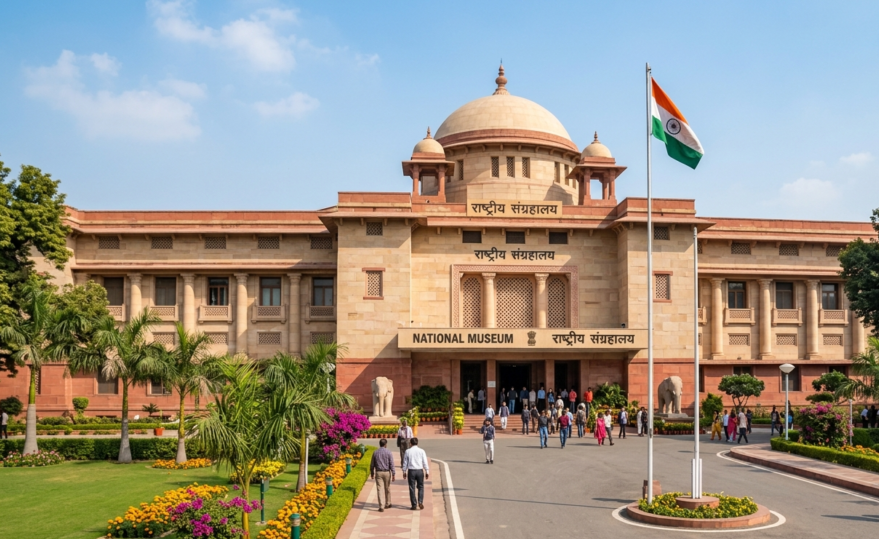
National Museum New Delhi :- The Ultimate Chronicle of India’s 5,000-Year-Old Civilization, Heritage, and Art
If you desire to stand face-to-face with the mystical bronze remnants of the ancient Indus Valley Civilization, bow before the authentic sacred relics of Lord Buddha, or marvel at the monumental bronze casting techniques of the Chola Dynasty, your search ends here. Positioned majestically on the historic Janpath avenue of New Delhi, the ‘National Museum’ stands as the premier, largest, and most culturally significant institutional museum in India. Home to a staggering treasury of over 200,000 unique, invaluable antiquities spanning from the prehistoric dawn of humankind to modern masterworks, this sanctuary encapsulates five millennia of human thought, philosophy, and artistic evolution under a single roof. In this detailed blog, we will journey through its foundational history, grand layout, timeless galleries, and comprehensive visitor matrix.
Detailed History :-
The chronicle of the National Museum is deeply intertwined with the dawn of India’s independence and the urgent post-colonial mission to reclaim and exhibit the nation’s scattered cultural wealth.
- The Genesis :– The concept of this supreme institution was sparked during the winter of 1947–48, when an extraordinary exhibition of rare Indian art was hosted at the Royal Academy of Arts in London. Upon the safe return of these treasures to Indian soil, state leaders and cultural historians collectively resolved that these historic masterpieces must be displayed permanently in a dedicated central national museum.
- The Inauguration :– Capitalizing on this vision, the National Museum was officially inaugurated within the staterooms of the Rashtrapati Bhavan on August 15, 1949, by the last Governor-General of India, Shri C. Rajagopalachari.
- The Sovereign Building :– Recognizing the need for an independent complex, the first Prime Minister of India, Pandit Jawaharlal Nehru, laid the foundation stone of the present-day iconic building on May 12, 1955. Phase one of this masterfully planned cultural archive was completed and formally dedicated to the global public on December 18, 1960. Today, it thrives as a premier autonomous wing under the Ministry of Culture, Government of India.
Detailed Architecture :-
Situated beautifully within the sophisticated administrative landscape of the Lutyens zone, the architecture of the National Museum represents a stellar blend of modern structural functionality and traditional Indian elements.
- Exterior Architecture :–
- The Sandstone Facade :– Sprawling elegantly across three massive floors, the building features an exterior heavily defined by alternating bands of rich red and cream-hued sandstones, mirroring the architectural vocabulary of neighboring imperial structures.
- The Grand Entry and Central Courtyard :– The high-ceilinged ceremonial foyer introduces a sense of monumental gravity. The entire structural frame is built concentrically around a spectacular, open-air Central Courtyard, designed to let natural sunlight stream into adjacent viewing zones while acting as an open-air sculpture garden for colossal medieval stone deities.
- Interior Architecture & Gallery Mapping :–
- The interior circulation is meticulously arranged in a chronological sequence across the floors, allowing travelers to systematically walk through time—from the stone age directly into the late medieval era.
- The structure houses over 20 specialized galleries, fitted with state-of-the-art temperature controls, anti-reflective secure glass encasements, and localized accent lighting designed to preserve these delicate organic and inorganic antiquities while offering crystal-clear observation angles.
Travel Guide & Routes :-
For global heritage scholars, student groups, solo backpackers, and families curating an educational tour of India’s crown-jewel museum, the complete operational index is sequenced below.
- Ticket Fee :–
- For Indian Citizens :– ₹20 per individual.
- For International Tourists :– ₹350 per individual (The international ticket price seamlessly includes a premium multi-language audio guide device free of charge).
- For Valid Students :– ₹1 only (Upon presenting a verified institutional photo ID card).
- Visiting Time :–
- Tuesday to Friday :– 10:00 AM to 06:00 PM.
- Saturday and Sunday :– 10:00 AM to 08:00 PM.
- Crucial Operational Note :– The National Museum remains strictly closed to the public every Monday and on designated national holidays.
- Travel Tip:– To truly appreciate even the core highlights, explorers should allocate a minimum of 3 to 4 hours.
- How to Reach :–
- By Metro (The Most Efficient Route) :– The closest rapid transit point is the ‘Udyog Bhawan’ Metro Station situated on the Yellow Line. Upon exiting, the museum gate is a brief 800-meter walk or a 2-minute auto-rickshaw journey down Janpath. Alternatively, the ‘Central Secretariat’ hub station is also within immediate proximity.
- By Bus :– The venue is extensively connected via central DTC bus lanes. Any bus navigating via Rajpath or Janpath circles drops passengers directly at the ‘National Museum’ designated bus bay.
- By Road/Cab :– You can input ‘National Museum, Janpath, New Delhi’ into any navigation app. The complex features a dedicated, secure on-site parking strip for visitors arriving via private cabs or personal vehicles.
Photography Spots, Local Flavors, and Famous Markets
- Photography Spots :–
- The Harappan Dancing Girl Altar :– Capturing the iconic, 4,500-year-old bronze ‘Dancing Girl’ silhouette is a bucket-list frame for every global art historian.
- The Central Courtyard Garden :– The sun-drenched central circle offers an impeccable outdoor portrait frame, surrounded by towering ancient stone columns and architectural motifs.
- The Chola Bronze Nataraja Hall :– Framing the dynamic, cosmic-dance geometry of the massive medieval Chola bronzes creates a visually stunning cinematic photo.
- (Crucial Restriction Note:– While non-commercial handheld photography is fully permitted inside the galleries, the absolute use of flash, tripods, monopods, or professional video rigs is strictly banned to safeguard the pigment integrity of ancient artifacts).
- Local Flavors :– The complex houses a charming, clean indoor Museum Cafeteria that serves light refreshments, artisanal tea, filter coffee, and standard North/South Indian vegetarian platters at highly submarket rates. For an upscale or traditional gastronomic feast, the iconic Andhra Bhawan Canteen and the countless bistros of Connaught Place are located just a short distance away.
- Famous Market :– Directly outside the institutional perimeter lies the vibrant Janpath Street Market. This colorful street bazaar is internationally acclaimed for sourcing authentic Tibetan brass curios, ethnic silver jewelry, embroidered textiles, Kashmiri pashminas, and vintage Indian coins.
Legendary Global Masterpieces within the Walls
Ensure your walking plan explicitly covers these five non-negotiable national treasures.
- The Indus Valley Civilization Gallery :– Home to the epochal ‘Dancing Girl’ bronze statuette, the terra-cotta ‘Mother Goddess’, and the enigmatic steatite seals depicting proto-Shiva figures from Mohenjo-daro.
- The Sacred Buddha Relics Gallery :– A deeply spiritual sanctum housing the authentic bone relics of Lord Buddha excavated from Piprahwa, Uttar Pradesh, enshrined inside a magnificent, custom-crafted pure gold pavilion presented by the Government of India.
- The Miniature Paintings Gallery :– The largest collection of Indian miniature art across the globe, explicitly charting the evolutions of Mughal court paintings, vibrant Rajasthani folios, and the poetic, nature-inspired Pahari schools.
- The Chola Bronze Masterpieces :– Showcasing the absolute pinnacle of medieval lost-wax casting, highlighted by the flawless cosmic-dance idol of Lord Nataraja.
- The Imperial Arms & Armour Gallery :– A thrilling depository housing the personal swords, inscribed jade daggers, heavy chainmail, and shields belonging to historic rulers, including Emperor Akbar, Maharana Pratap, and Tipu Sultan.
Interesting Facts :-
- The sacred Buddha relics housed inside this museum hold immense global diplomatic and spiritual value; on special state requests, they are flown under high-security military escorts to nations like Mongolia, Thailand, and Sri Lanka for public exposition.
- The museum safeguards the world-famous ‘Central Asian Collection’ brought to India by the legendary explorer Sir Aurel Stein, featuring rare silk-banners, manuscripts, and wall paintings recovered from lost cities along the ancient Silk Road.
Important Questions and Answer :-
Question 1:- Is a cloakroom facility available for international tourists carrying heavy luggage packs?
Answer:- Yes, the museum operates a secure, free-of-charge cloakroom desk at the main entrance foyer where travelers must deposit all large backpacks, umbrellas, and heavy parcels before entering the high-security screening queues.
Question 2:– Can I hire an official human tourist guide inside the National Museum?
Answer:- Yes, besides the highly recommended electronic audio-guide devices available at the ticket desk, certified institutional museum guides can be booked in advance for customized scholarly group walks.
Question 3:– Is the National Museum fully accessible for differently-abled international travelers?
Answer:- Yes, the entire museum structure is thoroughly engineered with modern accessibility ramps, smooth elevators connecting all three structural floors, and dedicated wheelchairs available at the reception desk free of charge.
Author’s Perspective :-
From my perspective, the National Museum in New Delhi is not a static warehouse of old stones and dusty showcases; it is a profound, chronological time-machine that instantly recalibrates your understanding of humanity. Standing before the ‘Dancing Girl’—a masterpiece cast by an anonymous artist 4,500 years ago, whose image we only ever saw printed in monochrome school textbooks—is an intensely moving experience. The absolute transition of energy as you step from the raw material grit of the Harappan era into the deep, golden spiritual silence of the Buddha Relics gallery is nothing short of transcendent. It stands as a vivid monument reminding us that India’s tryst with art, science, metallurgy, and cosmic philosophy was fully realized when most of the modern world was yet to construct its first cities. If you wish to look beyond the chaotic neon signs of modern Delhi and tap straight into the ancient soul of human civilization, dedicating a full afternoon to the galleries of Janpath is an absolute prerequisite.“Breathing silently amidst the imperial avenues of Janpath, this monumental storehouse stands as the eternal mirror of India—where the dust of the Indus Valley seamlessly dissolves into the golden serenity of the Buddha.”