
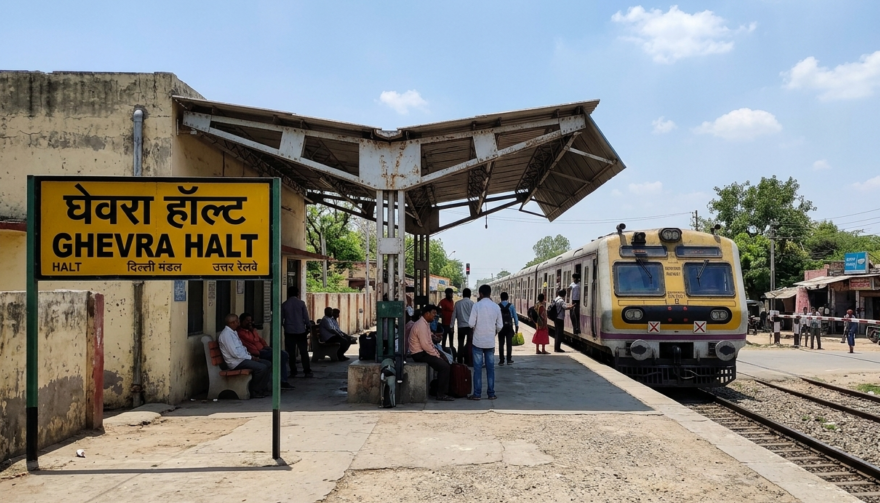
Ghevra Halt Railway Station Delhi :- History, Rural Connectivity & Complete Travel Guide
Detailed History :-
Ghevra Halt Railway Station is a quiet yet highly essential suburban transit stop situated on the far north-western periphery of the National Capital Territory of Delhi. Positioned directly on the historic Delhi-Rohtak-Bathinda rail corridor, it forms a crucial part of the expansive broad-gauge network managed by the Northern Railway zone. Geographically, the station sits in close proximity to the interstate border separating outer Delhi from the Jhajjar and Bahadurgarh districts of Haryana, making it a vital geographic link between the capital’s rural edges and emerging industrial zones.
Historically, Ghevra was defined by its vast agricultural fields and traditional rural lifestyle. However, over the past few decades, the rapid outward expansion of Delhi and the industrial industrialization of nearby Bahadurgarh have amplified the strategic importance of this small halt station. The station was originally established to provide a direct and affordable rail connection for the residents of Ghevra village, Rasulpur, Ranikhera, and adjoining settlements. Today, it serves as a critical economic lifeline for thousands of daily commuters, local farmers, milk vendors, industrial laborers, and students traveling toward core areas like Nangloi, Shakurbasti, New Delhi, Old Delhi, and Rohtak.
Detailed Architecture :-
The architectural layout of Ghevra Halt Railway Station represents a classic, minimalist Indian rural railway halt, focusing purely on basic utility and commuter transit rather than elaborate modern infrastructure.
- Exterior Architecture :– The primary station structure consists of a simple, single-story concrete block that houses the manual unreserved ticket counter and a small office for railway staff. The exterior surroundings offer a highly rustic, tranquil ambiance with open dirt roads and designated boarding points for local battery-operated e-rickshaws.
- Interior Architecture :– The station maps 2 low-set platforms equipped with standard concrete seating benches and modest tin-roof weather sheds to shield waiting passengers from harsh elements. The platforms are interconnected via a reinforced steel Foot Over Bridge (FOB) to ensure passenger safety and eliminate track trespassing. The basic amenities are limited to standard drinking water booths and essential platform lighting.
Interesting Facts :-
- Ghevra Halt Railway Station is structurally the final rural rail outpost of Delhi on this route, immediately past which the tracks enter the state boundary of Bahadurgarh, Haryana.
- The station serves as the backbone of the local micro-economy; every morning, a large number of local milk vendors and small-scale farmers board the trains here with fresh dairy products and produce bound for Delhi’s wholesale markets.
- It is located directly adjacent to the massive Ranikhera-Ghevra logistics hub, which houses sprawling commercial warehouses and fulfillment centers for major national e-commerce corporations.
- The peaceful, semi-rural setting of Ghevra offers a complete stark contrast to the high-speed, chaotic energy of central Delhi’s major terminal junctions.
Nearby Attractions :-
- Ranikhera-Ghevra Industrial & Logistics Hub :– A vast nearby commercial belt that has quickly transformed into a premier storage and logistics center for North India.
- Bahadurgarh Town :– Located just a few kilometers down the line, this prominent Haryanvi town is globally recognized for its massive footwear manufacturing clusters.
- Surrounding Agricultural Landscapes :– The lush green fields immediately bordering the tracks present a beautiful glimpse of Delhi’s surviving agrarian heritage.
Travel Guide & Routes :-
- Tickets and Booking :– The main ticketing hall houses a single physical window for unreserved local passenger tickets. Commuters are highly encouraged to utilize the Indian Railways’ UTS mobile application for instant, digital paperless ticketing to avoid physical queues.
- Timings :– While the rail line remains active 24/7 for heavy industrial freight, the scheduled halts for suburban commuter EMU and passenger trains run primarily between 05:30 AM and 10:30 PM.
- How to Reach :–
- By Metro :– The most efficient structural transit link is the ‘Ghevra Metro Station’ on the Green Line, located on Rohtak Road. The railway station sits roughly 1.5 to 2 km away from the metro exit, a distance easily covered via a brief e-rickshaw ride.
- By Road/Bus :– The station zone is connected via inner link roads to the main National Highway 10 (Rohtak Road). Delhi Transport Corporation (DTC) and Haryana Roadways buses provide high-frequency drops at the Ghevra turnoff.
- Local Transport :– Eco-friendly electric e-rickshaws, shared three-wheelers, and localized ‘Gramin Seva’ transit vans maintain a permanent presence outside the gates for quick last-mile dispersal.
- Photography Spots :– The vintage tin sheds, rustic platforms, and long straight tracks stretching out toward the horizon offer an exceptional rustic canvas for rail enthusiasts and vintage-themed street photography.
- Local Taste :– The small local tea stalls and modest eateries operating outside the station perimeter serve traditional North Indian snacks, including freshly fried Samosas, hot Kachoris, and strong ginger-infused masala cutting chai at incredibly budget-friendly prices.
- Famous Markets :– For major commercial needs, the nearby Nangloi Main Market and the Bahadurgarh Local Retail Market are highly favored by residents for affordable apparel, electronics, and daily provisions.
Important Questions and Answer :-
Question 1:- What is the official station code assigned to Ghevra Halt Railway Station?
Answer:- The official Indian Railways station code for Ghevra Halt Railway Station is GHE.
Question 2:– Do high-speed express or superfast trains halt at Ghevra Station?
Answer:- No, Ghevra (GHE) is classified strictly as a suburban passenger halt. Only local EMU, MEMU, and short-distance general passenger trains traveling along the Delhi-Rohtak-Jakhal line make scheduled stops here.
Question 3:– Under which railway zone and division does Ghevra Station operate?
Answer:- It is managed and operated under the Delhi Railway Division of the Northern Railway (NR) zone.
Question 4:- How far is the Ghevra Railway Station from the nearest Delhi Metro station?
Answer:- The Ghevra Metro Station (Green Line) is approximately 1.5 to 2 kilometers away, and local e-rickshaws easily bridge the distance in about 5 to 7 minutes.
“Marking the rustic borders of the capital where simplicity meets the rails – Ghevra Halt Railway Station.“