
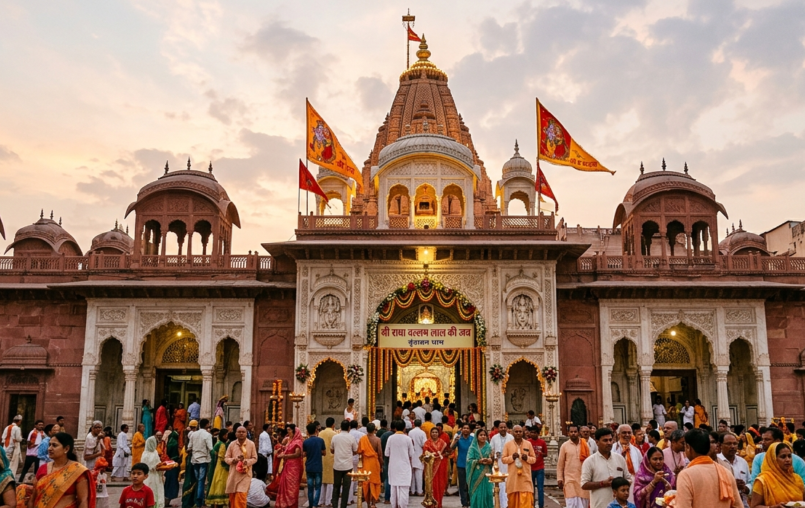
Shri Radha Vallabh Temple Vrindavan :- History, Architecture, and Complete Travel Guide
Here is the detailed English translation of the blog based on the devotional, historical, and cultural journey to Shri Radha Vallabh Temple, Vrindavan (Mathura)
Detailed History
Shri Radha Vallabh Temple is one of the most ancient, sacred, and prominent seven shrines of Vrindavan. The temple was established in the year 1535 AD (Vikram Samvat 1592) by Saint Sri Hit Harivansh Mahaprabhu, the founder of the ‘Radha Vallabh Sampradaya’.
According to sacred tradition, Saint Sri Hit Harivansh Mahaprabhu received this unique idol of Sri Radha Vallabh Ji as a divine grace following his intense penance to Lord Shiva. He brought the deity from Deoband (Saharanpur, Uttar Pradesh) to Vrindavan. The spiritual defining feature of this shrine is that Sri Radha Rani is revered as the supreme deity here. The name ‘Radha Vallabh’ translates to ‘Lord Krishna, the beloved of Sri Radha’. This tradition places immense emphasis on ‘Ras Bhakti’ (pure, loving devotion), where the deity is worshipped with deep affection.
Detailed Architecture
- Exterior Architecture :– The historical ancient building of the temple was constructed during the 16th century (during the reign of Mughal Emperor Akbar) using high-quality red sandstone. It showcases a magnificent fusion of Hindu and medieval Rajasthani architectural styles. The outer walls are remarkably thick and sturdy, featuring carved arches and ornate pillars.
- Interior Architecture :– The sanctum sanctorum (Garbhagriha) is divine and mesmerizing. At the center stands the captivating idol of Lord Krishna (Sri Radha Vallabh Ji) in the Tribhanga posture, featuring an enchanting smile on His face.
- Presence of Sri Radha Rani :– The most distinct feature of this temple is that there is no separate idol of Sri Radha Rani placed next to Lord Krishna. Instead, a sacred throne and seat are placed immediately to the left of Sri Radha Vallabh Ji, upon which a beautiful golden crown is worshipped. This crown symbolizes the eternal and direct presence of Sri Radha Rani.
Travel Guide & Routes
- Entry Fee :– Free (No entry tickets or VIP passes required for general darshan).
- Timings :–
- Morning:- 05:00 AM to 12:00 PM (Summers) / 06:00 AM to 01:00 PM (Winters)
- Evening:- 06:00 PM to 09:00 PM (Summers) / 05:00 PM to 08:30 PM (Winters)
- Mangala Aarti:- Around 05:00 AM (Subject to slight seasonal variations)
- How to Reach :–
- By Train :– The nearest major railway station is Mathura Junction (approx. 14 km). E-rickshaws, auto-rickshaws, and taxis are easily available to Vrindavan.
- By Road :– Vrindavan is well-connected via NH-19 and the Yamuna Expressway from Delhi and Agra. The temple is about 2 km from the Vrindavan Bus Stand, accessible via local e-rickshaws through narrow lanes.
- By Air :– The nearest international airport is Indira Gandhi International Airport, New Delhi (approx. 150 km), and the nearest domestic airport is Agra (approx. 72 km).
- Photography Spots :– Photography and videography inside the temple complex and in front of the sanctum sanctorum are strictly prohibited. You can capture photographs in the ancient historic lanes outside the temple.
- Local Flavors & Famous Markets :– Enjoy Vrindavan’s famous Rabri, Lassi, Makkhan-Mishri, Peda, and hot Hing-Kachori in the temple lanes. At nearby shops, you can purchase Radha-name scarves, Tulsi rosary beads, brass items, and deity attire.
Interesting Facts
- Symbolic Representation of Sri Radha :– This shrine is renowned throughout the Braj region for worshipping Radha Rani through Her sacred golden crown and throne rather than a physical deity.
- Ras Bhakti & Samaj Gayan :– The temple serves as the central seat of the Radha Vallabh Sampradaya, where classical music-based devotional singing (‘Samaj Gayan’) takes place daily.
- Historic Preservation :– During the invasions of Aurangzeb, the sacred deity was temporarily moved to Kaman in Rajasthan for protection and later brought back to Vrindavan once peace was restored.
Important Questions and Answer :-
Question 1:- Is there any entry fee for Darshan at Radha Vallabh Temple?
Answer:- No, entry and darshan at Sri Radha Vallabh Temple are completely free of charge.
Question 2:- Why is there no idol of Sri Radha Rani in the temple?
Answer:- As per the philosophy of this sampradaya, Radha Rani and Lord Krishna share one soul in two forms; hence, Her presence is worshipped through a sacred throne and golden crown beside Krishna.
Question 3:- Can visitors take cameras inside the temple premises?
Answer:- Mobile phones can be carried, but taking photos or recording videos inside the main courtyard and sanctum is strictly prohibited.
Nearby Attractions
- Sri Bankey Bihari Temple :– Vrindavan’s most famous shrine, located within short walking distance (approx. 500 meters) from Radha Vallabh Temple.
- Seva Kunj :– Located very close to the temple, this sacred grove is known as the site where Lord Krishna served the lotus feet of Radha Rani.
- Radha Raman Temple :– A 500-year-old historic shrine situated a short walk away.
- Shahji Temple :– Famous for its marble craftsmanship and Belgian glass chandeliers, located in the same area.
Author’s Thoughts
The atmosphere of Sri Radha Vallabh Temple immerses every visitor in an unadulterated essence of divine love and devotion. Listening to the traditional Samaj Gayan sung by saints in the courtyard brings profound inner tranquility. Beholding the enchanting form of Lord Krishna alongside Sri Radha’s sacred crown leaves one deeply moved. When planning a pilgrimage to Vrindavan, visiting this historical and spiritual sanctuary is an unmissable experience.
“Where the unexcelled unity of Radha-Krishna’s divine love comes alive, that sacred abode is Sri Radha Vallabh Temple Vrindavan.”