
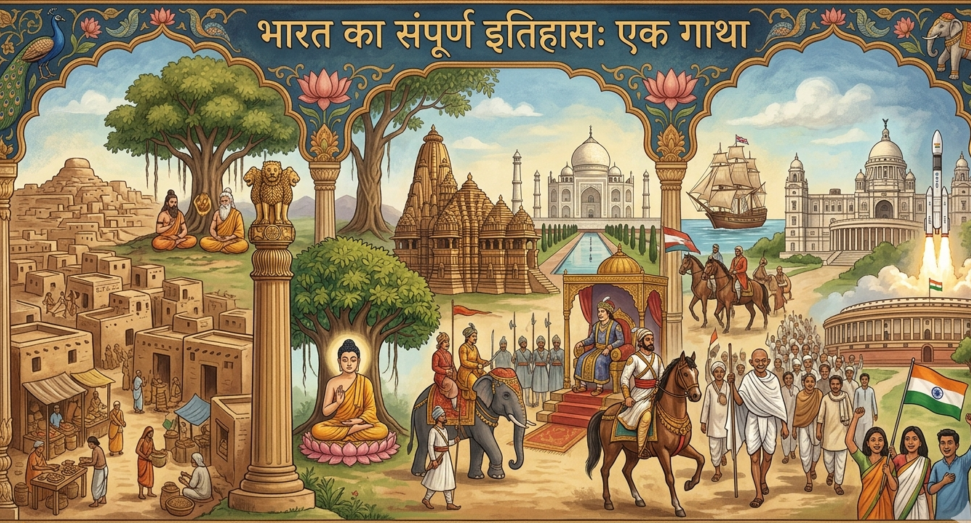
The Comprehensive History of India :- A Saga from Antiquity to Modernity
Detailed History :-
The history of India is not merely a record of territorial changes; it is the living narrative of a civilization that has flowed continuously for millennia.
1. Prehistoric and Indus Valley Civilization (3300 BCE – 1900 BCE) :–
The foundation of Indian history lies in the Indus Valley Civilization, one of the four oldest urban civilizations in the world. Harappa and Mohenjo-daro were its major hubs. The town planning, burnt-brick houses, and drainage systems were far ahead of their time. It was a mercantile society with trade links extending to Mesopotamia.
2. Vedic Period and the Rise of Mahajanapadas (1500 BCE – 600 BCE) :–
Following the decline of the Indus Valley, the Vedic Period saw the development of Aryan culture and the Sanskrit language. The four Vedas – Rigveda, Samaveda, Yajurveda, and Atharvaveda – were composed during this era. Small tribes eventually evolved into 16 Mahajanapadas (great kingdoms), with Magadha emerging as the most powerful.
3. Ancient Empires and the Golden Age (600 BCE – 500 CE) :–
Under the leadership of Chandragupta Maurya and the strategic genius of Chanakya, the Mauryan Empire achieved the first unification of India. Emperor Ashoka spread the message of ‘Dhamma’ and peace worldwide after the Kalinga War. Later, the Gupta Dynasty ushered in the ‘Golden Age‘ of India, marked by revolutionary advancements in mathematics (Aryabhata) and literature (Kalidasa).
4. Medieval India and Foreign Incursions (600 CE – 1707 CE) :–
This era witnessed the rise of powerful Southern dynasties like the Cholas and Pallavas. From the 12th century, Turkic and Arab invasions led to the Delhi Sultanate. In 1526, the Mughals established their rule. Figures like Akbar and the architectural brilliance of Shah Jahan gave India the Taj Mahal. Simultaneously, the Vijayanagara Empire and Chhatrapati Shivaji Maharaj’s Maratha power defended Indian culture.
5. British Raj and the Freedom Struggle (1757 CE – 1947 CE) :–
The British East India Company began political control after the Battle of Plassey. The Revolt of 1857 shook British foundations. Eventually, through the non-violent movements of Mahatma Gandhi and the sacrifices of revolutionaries like Bhagat Singh and Subhash Chandra Bose, India gained independence on August 15, 1947.
Architecture, Facts, and Travel :-
- Architecture :– Indian architecture is a symphony of diverse styles. From the intricate carvings of Khajuraho to the Indo-Islamic grandeur of the Red Fort, every stone tells a story.
- Travel Guide :– The Golden Triangle (Delhi-Agra-Jaipur) and the Buddhist Circuit are world-famous. India’s vast railway and air networks make every historical site accessible.
- Interesting Facts :– India gave the world the concept of Zero, the first university (Takshashila), and the art of Yoga. It has never invaded another country in its 10,000-year history.
“Indian history is the ultimate confluence of ancient wisdom and modern aspirations.”