
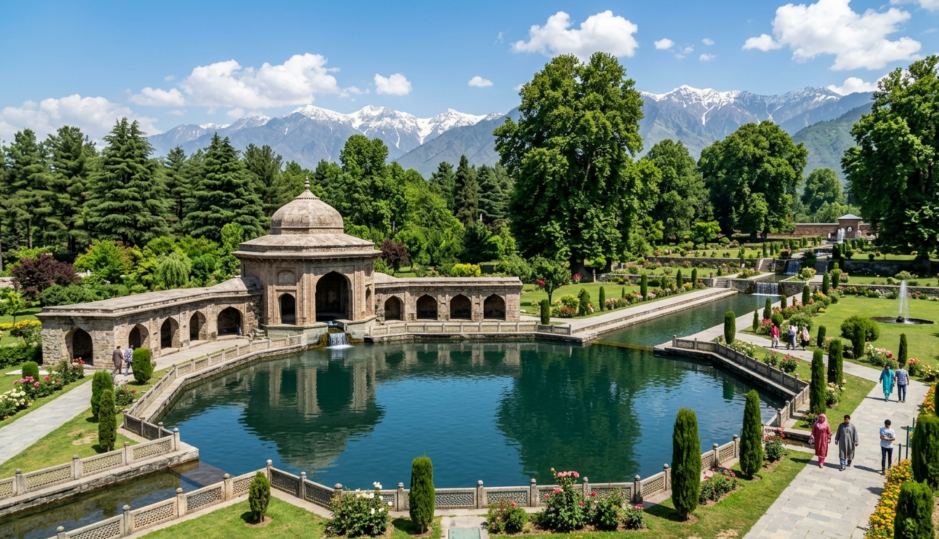
Verinag Lake :- The Sapphire Heart and Source of Jhelum
Detailed History
Verinag Lake, situated in the Anantnag district at the base of the Pir Panjal range, is a landmark of immense historical and geographical significance. It is officially recognized as the main source of the Jhelum River. Originally a natural spring, its potential beauty was recognized by the Mughal Emperor Jahangir, who in 1612 AD, transformed it into an octagonal stone basin. Later, Emperor Shah Jahan added the sprawling gardens and canals, making it a masterpiece of Mughal landscaping.
Detailed Architecture/Structure
Exterior Structure :–
- Octagonal Basin :– The lake is enclosed in a perfect octagonal shape made of finely carved stones, a hallmark of Mughal geometry.
- Mughal Gardens :– The surrounding garden is designed in the ‘Charbagh’ style, featuring symmetrical lawns, Chinar trees, and flowing water channels.
- Arcaded Cloisters :– There are 24 arched chambers surrounding the pool, designed for royalty to sit and enjoy the cool breeze.
Internal Ecosystem :–
- Hues and Depth :– The water is famous for its deep sapphire blue color. It reaches a depth of about 15 meters at the center where the spring gushes out.
- The Flow :– The water emerges from the bottom of the basin and flows through a 300-yard canal into the open fields, eventually forming the Jhelum.
- Aquatic Life :– The basin is home to a large number of sacred Carp fish, which are protected and fed by visitors, maintaining a pristine internal balance.
Nearby Attractions
- Jawahar Tunnel :– The gateway connecting the Kashmir Valley to the rest of India.
- Kokernag Spring :– A massive spring complex nearby known for its medicinal waters.
- Achabal :– A royal Mughal garden featuring sophisticated water engineering.
- Sinthan Top :– A high-altitude pass offering panoramic views of the Himalayas.
- Apple Orchards :– The scenic routes leading to Verinag are lined with vast apple plantations.
Travel Guide & Routes
- Tickets :– A nominal entry fee of ₹20-50 for adults is charged at the garden entrance.
- Timing :– 9:00 AM to 7:00 PM daily. Best visited during the spring and summer (April-June).
- How to Reach :– Located 78 km from Srinagar. It is easily accessible by car via the Srinagar-Jammu National Highway.
- Photography Spots :– The perspective from the main entrance showing the octagonal pool and the arched cloisters is iconic.
- Local Taste :– Try the local ‘Kashmiri Wazwan‘ available at restaurants near the highway.
- Famous Markets :– Local shops outside the garden sell authentic honey, dried fruits, and hand-embroidered items.
Interesting Facts
- Emperor Jahangir loved Verinag so much that he expressed a dying wish to be buried here, though he was eventually buried in Lahore.
- The water temperature remains consistently cool, even during the peak of summer.
- Persian inscriptions on the stone walls of the basin still narrate the history of its construction.
Important Questions and Answer :-
- Question:- What is the significance of Verinag Lake?
- Answer:- It is the primary source of the Jhelum River, the most important river in the Kashmir Valley.
- Question:- Who designed the current structure of Verinag?
- Answer:- Mughal Emperor Jahangir built the octagonal basin, and Shah Jahan later developed the gardens.
- Question:- Can we see the water gushing out?
- Answer:- Yes, the center of the pool continuously bubbles as water rises from the deep underground springs.
- Question:- Is it open during winters?
- Answer:- Yes, it is open year-round, though the garden is at its most beautiful in the spring.
- Question:- How far is it from Anantnag city?
- Answer:- It is approximately 26 km away from the main Anantnag town.
Author’s Thoughts
Verinag is where nature and history breathe together. Standing by the deep blue pool, one can almost feel the presence of the royals who once walked these corridors. It is a place of profound peace, where the only sound is the gentle gurgle of the water that goes on to sustain an entire valley. It is a must-visit for anyone who appreciates fine architecture and natural wonders.
“Where history flows into the future—Verinag, the soul of Jhelum.”