
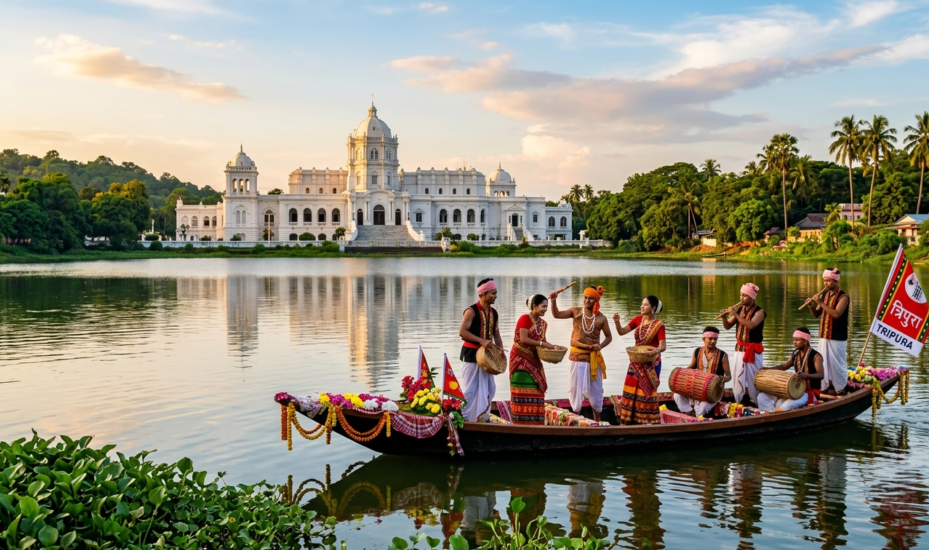
Tripura :- The Realm of Dynastic Splendour, Sacred Monoliths, and Deccani-Eastern Heritage
Detailed History
Tucked away in the lush, sub-tropical valleys of the northeastern frontier of India, ‘Tripura’ unfolds as an ancient kingdom characterized by intense cultural preservation, royal visionary patronage, and distinct geographic isolation. Surrounded on three sides by the international border of Bangladesh, this elevated landscape boasts a historical lineage chronicled extensively in the epic Mahabharata and the ancient Puranas. Tripura was governed continuously for over five centuries by the independent Manikya Dynasty, ranking it among the longest uninterrupted sovereign ruling lineages in global monarchical history.
The Manikya rulers successfully defended their sovereign mountain territorial boundaries against repeated expansionist incursions by the Mughal Empire and later retained internal administrative autonomy during the British Raj. This deep intellectual and cultural refinement attracted the Nobel Laureate Rabindranath Tagore, whose profound lifelong friendship with the Tripura royal court heavily inspired several of his seminal literary masterpieces, including the plays Rajarshi and Visarjan. Following the dissolution of the British empire, the state formally integrated into the Indian Union via the signing of the ‘Tripura Merger Agreement‘ on October 15, 1949, subsequently achieving full, autonomous statehood on January 21, 1972.
Detailed Architecture :-
The architectural landscape of Tripura exhibits an extraordinary structural synthesis of traditional Bengali Hindu temple forms, indigenous tribal building expressions, and distinct imperial Indo-Saracenic (Mughal-British) design components. Its historical masterworks are highlighted by intricate water-locked engineering and grand cliff-side relief carvings:
1. The Ujjayanta Palace :–
Situated in the heart of the capital city of Agartala, this grand palace marks the apex of Tripura’s residential royal architecture. Commissioned in 1901 by Maharaja Radha Kishore Manikya, the two-storeyed white palace is a stellar execution of the Indo-Saracenic style. Its structural framework is highlighted by three monumental ribbed domes, with the central focal dome rising significantly higher to dominate the horizon. The front facade features formal British-style Mughal gardens, synchronized water fountains, and sprawling geometric tiled courtyards, while the interiors display highly intricate, hand-carved wooden ceilings and monumental imperial durbars.
2. Neermahal (The Water Palace) :–
Erected precisely in the center of the expansive waters of the Rudrasagar Lake in Melaghar, this monument stands as the second-largest water palace in the Indian subcontinent. Built during the 1930s under the personal direction of Maharaja Bir Bikram Kishore Manikya, its design masterfully cross-pollinates Mughal structural geometry with traditional Hindu residential forms. The palace is split into two primary zones: the western Andar Mahal (royal inner apartments) and the eastern zone featuring an open-air amphitheater for cultural gatherings. Floating elegantly above the shifting lake waters, its fluted minarets, targeted bridge causeways, and heavy structural arches mimic a mystical oasis.
3. The Bas-Relief Sculptures of Unakoti :–
Deep within dense, unmanaged forests lies an unparalleled ancient open-air art gallery and structural sanctuary. Sculpted directly into the vertical faces of the primary sandstone hillsides are ninety-nine lakh ninety-nine thousand nine hundred and ninety-nine (99,99,999) colossal rock-cut reliefs representing Lord Shiva and various pantheons of Hindu divinities. The central, imposing face of ‘Unakotishwera Kal Bhairav’ towers roughly 30 feet high, featuring an elaborate, deeply chiseled stone headdress that displays the sheer brilliance of early medieval stone masonry.
Travel Guide & Routes
Mandatory Permits & Entry Regulations :–
- Domestic Indian travelers do not require any form of Inner Line Permit (ILP) or specialized administrative clearance to visit the urban or rural heritage zones of Tripura. International tourists must maintain valid passports and visas, with certain remote international border installations subject to routine military checkpoint verifications.
Tickets and Entry Fees :–
- Ujjayanta Palace (State Museum) :– Standard entry tickets are priced at approximately ₹20 – ₹30 for domestic Indian citizens and ₹150 – ₹200 for international visitors.
- Neermahal :– The base entry ticket to the lakeside monument is ₹20; however, access requires boarding a government-regulated motorboat or a traditional manual country boat across Rudrasagar Lake, costing approximately ₹50 – ₹100 per passenger.
- Tripura Sundari Temple & Unakoti :– Admission into these major active spiritual sanctuaries and heritage sites is completely Free of cost.
Timings (Visiting, Opening & Closing Times) :–
- Best Time to Visit :– The optimal travel window falls within the cool, crisp winter months from October to March. This period showcases the state’s most magnificent cultural event, Durga Puja (Oct), which transforms the entire region into an open-air art exhibition. The ancient, highly esoteric tribal festival of ‘Kharchi Puja’ is celebrated with immense fervor in July.
- Operating Hours :–
- Ujjayanta Palace :– Open to the public from 10:00 AM to 05:00 PM (Strictly closed for maintenance on Mondays).
- Neermahal :– Open daily for boat transfers and exploration from 09:00 AM to 05:00 PM.
- Tripura Sundari Temple (Udaipur) :– Accessible daily from 05:00 AM to 01:00 PM, closing briefly, and reopening from 03:00 PM to 09:00 PM.
How to Reach (Routes) :–
- By Air :– The state is served by the Maharaja Bir Bikram Airport (IXA) in Agartala, which stands as the second-busiest aviation hub in Northeast India. It operates frequent daily direct flights to Kolkata, Guwahati, Delhi, and Imphal.
- By Rail :– The Agartala Railway Station (AGTL) is fully integrated into the Indian Railways broad-gauge network. Premium long-distance express trains, such as the ‘Agartala Humsafar Express’ and ‘Tripura Sundari Express’, connect the capital directly to major hubs like New Delhi (Anand Vihar), Kolkata (Sealdah), and Guwahati.
- By Road :– National Highway 8 (NH-8) serves as the primary multi-lane terrestrial economic artery linking Tripura through the hills of Assam to the rest of the country. Regular long-distance state and private luxury buses operate from Guwahati and Silchar to the Agartala ISBT. Within city limits, eco-friendly E-Rickshaws, metered autos, and private local rental jeeps handle internal transit smoothly.
Photography Spots, Local Cuisine, and Famous Markets
Photography Spots :–
- The Sunset Reflection of Neermahal :– Positioning your camera on the eastern banks of Rudrasagar Lake during the golden hour yields spectacular long-exposure shots of the crimson sky reflecting off the lake water, framing the symmetrical white arches of the palace.
- The Illuminated Facade of Ujjayanta Palace :– Captured from the edge of the formal reflection pools at night, when the grand neoclassical domes are dynamically backlit by a state-of-the-art multi-colored lighting network.
- The Monolithic Chisel Lines of Unakoti :– Offers highly dramatic macro and wide-angle framing opportunities, capturing the deep moss-covered lines of the massive stone deities emerging straight out of the primeval green canopy.
Local Cuisine :–
- The gastronomy of Tripura presents an incredibly clean, health-conscious combination of non-greasy indigenous tribal techniques and rich culinary preparations from Bengal. The centerpiece of traditional tribal food is ‘Mui Borok’, which centers around ‘Berma’—an authentic, oil-free ingredient made of sun-dried, fermented state river fish cooked with fresh green chilies, local herbs, and organic vegetables. For plant-based food enthusiasts, the locally harvested ‘Bamboo Shoot Curry’ (tender bamboo stalks slow-cooked with wild ginger) and ‘Chuwak’ (a freshly brewed, artisanal ceremonial rice beverage) offer highly exotic flavor profiles.
Famous Markets :–
- Maharajganj Bazaar (Agartala) :– The primary commercial and historical wholesale marketplace of the state. It is universally celebrated for authentic Bamboo & Cane Handicrafts, ranging from structurally intricate hand-woven storage baskets to finely chiseled decorative lamps and lightweight furniture. Additionally, visitors can buy ‘Risa’ and ‘Rinai’—stunning, hand-loomed traditional tribal fabrics featuring protected geometric tribal weaves that now hold an official GI Tag (Geographical Indication).
Nearby Attractions
- Tripura Sundari Temple (Udaipur) :– Popularly known as Matabari, this highly revered shrine is recognized as one of the 51 holy Shakti Peethas of India, uniquely constructed atop a hillock explicitly shaped like the shell of a turtle (Kurma Peetha).
- Sepahijala Wildlife Sanctuary :– A rich bio-reserve located just outside the capital, internationally famous for conserving the rare, endemic Spectacled Langur (Chashmadhari Bandar) and hosting a massive natural lake system.
- Chhabimura :– An extraordinary archaeological site featuring massive rock-cut relief carvings of Goddess Durga and other deities chiseled directly into the sheer rock walls flanking the roaring Gomati River, often described as the ‘Amazon of the East’ due to its dense boat-accessible river ravines.
- Jampui Hills :– The highest elevated mountain ridge and premier hill station of Tripura, famous for its misty sub-alpine climate, expansive orange orchards, and panoramic views of the Mizoram border valleys.
- Kamalasagar Kali Temple :– A historic 15th-century hilltop temple base situated directly on the international border fencing, providing a safe, panoramic view across the fields of neighboring Bangladesh.
Interesting Facts
- The literal etymological definition of ‘Unakoti’ translates precisely to ‘One Less than a Crore’ (99,99,999) in the local vernacular. According to regional mythology, Lord Shiva was traveling to Kashi with one crore divinities; when the others failed to wake before dawn as commanded, a furious Shiva cursed them to remain frozen as stone monoliths on this hillside forever.
- The indigenous ‘Risa’ textile—a hand-woven cloth utilized as a ceremonial headgear and chest drape—is woven entirely without mechanical assistance on traditional loin looms, carrying custom geometric motifs that identify the specific clan lineage of the weaver.
- Neermahal stands proud as the absolute largest and only medieval water palace across the entire eastern territory of India, featuring specialized internal water tunnels designed to allow the Maharaja’s royal speedboats to dock directly inside the residential apartments.
Important Questions and Answer :-
Question 1:- What specialized structural engineering allowed the foundations of Neermahal to remain completely stable within a dynamic lake bed for nearly a century?
Answer:– The engineering executed by the firm ‘Martin & Burn’ for Neermahal required a comprehensive understanding of deep hydraulic pressures. To establish a rigid foundation on the soft, silty bed of Rudrasagar Lake, engineers sunk massive reinforced brick-and-concrete wells deep into the underlying solid strata (Deep Well Foundation). The superstructure was assembled using high-density, kiln-fired red bricks bound together by a proprietary hydraulic lime-and-surkhi mortar mix. This organic mortar undergoes a slow chemical curing process when exposed to water, preventing moisture from seeping into the core walls and allowing the palace to successfully resist persistent hydrostatic pressure and wave action.
Question 2:- What are the primary stylistic differences between the rock-cut reliefs of Unakoti and standard classical Indian temple sculptures?
Answer:– Unlike classical Indian temple art (such as that found in Khajuraho or Ellora), which relies on highly standardized, three-dimensional anthropomorphic proportions dictated by ancient shastras, the reliefs of Unakoti display a captivating, rustic tribal-stylistic execution. The carvings are essentially two-dimensional bas-reliefs chiseled directly into the face of a live mountain. The facial profiles feature flat, sweeping geometric lines, elongated slit eyes, and stylized horizontal lip patterns that draw heavily from indigenous tribal art forms of Northeast India. This makes Unakoti a critical transitional bridge between formal classical iconography and raw folk-tribal artistry.
Question 3:- How does the architectural configuration of the Tripura Sundari Temple reflect a unique synthesis of regional structural formats?
Answer:– The Tripura Sundari Temple in Udaipur is a brilliant manifestation of regional architectural synthesis. The base of the temple features a heavy, thick-walled square sanctuary that mirrors orthodox North Indian temple planning. However, the roof structure rejects the typical soaring stone spire (Shikhara) in favor of the traditional Bengali ‘Char-Chaala’ (four-sloped curved roof) format, mimicking the organic profile of rural thatched huts. This curved roof is crowned by a structural, multi-tiered circular dome that tapers into a sacred finial (Kalasa), visually bridging the gap between Islamic dome structural engineering, Buddhist stupa profiles, and indigenous structural traditions.
“Cradled within the white symmetry of Neermahal floating over Rudrasagar, the silent stone faces of Unakoti emerging from primordial forests, and the vibrant geometric threads of the Risa cloth, Tripura remains an imperial, untouched chapter of India’s grand architectural mosaic.”