
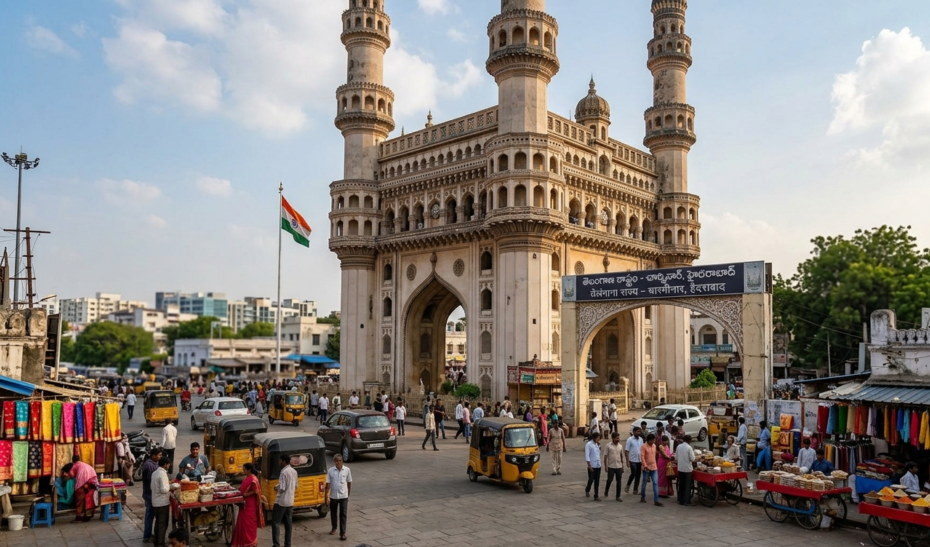
Telangana :- The Architecture of Kakatiyas, Nizam’s Opulence, and Deccani Heritage
Detailed History
Situated in the south-central plateau region of the Indian peninsula, Telangana stands as a historically profound territory showcasing a rich political and cultural evolution. Its historical roots span over two millennia, traceably ascending to prominence under the ancient Satavahana Dynasty following the decline of the Mauryan Empire. Following several interim regimes, the region entered its definitive classical golden age during the 12th to 14th centuries under the aegis of the Kakatiya Dynasty. The Kakatiyas transformed the linguistic and geographic landscape of Telangana, pioneering sophisticated irrigation networks and grand dry-stone structural engineering. Notably, this era was distinguished by the reign of Rani Rudrama Devi, one of the very few sovereign female monarchs in the history of the Indian subcontinent.
Following the fall of Warangal to the Delhi Sultanate, the region transitioned through the Bahmani Sultanate before emerging as the core of the sovereign Qutb Shahi Dynasty in the 16th century, who fortified the massive citadel of Golconda and founded the planned city of Hyderabad. By the mid-18th century, the Asaf Jahi Dynasty (the Nizams) institutionalized a wealthy and strategic princely state that governed until Indian independence. In September 1948, through the tactical military intervention named ‘Operation Pollo’, the Hyderabad state was formally integrated into the Indian Union. Following sustained socio-political statehood movements spanning several decades, Telangana officially split from Andhra Pradesh on June 2, 2014, becoming a separate progressive state of modern India.
Detailed Architecture :-
The structural heritage of Telangana is a living museum displaying a masterful synthesis of indigenous Hindu-Kakatiya craftsmanship and highly sophisticated Indo-Islamic (Deccani) architectural forms. The engineering solutions utilized across these structures remain highly celebrated:
1. Kakatiya Lithic Engineering & Seismic Sandbox Technology :–
- The Ramappa Temple (UNESCO World Heritage Site) :– Located in Palampet, this monument represents the absolute zenith of Kakatiya temple art. The primary engineering marvel lies in its super-structure, which was constructed using specialized ‘Floating Bricks’ mixed with porous materials, making them buoyant enough to float on water and drastically reducing the dead load on the sanctuary walls. Furthermore, the foundations utilize an advanced ‘Sandbox Technique’ where layers of processed sand were packed below the structure to cushion and absorb destructive seismic vibrations. The dark, highly polished basalt pillars feature incredibly delicate, deep relief carvings of celestial dancers (Madanikas).
- The Thousand Pillar Temple :– Situated in Hanamkonda, this complex is an exceptional structural model of the Trikutalayam (triple-shrine) framework. It features perfectly inter-locked, meticulously carved pillars and a colossal, monolithic basalt Nandi bull facing the sanctuary.
- The Warangal Fort :– Famous for its majestic freestanding structural stone arches, known as the ‘Kakatiya Kala Thoranam’, which now serve as the definitive official state emblem of Telangana.
2. Deccani Sultanate and the Palatial Splendour of the Nizams :–
- The Charminar :– Commissioned in 1591 by Muhammad Quli Qutb Shah to mark the cessation of a plague, this iconic monument is constructed of solid granite, limestone, and pulverized marble. The structure features a perfectly symmetrical square floor plan punctuated at each corner by four fluted, decorative minarets soaring 56 meters high, housing a historic mosque and elegant open structural arches.
- The Golconda Fort :– A formidable multi-tiered granite military citadel built directly into an expansive hill. The structural marvel of the fort lies in its advanced Acoustic Dynamics. A precise clap executed under the grand dome of the main entry gate (Fateh Darwaza) generates acoustic waves that travel along calculated geometric vaults to reverberate sharply at the highest pavilion (Bala Hisar) nearly a kilometer away, acting as a foolproof ancient military early-warning system.
- Chowmahalla and Taj Falaknuma Palace :– Exhibiting absolute royal opulence, these complexes fuse Neo-Classical Italian architectural forms with traditional Persian stucco work, featuring massive Belgian crystal chandeliers, sprawling courtyards, and flawless white marble platforms.
Travel Guide & Routes
Mandatory Permits & Entry Regulations :–
- No Inner Line Permits (ILP) or specific defensive restricted zone clearances are required for domestic Indian citizens or international passport holders to explore the historical monuments and districts of Telangana.
Tickets and Entry Fees :–
- Golconda Fort & Charminar :– Regulated entry fees apply, charging approximately ₹20 – ₹25 for domestic Indian citizens and ₹250 – ₹300 for international tourists.
- Chowmahalla Palace :– Admission is priced at approx. ₹100 for Indian residents and ₹400 for international visitors.
- Ramappa and Thousand Pillar Temples :– General admission into these active religious and heritage reserves is entirely Free of charge.
Timings (Visiting, Opening & Closing Times) :–
- Best Time to Visit :– The cooler winter months from October to March present highly pleasant weather conditions for heritage walks and excursions. This period coincides with the state’s vibrant indigenous floral harvest festival, ‘Bathukamma’ (Sept-Oct), and the high-energy ‘Bonalu’ monsoon festival (July-August). The peak summer season from April to June sees harsh sub-tropical temperatures exceeding 40°C.
- Operating Hours :–
- Charminar & Golconda Fort :– Open daily from 09:00 AM to 05:30 PM. Golconda Fort hosts a spectacular Sound and Light light show in the evening detailing the fortress’s history.
- Chowmahalla Palace :– Accessible from 10:00 AM to 05:00 PM (Strictly closed to public access on Fridays).
- Heritage Temples :– Generally open for visitors from 06:00 AM to 12:00 PM, closing mid-day, and reopening from 04:00 PM to 08:00 PM.
.
How to Reach (Routes) :–
- By Air :– The capital city houses the Rajiv Gandhi International Airport (HYD) at Shamshabad, universally recognized as a state-of-the-art aviation hub connecting straight to primary global and domestic economic centers via daily direct flights.
- By Rail :– The Hyderabad metropolitan area is served by three major multi-platform rail terminals—Secunderabad Junction (SC), Hyderabad Deccan (Nampally – HYB), and Kacheguda (KCG)—offering high-speed express connections to Delhi, Mumbai, and Chennai. Warangal (WL) stands as another vital junction on the major north-south trunk line.
- By Road :– National Highway 44 (NH-44), the longest highway in India, cuts directly through Telangana, ensuring premium multi-lane road access. The Telangana State Road Transport Corporation (TSRTC) manages an extensive fleet of luxury long-distance AC Volvo coaches. Within the capital city, the high-speed Hyderabad Metro Rail network, metered cabs, and eco-friendly auto-rickshaws provide rapid urban transit.
Photography Spots, Local Cuisine, and Famous Markets
Photography Spots :–
- The Arches of Charminar :– Best captured from the narrow, colorful side alleys of Laad Bazaar to frame the monumental minarets amidst the classic, vibrant street life of the Old City.
- Sunset from Bala Hisar (Golconda Fort) :– Offers dramatic wide-angle compositions of the ancient crumbling stone fortifications dropping off into the sprawling skyline of modern Hyderabad city below.
- The Monolithic Buddha Statue at Hussain Sagar :– Captured at dusk from a ferry boat as the massive 18-meter-high single-stone sculpture is dynamically illuminated against the water and city lights.
Local Cuisine :–
- Telangana’s cuisine is a highly celebrated gastronomic synthesis of rich, slow-cooked Mughal-Nizami royal recipes and the intensely spiced, rustic flavors of the Deccan plateau. The global centerpiece is the authentic ‘Hyderabadi Dum Biryani’, where premium basmati rice, tender meats, and selected aromatics are sealed in a clay pot and cooked slowly over charcoal. Other seasonal delicacies include ‘Haleem’ (a rich, slow-cooked paste of meat, wheat, and pure ghee served during Ramadan), ‘Talawa Gosht’, and ‘Sarva Pindi’—a savory, crispy rice-flour pancake embedded with lentils and spices unique to Telangana’s rural heritage. Dessert highlights include ‘Khubani ka Meetha’ (stewed apricots served with fresh cream) and ‘Double ka Meetha’ (a rich saffron-infused bread pudding).
Famous Markets :–
- Laad Bazaar :– Located immediately adjacent to the Charminar, this historic century-old market is world-renowned for its authentic handmade lacquer bangles (Laad Bangles) embedded with glittering stones, natural pearls, and traditional bridal textiles.
- Pochampally :– A designated handloom cluster globally acclaimed for ‘Pochampally Ikat’ textiles. These sarees utilize an intricate pre-dyeing and geometric weaving process that holds a protected Geographical Indication (GI Tag). For unique metal craft, look for ‘Bidriware’, an ancient art featuring fine pure silver wire inlay intricately hammered into a blackened zinc-copper alloy base.
Nearby Attractions
- Hyderabad & Secunderabad :– Encompassing the historic core of Charminar, Golconda Fort, the Qutb Shahi Tombs, Salar Jung Museum, Hussain Sagar Lake, and the monolithic white basalt Birla Temple.
- Ramoji Film City :– Recognized as the world’s largest integrated film studio complex, offering expansive cinematic sets, amusement parks, and structural tours.
- Warangal & Hanamkonda :– The ancient urban center of the Kakatiya Dynasty, housing the spectacular Thousand Pillar Temple, the ruins of Warangal Fort, and Bhrakali Temple.
- Ramappa Temple & Laknavaram Lake :– Combining the UNESCO protected stone temple with the serene expanse of Laknavaram Lake, famous for its hanging suspension bridges cutting through dense forests.
- Yadadri Lakshmi Narasimha Swamy Temple :– A monumental hilltop temple complex completely reconstructed in recent years utilizing traditional black granite stone masonry according to ancient architectural treatises.
- Bhongir Fort :– An extraordinary military outpost sculpted directly onto the surface of a single, massive egg-shaped monolithic rock rising 500 feet above the plains, highly popular for heritage trekking.
Interesting Facts
- The legendary Koh-i-Noor Diamond, along with other famous global diamonds like the Hope Diamond, was unearthed from the historic Kollur Mines within the Golconda Kingdom, which was once the absolute global epicenter of diamond mining and trade.
- The Ramappa Temple is the only medieval monument in India that derives its official name from its master sculptor, Ramappa, immortalizing the architect rather than the ruling monarch or the enshrined deity.
- ‘Bathukamma’, Telangana’s unique state festival, is a celebration of nature where women arrange seasonal wildflowers in perfectly engineered, vibrant concentric layers to form beautiful floral pyramids, symbolizing life and ecological harmony.
Important Questions and Answer :-
Question 1:- What specific scientific formulation allowed the ancient bricks of the Ramappa Temple to float on water?
Answer:– To reduce the total structural load acting on the massive stone columns, the Kakatiya master engineers developed an ingenious material formulation to create lightweight, low-density bricks for the temple’s roof tower. They blended fine clay with organic binders, sawdust, rice husk, and porous volcanic materials before baking them at controlled temperatures. This process created a network of trapped air pockets within the matrix, dropping the bulk density below 0.8 \text{ g/cm}^3 (less than the density of water), allowing these heavy-looking structural bricks to float and effectively preventing the temple from collapsing under its own weight.
Question 2:- How does the calculated geometric design of Golconda Fort facilitate its flawless acoustic early-warning network?
A: The acoustic signaling matrix of Golconda Fort is a masterpiece of Deccani structural planning. The main entrance dome (Fateh Darwaza) was constructed using highly specific compression arches and a sound-reflecting mortar mix. The walls were angled precisely to compress and guide sound waves inward. When a sharp clap is executed at the focal center of the gate, the acoustic energy does not dissipate; instead, it undergoes multiple controlled reflections along the ceiling vaults, traveling like a directed wave straight up the hill to the royal pavilion (Bala Hisar), immediately warning the garrison generals of incoming threats.
Question 3:- What makes the metallurgy and finishing process of ‘Bidriware’ handicrafts completely unique to the Deccan region?
Answer:– Bidriware is an ancient metal craft originating in the 14th century under the Bahmani rulers. The base object is cast from an alloy of approximately 95% zinc and 5% copper. The artisan then chisels intricate freehand patterns onto this metal and meticulously hammers pure silver wires or sheets into the grooves. The defining transformation happens during the final chemical finish: the object is rubbed with a specific mud paste gathered from the deep, dark soil beneath the historic forts of the region, which contains unique nitrate minerals. This compound oxidizes the zinc-copper base into a rich, permanent jet-black color while leaving the embedded silver completely unaffected, creating a stunning contrast.
“Immersed in the Nizam’s royal magic echoing through the arches of Charminar, the structural music carved into the stone of Ramappa, and the sharp geometric lines of Ikat silks, this ancient Deccani territory presents an unmatched imperial legacy to every traveler.”