
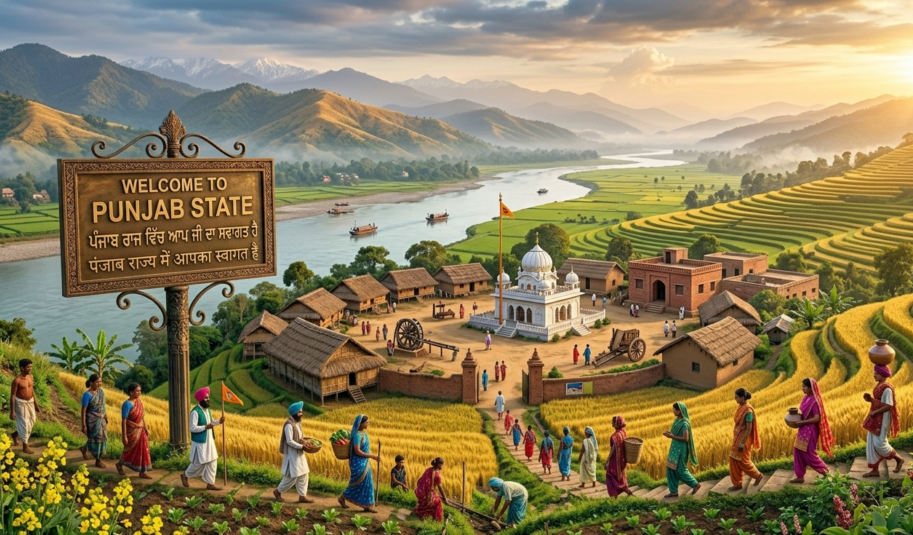
Punjab :- The Land of Five Rivers, Valour, and Rich Cultural Heritage
Detailed History
Situated on the northwestern frontier of India, Punjab is universally acclaimed as the ‘Granary of India’ and the ‘Land of the Brave’. The etymology of ‘Punjab’ traces back to two Persian words—’Panj’ (meaning five) and ‘Aab’ (meaning water), signifying the ‘Land of Five Rivers’. These five perennial rivers are the Jhelum, Chenab, Ravi, Beas, and Satluj. In ancient Vedic literature, this fertile land was known as ‘Sapta Sindhu’ (the land of seven rivers) and formed the core territorial expanse of the Indus Valley Civilization.
The historical trajectory of Punjab is a saga of indomitable courage, relentless struggle, and supreme sacrifice. Due to its strategic geographical gateway positioning, almost all major foreign invasions of the Indian subcontinent (including Alexander the Great, the Mughals, and the Afghans) first breached through Punjab, where they were fiercely resisted by regional warriors. The 15th century witnessed a momentous spiritual epoch on this sacred soil with the birth of Sikhism, founded by Sri Guru Nanak Dev Ji. In the early 19th century, the legendary Maharaja Ranjit Singh consolidated these lands into a vast and prosperous Sikh Empire with its capital at Lahore.
In modern history, Punjab bore the most traumatic brunt of the 1947 Partition of India, which bifurcated the region, leaving its western half with Pakistan. Subsequently, the modern state of Punjab was linguistically reorganized on November 1, 1966. In the 1960s, Punjab became the epicentre of the ‘Green Revolution’, pioneering agricultural advancements that established the state as the primary food security anchor for the entire nation.
Detailed Architecture
The architectural fabric of Punjab mirrors a brilliant synthesis of spiritual sanctity, royal opulence, and rustic structural simplicity. The regional architectural styles are broadly categorized into three distinct domains:
1. Indo-Islamic and Sikh Architecture :–
- Sri Harmandir Sahib (The Golden Temple, Amritsar) :– This stands as the absolute zenith of Sikh architectural engineering. Its design uniquely synthesizes Islamic and Rajput structural aesthetics. Erected in the center of a massive sacred pool (Amrit Sarovar), the sanctum is approached via a causeway. It features four entrance doors facing the cardinal directions, symbolizing that the sanctuary is open to humanity without any distinctions of creed or caste. The upper storeys are heavily sheathed in pure gold leaf plates, while the interior walls display spectacular Pietra Dura (inlaid semi-precious stonework) and vibrant Frescoes (traditional wall paintings).
2. Royal and Mughal Substructure :–
- Architectural marvels like the Qila Mubarak in Patiala and the Jagatjit Palace in Kapurthala exhibit a profound incorporation of European (specifically French Renaissance) and Indo-Saracenic design sensibilities. Kapurthala’s magnificent public buildings earned it the title ‘The Paris of Punjab’.
3. Modern Planned Architecture :–
- Chandigarh:– Serving as the joint capital of Punjab and Haryana, Chandigarh is celebrated globally as India’s first post-independence planned modern city. Formulated by the legendary French architect Le Corbusier, its layout is characterized by monumental raw concrete administrative buildings, a strict grid-iron sector network, and vast integrated green spaces.
Travel Guide & Routes
Mandatory Permits & Entry Regulations :–
- Domestic Indian travelers and international passport holders do not require any specialized inner line permits or restricted area clearances to travel through Punjab.
Tickets and Entry Fees :–
- Sri Harmandir Sahib (Amritsar) & Jallianwala Bagh :– Admission to these prominent historical and spiritual spaces is completely Free of cost.
- Wagah Border Ceremony :– Watching this high-energy patriotic military ceremony requires no entry tickets; access is entirely free.
- Minimal preservation fees (approx. ₹20) may apply at advanced museum complexes like Virasat-e-Khalsa in Anandpur Sahib.
Timings (Visiting, Opening & Closing Times) :–
- Best Time to Visit :– The winter months from October to March offer an ideal climate for exploring Punjab, featuring crisp, cool weather. The month of January is highly festive due to ‘Lohri’ celebrations. The summer months from April to June feature intense, dry heat.
- Operating Windows :– The Golden Temple remains accessible 24 hours a day, with the community kitchen (Langar) operating continuously. Jallianwala Bagh is open daily from 06:30 AM to 07:30 PM. The Wagah Border parade commences around 04:30 PM in winters and 05:30 PM during summers; travelers are advised to arrive early for seating.
How to Reach (Routes) :–
- By Air :– The Sri Guru Ram Dass Jee International Airport (ATQ) in Amritsar is the largest aviation hub, offering direct domestic connections and international flights to major global destinations. The Chandigarh International Airport (IXC) serves as another major entryway.
- By Rail :– Punjab possesses a highly efficient railway infrastructure. Major rail junctions include Amritsar (ASR), Ludhiana (LDH), Jalandhar (JUC), and Bathinda (BTI), all running daily superfast trains to Delhi, Mumbai, and Kolkata.
- By Road :– National Highway 44 (NH-44 / historic Grand Trunk Road) flawlessly connects Punjab to Delhi and Jammu & Kashmir. Premium air-conditioned state buses operate round-the-clock from Delhi and Chandigarh. Within cities, E-Rickshaws and auto-rickshaws provide highly economical and efficient point-to-point transit.
Photography Spots, Local Cuisine, and Famous Markets
Photography Spots :–
- The Golden Temple (Amritsar) :– Exceptional for long-exposure night photography when the entire illuminated golden shrine casts a flawless reflection onto the still waters of the holy pool.
- The Mustard Fields (Sarson ke Khet) :– The rural highways during winter provide iconic vistas of bright yellow blooming mustard fields set against traditional tractors, capturing the essence of agrarian life.
- Wagah Border :– Perfect for action photography, capturing the dramatic, high-stepping drills of the border guards and the emotional, patriotic expressions of the massive crowds.
Local Cuisine :–
- Punjabi cuisine is celebrated across the world for its rich flavors and generous use of pure desi ghee and butter. The quintessential seasonal dish is ‘Makki di Roti aur Sarson da Saag’ (flatbread made of corn flour paired with slow-cooked mustard greens), traditionally served with fresh white butter and jaggery. Other global favorites include tandoor-baked ‘Amritsari Kulchas’, rich Dal Makhani, Tandoori Chicken, and Butter Chicken. A traditional culinary experience must be rounded off with a large brass tumbler of thick, creamy ‘Patiala Lassi’.
Famous Markets :–
- Hall Bazar & Katra Jaimal Singh (Amritsar) :– The premier historic bazaars for authentic hand-embroidered ‘Phulkari Suits and Dupattas’, handcrafted leather ‘Simple Punjabi Juttis’, premium wool shawls, and traditional turbans. These markets are also famous for local culinary take-aways like Amritsari Papad and sun-dried lentil chunks.
- Ludhiana Hosiery Market :– Recognized as Asia’s largest wholesale textile hub for high-quality, affordable woolen winter wear.
Nearby Attractions
- Amritsar :– The spiritual capital of Sikhism, housing the glorious Golden Temple, the sacred Durgiana Temple, and the poignant Jallianwala Bagh memorial.
- Wagah Border :– Located 30 km from Amritsar on the international border with Pakistan, famous for its daily theatrical evening ‘Beating Retreat’ ceremony.
- Virasat-e-Khalsa (Anandpur Sahib) :– A state-of-the-art museum complex detailing 500 years of Sikh history and the historic inception of the Khalsa Panth.
- Kapurthala :– Noted for its heritage French-style palaces and the unique Moorish Mosque, earning it the moniker ‘The Paris of Punjab’.
- Chandigarh :– A modernist, meticulously clean city featuring world-renowned tourist sites like the unique Rock Garden, Sukhna Lake, and the expansive Rose Garden.
Interesting Facts
- The name ‘Punjab’ represents the vast historic undivided region, a significant portion of which now forms the Punjab province of Pakistan.
- The community kitchen (Langar) at Harmandir Sahib is the largest free mega-kitchen in the world, serving free hot meals to over 100,000 people daily.
- Punjab has historically contributed the highest percentage of soldiers and prominent freedom fighters (such as Shaheed Bhagat Singh and Udham Singh) to the nation.
Important Questions and Answer :-
Question 1:- Why is Punjab historically recognized as the cradle of the Green Revolution in India?
Answer:– In the 1960s, India faced severe food-grain shortages, prompting the implementation of the ‘Green Revolution’. Punjab became its primary testing ground due to its fertile alluvial soil, an exceptional network of five canal systems, and highly industrious farmers. The widespread deployment of high-yielding variety (HYV) seeds and modern mechanized farming transformed Punjab into the ultimate ‘Food Bowl’ of India, achieving self-sufficiency for the nation.
Question 2:- What is the historical background of the Jallianwala Bagh Massacre?
Answer:– The Jallianwala Bagh Massacre transpired on April 13, 1919, on the festive day of Baisakhi in Amritsar. A peaceful public assembly gathered to protest the draconian Rowlatt Act was trapped inside the ground when British troops under Brigadier-General Reginald Dyer blocked the solitary exit and opened fire on the unarmed crowd without warning. Hundreds of innocent men, women, and children were martyred. The bullet-scarred walls are still preserved today as a national memorial.
Question 3:- When and by whom was the ‘Khalsa Panth’ established?
Answer:– The ‘Khalsa Panth’—the collective community of initiated Sikhs—was formally established by the tenth and final human Sikh Guru, Sri Guru Gobind Singh Ji, on Baisakhi day in the year 1699 at Anandpur Sahib. He institutionalized the sacred code of conduct and mandated the wearing of the five distinctive symbols of faith, known as the Five Ks: Kesh (uncut hair), Kangha (wooden comb), Kara (iron bracelet), Kachera (cotton undergarment), and Kirpan (ceremonial iron dagger).
“Resonating with the pristine waters of its five rivers, the rich fragrance of its fertile fields, and the roaring echoes of ‘Jo Bole So Nihal’, Punjab’s sacred soil welcomes every traveler with profound hospitality and boundless vitality.”