
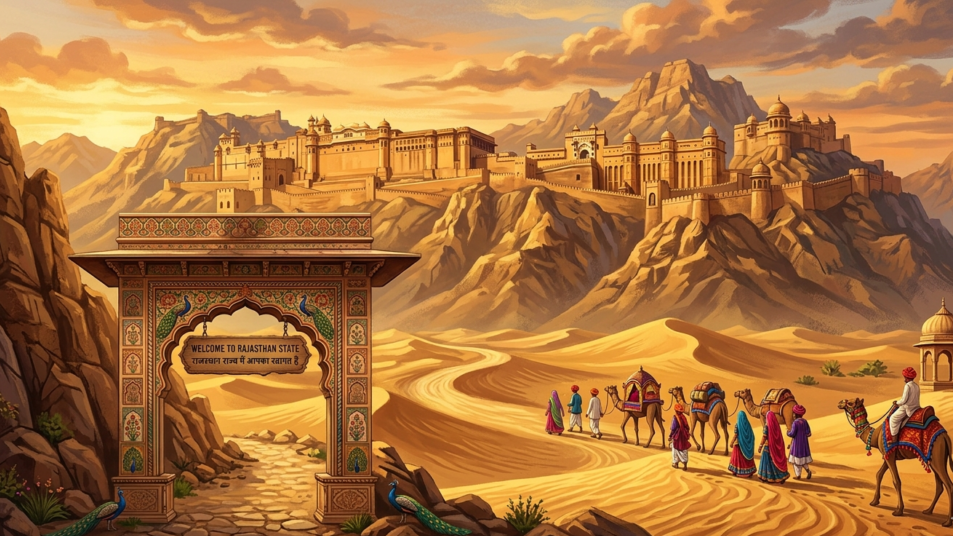
Rajasthan :- The Land of Sovereigns, Desert Magic, and Royal Cultural Heritage
Detailed History
Situated in the northwestern region of India, Rajasthan is the largest state by geographical area in the country, historically acclaimed as ‘The Abode of Kings’ or ‘Rajputana’. The historical legacy of this sacred soil is a living testament to indomitable valour, chivalry, supreme sacrifice, and architectural genius. The state’s history traces its antiquity back to the Indus Valley Civilization at Kalibangan. During the medieval epoch, it emerged as the core citadel of powerful Rajput dynasties, including the Guhilas-Sisodias of Mewar, the Rathores of Marwar, the Kachwahas of Amber, and the Hadas of Bundi and Kota.
This land has witnessed the unyielding pride of Maharana Pratap, the strategic bravery of Prithviraj Chauhan, the historic sacrifice (Jauhar) of Rani Padmini, and the absolute spiritual devotion of Meerabai. Throughout the Mughal era and the British Raj, the princely states of Rajasthan meticulously preserved their autonomous cultural identity. Following independence, the integration of 22 princely states occurred in seven structured phases from March 17, 1948, culminating in the formation of the modern state on November 1, 1956. The state houses the vast ‘Thar Desert’, India’s largest arid zone, which holds centuries of royal folklore and pristine history within its golden sands.
Detailed Architecture
The architectural landscape of Rajasthan is celebrated globally for its sheer scale, grandeur, and structural diversity. The state’s massive hill forts, intricately carved mansions (Havelis), and opulent palaces reflect a flawless synthesis of Rajput military architecture and Mughal design aesthetics (Indo-Islamic Architecture). The regional architecture is systematically categorized into three core domains:
1. UNESCO World Heritage Hill Forts :–
- Six monumental forts of Rajasthan—Chittorgarh, Kumbhalgarh, Ranthambore, Gagron, Amer, and Jaisalmer—are collectively designated as UNESCO World Heritage Sites. Eerected with colossal stone ramparts, massive bastions, and multi-layered defensive gates, these citadels were virtually impregnable. The perimeter wall of Kumbhalgarh Fort extends across 36 kilometres, recognized as the second-longest continuous wall in the world, surpassed only by the Great Wall of China.
2. Chromatic Urban Environments and Structural Innovations :–
- Jaipur (The Pink City) :– Founded by Maharaja Sawai Jai Singh II, Jaipur is celebrated as India’s first planned city, conceptualized strictly on the grid system of ancient Vedic Silpa Shastra. The iconic Hawa Mahal (Palace of Winds) stands as a unique five-storey screen-wall without a conventional structural foundation, embedded with 953 intricately carved casements (Jharokhas).
- Udaipur (City of Lakes) & Jodhpur (The Blue City) :– Udaipur features pristine white marble palaces seemingly floating on water bodies (such as the Lake Palace), while Jodhpur displays a stunning indigo hue across its residential grid below the Mehrangarh Fort. Jaisalmer is dubbed the ‘Golden City’ due to the exclusive use of yellow habur and jurassic sandstone.
- The Frescoed Havelis :– The grand aristocratic mansions of the Shekhawati region feature exquisite wall paintings (Frescoes), making the entire district the world’s largest ‘Open Air Art Gallery‘.
Travel Guide & Routes
Mandatory Permits & Entry Regulations :–
- Indian domestic travelers and international tourists do not require any restricted area permits or inner line clearances to freely explore the state of Rajasthan.
Tickets and Entry Fees :–
- Entrance to protected monuments, museums, and historical forts (such as Amer Fort, Mehrangarh, and Chittorgarh) is systematically regulated. Ticket prices range from ₹20 to ₹200 for domestic Indian tourists and ₹100 to ₹600 for international passport holders. Travelers can opt for ‘Composite Tickets’ issued by the state tourism department for bundled access to major municipal monuments.
Timings (Visiting, Opening & Closing Times) :–
- Best Time to Visit :– The winter season spanning from October to March is the ideal window to visit Rajasthan, featuring comfortable daytime temperatures and cool desert nights. Major cultural spectacles like the ‘Gangaur Festival’ (March/April) and the globally renowned ‘Pushkar Camel Fair’ (November) occur during this period. The summer months from May to September experience extreme, arid heat.
- Operating Windows :– Most public heritage sites, museums, and fortifications operate daily from 09:00 AM to 05:00 PM. Select premium forts host spectacular multimedia ‘Light & Sound Shows’ during the evening hours.
How to Reach (Routes) :–
- By Air :– The Jaipur International Airport (JAI) serves as the primary aviation gateway. Additionally, operational domestic airports at Udaipur (UDR), Jodhpur (JDH), and Jaisalmer connect the state directly to all major macro-cities across India.
- By Rail :– Rajasthan possesses an exceptionally dense and efficient railway infrastructure. Major rail hubs include Jaipur (JP), Jodhpur (JU), Ajmer (AII), and Kota (KOTA). The iconic luxury train ‘Palace on Wheels’ offers an exclusive curated royal heritage itinerary through the state.
- By Road :– National Highway 48 (NH-48) offers a pristine multi-lane highway connectivity from Delhi to Jaipur. The Rajasthan State Road Transport Corporation (RSRTC) operates a vast fleet of premium air-conditioned Volvo and express buses from adjacent states. Within urban limits, E-Rickshaws, auto-rickshaws, and app-based cab aggregates are readily available.
Photography Spots, Local Cuisine, and Famous Markets
Photography Spots :–
- Hawa Mahal & Amer Fort (Jaipur) :– The classic symmetric street-view shot of Hawa Mahal at sunrise, and the panoramic reflection of Amer Fort captured across the pristine waters of Maota Lake.
- Sam Sand Dunes (Jaisalmer) :– Capturing camel caravans moving in silhouette along the ridge of shifting sand dunes against a vivid desert sunset.
- Lake Pichola (Udaipur) :– Wide-angle sunset shots of the gleaming Lake Palace taken during a curated boat cruise.
Local Cuisine :–
- Rajasthani culinary traditions are heavily influenced by the historical scarcity of water and fresh vegetables in its arid zones. The ultimate signature dish is ‘Dal-Baati-Churma’ (hard, unleavened wheat balls baked over coal cakes, crushed and drenched in pure desi ghee, served with spiced lentil broth and sweet wheat crumble). Other highly acclaimed dishes include Pyaaz Kachori, Gatte ki Sabzi, Ker-Sangri (a unique desert berry and bean preparation), and the fiery Jodhpuri Mirchi Bada. For sweets, the traditional Mawa Ghevar of Jodhpur and the rich Milk Cake (Kalakand) of Alwar are legendary.
Famous Markets :–
- Johari Bazar & Bapu Bazar (Jaipur) :– Globally famous destinations for traditional ‘Bandhani (Tie-Dye) textiles’, authentic gemstone cutting, Kundan-Meenakar jewellery, Handcrafted leather footwear (Mojris), and traditional Blue Pottery.
- Sadar Bazar (Jaisalmer) & Clock Tower Market (Jodhpur) :– Ideal shopping hubs for authentic ethnic wooden handicrafts, block-printed fabrics, traditional Rajasthani puppets, and hand-woven antique carpets.
Nearby Attractions
- Jaipur (The Pink City) :– Home to Amer Fort, City Palace complex, the UNESCO-listed Jantar Mantar observatory, Albert Hall Museum, and Nahargarh Fort.
- Udaipur (The City of Lakes) :– Featuring the grand City Palace, Jag Mandir island palace, Saheliyon-ki-Bari gardens, and the hilltop Sajjangarh Monsoon Palace.
- Jodhpur (The Blue City) :– Centered around the towering Mehrangarh Fort, Jaswant Thada (the Taj Mahal of Marwar), and the grand Umaid Bhawan Palace.
- Jaisalmer (The Golden City) :– Showcasing the living Jaisalmer Fort (Sonar Qila), the architectural Patwon ki Haveli, and the desert camps of Sam.
- Pushkar & Ajmer :– Housing the world’s solitary ancient Lord Brahma Temple, the sacred Pushkar Lake, and the revered Sufi shrine of Khwaja Moinuddin Chishti.
Interesting Facts
- Jaisalmer Fort is one of the very few fully functional ‘Living Forts’ remaining globally, housing nearly a quarter of the old city’s civil population inside its medieval stone walls.
- The Aravalli Range traversing through Rajasthan stands as one of the oldest geological fold mountain systems in the world, predating the Himalayas.
- The royal astronomers of Rajasthan constructed the historic ‘Jantar Mantar’ observatory in Jaipur, which houses the world’s largest stone sundial, capable of measuring local time to an accuracy of two seconds.
Important Questions and Answer :-
Question 1:- Why were the fortifications of Rajasthan built with such massive walls, and why are its cities color-coded?
Answer:– The massive, towering stone ramparts were a core component of medieval military defense engineering, designed to absorb the kinetic impact of heavy artillery and prevent infantry scaling. The color-coding of cities served both practical and aesthetic purposes; for instance, the indigo-blue lime wash in Jodhpur systematically reflects solar radiation to keep structures cool, while Jaipur was painted pink as a royal edict to signify hospitality for visiting dignitaries.
Question 2:- What makes the perimeter wall of Kumbhalgarh Fort a global architectural marvel?
Answer:– Built under the patronage of Maharana Kumbha, the massive defensive wall of Kumbhalgarh Fort extends continuously for 36 kilometers across the rugged Aravalli ridges. It is structurally wide enough for eight horsemen to ride abreast, earning it the title of ‘The Great Wall of India’ and rendering the fortress virtually unconquerable throughout its history.
Question 3:- What is the historical origin of Rajasthan’s staple dish, ‘Dal-Baati-Churma’?
Answer:– The origin of ‘Baati’ traces back to the wartime rations of the Rajput cavalries. Soldiers would bury balls of unleavened wheat dough under the hot desert sands before leaving for the battlefield. By afternoon, the intense desert heat perfectly baked the dough. Upon returning, they would drench the baked balls in ghee and pair them with wild lentils, creating a highly nutritious, long-lasting meal that evolved into the state’s iconic culinary identity.
“Steeped in the honor of colorful turbans, the enduring majesty of historic hill forts, and the profound warmth of its timeless call ‘Padharo Mhare Des’, this golden desert state wraps every traveler in unparalleled royal hospitality.”