
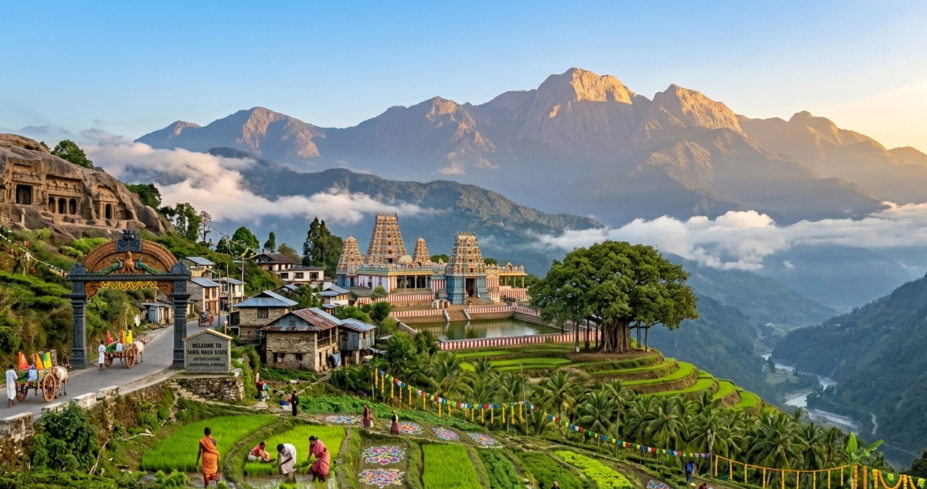
Tamil Nadu :- The Zenith of Chola Architecture, Dravidian Culture, and the Nilgiri Hills
Detailed History
Situated in the southernmost expanse of the Indian subcontinent, Tamil Nadu stands as one of the most ancient and culturally resilient civilizations in human history. The state’s legacy spans several millennia, deeply anchored in the ‘Tamil’ language—one of the oldest surviving classical languages globally—and the illustrious ‘Sangam Era’. In the ancient and medieval epochs, this sacred territory was the cradle of three dominant dynasties: the Cholas, the Cheras, and the Pandyas. These maritime empires extended their cultural, economic, and political hegemony across South India and deep into Southeast Asia, including Sri Lanka, Malaysia, and parts of Indonesia. Later, the Pallavas and the Vijayanagara Empire also left indelible marks on the region.
This land witnessed the absolute golden age of military and cultural expansion under Emperor Raja Raja Chola I and his successor Rajendra Chola I, who pioneered pathbreaking naval expeditions and monumental architecture. During the British colonial era, the territory formed the core of the vast ‘Madras Presendency’. Post-independence, following the linguistic reorganization of states, the territory was initially known as Madras State, which was officially renamed Tamil Nadu (meaning ‘The Land of the Tamils’) on January 14, 1969. Today, it stands as a premier macro-economic powerhouse and industrial hub of modern India.
Detailed Architecture
The architectural landscape of Tamil Nadu represents the absolute historical culmination of the ‘Dravidian Style’. Characterized by monumental multi-storeyed entry gateways called ‘Gopurams’, expansive temple layouts, and extensively carved monolithic pillars, the structures demonstrate an extraordinary mastery over stone masonry. The core architectural epochs include:
1. The Great Living Chola Temples (UNESCO World Heritage) :–
- The Brihadeeswarar Temple (Thanjavur) :– Commissioned by Raja Raja Chola I, this temple is the definitive masterpiece of Dravidian engineering. The central ‘Vimanam’ (temple tower) rises to a height of 216 feet and is engineered with such geometric precision that its apex shadow never falls on the ground at noon during any season. The capstone or ‘Kumbham’ resting at the top is chiseled out of a single monolithic block of granite weighing approximately 81 tonnes.
2. Pallava Monolithic and Rock-Cut Infrastructure :–
- Mahabalipuram (Mamallapuram) :– The Pallava dynamic rulers of the 7th century carved spectacular monolithic shrines out of solid granite cliffs, famously known as the ‘Pancha Rathas’. The site also features masterfully executed bas-reliefs like ‘The Descent of the Ganges’ (or Arjuna’s Penance), depicting complex open-air mythological tableaux.
3. Colossal Pillared Corridors and Chromatic Polychrome Towers :–
- Ramanathaswamy Temple (Rameswaram) :– Features the longest continuous pillared temple corridor in the world, flanked by over 1,212 masterfully sculpted granite pillars.
- Meenakshi Amman Temple (Madurai) :– Universally recognized for its 14 monumental, soaring Gopurams completely sheathed in thousands of brightly painted, intricate stucco sculptures depicting celestial deities and epic puranic lore.
Travel Guide & Routes
Mandatory Permits & Entry Regulations :–
- Indian domestic tourists and international passport holders do not require any restricted area permits or inner line clearances to travel across Tamil Nadu.
Tickets and Entry Fees :–
- Admission to protected UNESCO World Heritage complexes (like the monuments at Mahabalipuram) is systematically regulated, charging approx. ₹40 for domestic Indian citizens and ₹600 for international tourists. General admission into operating temples is completely Free of cost, though municipal boards offer premium ‘Special Darshan’ ticketing systems (ranging from ₹50 to ₹250) for accelerated access.
Timings (Visiting, Opening & Closing Times) :–
- Best Time to Visit :– The winter months from November to March are highly ideal, presenting pleasant temperatures across the coastal plains. The state’s marquee harvest festival, ‘Pongal’, is celebrated with immense cultural fervor in mid-January. The summer season from May to August experiences heavy tropical heat and high humidity.
- Operating Windows :– Most traditional temples follow distinct operating structures, remaining accessible from 05:00 AM to 12:30 PM, closing mid-day, and reopening from 04:00 PM to 09:00 PM. The archaeological reserves at Mahabalipuram are open daily from 06:00 AM to 06:00 PM.
How to Reach (Routes) :–
- By Air :– The Chennai International Airport (MAA) is the primary global aviation gateway into South India. The state is further serviced by excellent domestic and international airports at Coimbatore (CJB), Tiruchirappalli (TRZ), and Madurai (IXM).
- By Rail :– Chennai Central (MAS) and Chennai Egmore (MS) serve as the terminal hubs for the Southern Railway network, connecting straight to Delhi, Mumbai, and Kolkata via high-speed express trains. For travel to the hill station of Ooty, the heritage Nilgiri Mountain Railway (Toy Train)—a UNESCO listed steam-cog railway—plies from Mettupalayam through Coonoor.
- By Road :– National Highway 44 (NH-44) cuts through the spine of the state, providing premium multi-lane road connectivity. The State Express Transport Corporation (SETC) operates an expansive network of ultra-luxury long-distance buses. Within urban limits, metered cabs, auto-rickshaws, and eco-friendly E-Rickshaws provide rapid point-to-point transit.
Photography Spots, Local Cuisine, and Famous Markets
Photography Spots :–
- The Towers of Meenakshi Temple (Madurai) :– Captured from elevated rooftop vantage points at dusk when the multi-colored sculptural arrays of the Gopurams are dynamically lit against the evening sky.
- The Shore Temple (Mahabalipuram) :– Exceptional wide-angle landscape compositions during the sunrise golden hour as the waves of the Bay of Bengal crash against the structural stone base.
- Nilgiri Tea Plantations (Ooty) :– The rolling, terraced green tea estates of the Western Ghats opening up through dramatic morning mist covers.
Local Cuisine :–
- Tamil Nadu’s culinary paradigm is a masterclass in fermenting rice and blending specialized roasted spices. The global signature breakfast layout includes ‘Idli, Crispy Dosa, Vada, and Uttapam’, paired with fresh coconut chutneys and hot, tang-infused sambar. The state is also world-renowned for its fiery ‘Chettinad Cuisine’ (characterized by freshly ground sun-dried spices), Pongal, and aromatic lemon rice. No meal is complete without partaking in the traditional ‘Madras Filter Coffee’, meticulously frothed using a classic brass ‘Dabarah’ and tumbler set.
Famous Markets :–
- Kanchipuram :– The global capital for authentic handloom ‘Kanchipuram Silk Sarees’, distinguished by their heavy weight, superior mulberry silk strands, and solid gold/silver thread weave (Zari).
- T. Nagar & Pondy Bazar (Chennai) :– One of the largest commercial retail clusters in Asia, highly famous for gold jewelry, authentic silk textiles, and traditional bronze handicrafts.
Nearby Attractions
- Chennai & Mahabalipuram :– Home to Marina Beach (India’s longest natural urban beach), the ancient Kapaleeshwarar Temple, and the Pallava rock cut shrines.
- Thanjavur & Tiruchirappalli (Trichy) :– Featuring the legendary Brihadeeswarar Temple, the Thanjavur Royal Palace, and the majestic Rockfort Temple complex in Trichy.
- Madurai :– Centered entirely around the ancient, labyrinthine Meenakshi Amman Temple complex and the historic Thirumalai Nayakkar Palace.
- Rameswaram & Kanyakumari :– Showcasing the architectural marvel of the Pamban Sea Bridge, the sacred Ramanathaswamy Temple, and Kanyakumari—the southernmost mainland tip where three oceans meet, housing the Vivekananda Rock Memorial.
- Ooty & Kodaikanal :– Premium mountain resorts nestled in the Western Ghats, highly favored for their temperate microclimates, botanical gardens, and calm high-altitude lakes.
Interesting Facts
- Tamil Nadu is appropriately hailed as the ‘Land of Temples’, holding a dense inventory of over 33,000 ancient religious complexes that have survived intact for centuries.
- Kanyakumari, the geographic terminus of mainland India, is one of the exceptionally rare places globally where a traveler can witness the sun simultaneously rising and setting over the open ocean from the exact same shoreline.
- ‘Bharatanatyam’, one of India’s premier classical dance forms, originated on this sacred soil, traceably developed from the ritualistic dances performed by Devadasis within the ancient temple courts.
Important Questions and Answer :-
Question 1:- How did medieval architects manage to hoist the colossal 81-tonne stone capstone to the summit of the Thanjavur Brihadeeswarar Temple?
Answer:– In the 11th century, long before the invention of mechanical cranes, the Chola engineering guilds developed an extraordinary solution to lift the 81-tonne monolithic Kumbham to the top of the 216-foot tower. They constructed a massive, structurally reinforced earth and timber incline ramp that extended nearly 6 kilometers from a nearby village straight to the summit of the tower. Using a systematic combination of war elephants, heavy ropes, and thousands of laborers, the stone was slowly rolled up the incline to its final location.
Question 2:- What gives authentic Kanchipuram Silk Sarees their unique global value and prestige?
Answer:– The tradition of weaving Kanchipuram sarees dates back over 400 years to the era of the Vijayanagara Empire. These sarees are hand-woven utilizing heavy, durable mulberry silk threads imported from South India. The defining hallmark of a true Kanchipuram saree is its inter-locked weaving technique where the body and the border are woven separately and then seamlessly joined. Furthermore, the metallic patterns (Zari) utilize pure silver wire that is heavily electroplated with authentic gold, ensuring that the textiles retain their sheen and material value across generations.
Question 3:- What makes the historic Pamban Railway Bridge an exceptional milestone in maritime engineering?
Answer:– Commissioned in 1914 by British engineers, the Pamban Railway Bridge is India’s first structural sea bridge, connecting the mainland peninsula to Rameswaram Island across the Palk Strait. Its defining technological feature is the legendary ‘Scherzer Rolling Lift’—a central double-leaf bascule section that can roll upward using hand-cranked gears to create a wide navigation clearance channel for massive international cargo ships to pass through safely.
“Immersed in the structural grandeur of its soaring Gopurams, the timeless rustle of Kanchipuram silk, and the rich aroma of authentic filter coffee, this ancient Dravidian land effortlessly transports every traveler into a glorious golden era of art and spirituality.”