
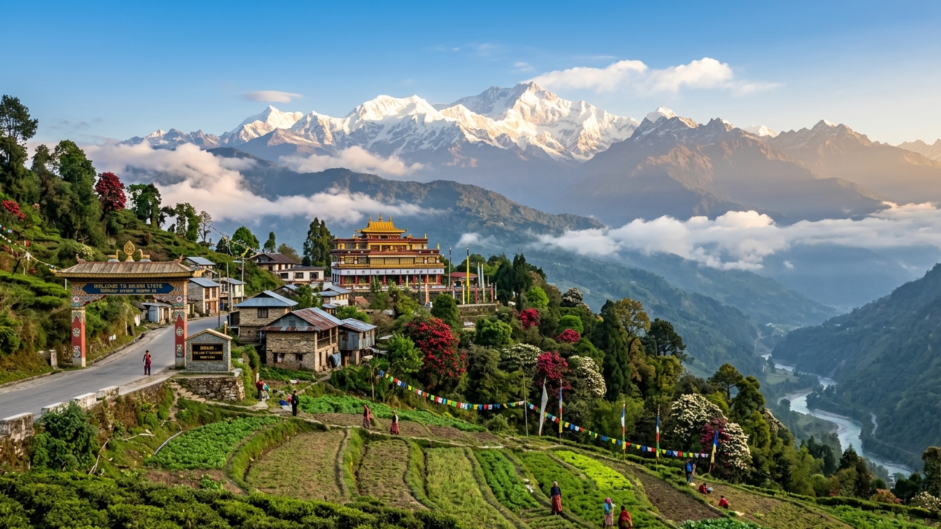
Sikkim :- The Canopy of Kangchenjunga, Sacred Monasteries, and Pristine Natural Splendour
Detailed History
Nestled in the pristine embrace of the Eastern Himalayas, Sikkim is the second smallest and the least populous state of India. Characterized by its unique thumb-shaped geographical contour, this mountainous state holds immense geopolitical significance, sharing international frontiers with Tibet (China) to the north and east, Nepal to the west, and Bhutan to the southeast. The ancient history of Sikkim is deeply intertwined with its indigenous tribal lineages—the Lepchas and the Bhutias. In 1642 AD, the historic Chogyal (monarchical priest-kings) dynasty was institutionalized, establishing Phuntsog Namgyal as the first sovereign ruler of Sikkim, transforming it into a sovereign Buddhist kingdom.
During the British Raj, Sikkim transitioned into a British protectorate. Following India’s independence in 1947, Sikkim continued its autonomous protectorate status under India, which managed its external defense, diplomacy, and strategic communications. In 1975, widespread civil unrest against the Chogyal monarchy culminated in a historic democratic referendum. The citizens of Sikkim overwhelmingly voted to integrate with the Indian Union, leading to the enactment of the 35th and 36th Constitutional Amendments. Consequently, on May 16, 1975, Sikkim officially became the 22nd state of India. In 2016, Sikkim achieved the historic global distinction of becoming the world’s very first 100% Organic State, completely outlawing the use of chemical fertilizers and pesticides.
Detailed Architecture
The architectural grammar of Sikkim is heavily influenced by Tibetan Buddhism and the cultural traditions of its native tribes. The spatial design emphasizes building in close harmony with nature, utilizing steep mountain topography effectively. The core architectural domains include.
1. Traditional Buddhist Monasteries (Gumpas) :–
- Sikkim is sanctuary to over 200 historical monasteries, with Rumtek, Pemayangtse, and Enchey serving as the premier architectural specimens. Constructed strictly in accordance with traditional Tibetan vernacular design, these structures utilize stone masonry, robust timber framing, and baked bricks. Their multi-tiered sloped roofs are painted in rich crimson or gold, adorned at the corners with stylized metallic dragons and Buddhist emblems like the Dharmachakra. Internally, the assembly halls feature exceptional Thangka scroll paintings (sacred iconography executed on silk) and vibrant murals detailing Buddhist cosmology.
2. Stupas and Chortens :–
- The Do-Drul Chorten in Gangtok stands as one of the most significant stupas in the region. Characterized by its classic whitewashed hemispherical dome and a towering golden spire, the perimeter is encircled by 108 sacred prayer wheels (Mani Lhalung) inscribed with the omnipotent mantra “Om Mani Padme Hum“, which pilgrims rotate clockwise.
3. Monumental Sculptures and Contemporary Heritage Complexes :–
- Siddhesvara Dham (Namchi) :– Features a monumental 108-foot-tall statue of Lord Shiva perched atop Solophok hill, surrounded by architectural replicas of India’s twelve Jyotirlingas and the core Char Dham pilgrimage sites.
- Tathagata Tsal (Buddha Park, Ravangla) :– Centered around a majestic 130-foot-high seated copper statue of Lord Buddha, set against Mt. Narsing, demonstrating the exceptional mastery of modern Sikkimese structural engineering.
Travel Guide & Routes
Mandatory Permits & Entry Regulations :–
- For Domestic Indian Citizens :– General tourist circuits like Gangtok, Pelling, Namchi, and Ravangla require no entry permits. However, because of proximity to sensitive international borders, a Protected Area Permit (PAP) is compulsory for exploring North Sikkim (Lachen, Lachung, Gurudongmar Lake, Yumthang Valley) and East Sikkim (Tsomgo Lake, Nathula Pass, Zuluk). This permit system is fully digitalized; travelers must secure QR-coded e-permits via registered local tour operators 1–3 weeks prior to arrival. Aadhaar cards are not accepted; a valid Voter ID, Passport, or Driving License is mandatory.
- For Foreign Nationals :– Accessing Sikkim requires a Restricted Area Permit (RAP), which can be obtained seamlessly and free of charge via the centralized online e-FRRO platform.
Tickets and Entry Fees :–
- Most natural reserves, waterfalls, and historical monasteries charge no entry fees.
- For restricted high-altitude destinations (like Nathula Pass), local operators charge nominal regulatory and environmental clearance processing fees (approx. ₹200 per vehicle allocation).
Timings (Visiting, Opening & Closing Times) :–
- Best Time to Visit :– Spring from March to May (when alpine valleys bloom with rhododendrons) and autumn from October to mid-December (offering crisp, clear blue skies and unparalleled visibility of Mt. Kangchenjunga). Monsoon season (July to September) should be strictly avoided due to severe landslide risks.
- Operating Hours :– Monasteries are generally open to visitors from 08:00 AM to 05:00 PM. Excursions to Tsomgo Lake and Nathula Pass necessitate an early morning departure (07:00 AM – 09:00 AM) from Gangtok, as high-altitude weather destabilizes rapidly with heavy fog and snow by midday. Nathula Pass remains operational for Indian citizens from Wednesday to Sunday only.
How to Reach (Routes) :–
- By Air :– Sikkim houses a domestic airport at Pakyong (PYG), though flights are highly weather-dependent. The most reliable and major commercial airport is Bagdogra International Airport (IXB) in West Bengal, located approximately 125 km from Gangtok.
- By Rail :– Sikkim currently has no active commercial rail terminal (the Sevoke-Rangpo rail project is underway). The nearest major broad-gauge rail hub is New Jalpaiguri (NJP) in Siliguri, West Bengal, connecting directly to major Indian metropolitan centers.
- By Road :– National Highway 10 (NH-10) serves as the primary arterial link connecting Siliguri to Gangtok. Sikkim Nationalised Transport (SNT) operates daily regular buses, alongside private luxury SUVs (Innova, Bolero, Xylo) that ply the route. Point-to-point intra-state travel within restricted mountain terrain is strictly serviced by locally registered tactical 4×4 vehicles.
Photography Spots, Local Cuisine, and Famous Markets
Photography Spots :–
- Gurudongmar Lake :– Located at an astounding elevation of 17,800 feet, this is one of the highest alpine lakes globally. The juxtaposition of its brilliant turquoise waters against the stark, snow-capped peaks offers a sublime canvas for landscape photographers.
- Yumthang Valley :– Famously called the ‘Valley of Flowers‘, it provides incredible wide-angle compositions during spring when dozens of distinct species of wild Rhododendrons bloom along the meandering channels of the Teesta River.
- Tashi View Point (Gangtok) :– The premier vantage point for capturing the sunrise over the majestic Kangchenjunga massif during the golden hour.
Local Cuisine :–
- Sikkimese cuisine is an authentic culinary amalgam of Tibetan, Nepalese, and indigenous Lepcha flavors. The most iconic offerings are handmade ‘Momos’ (steamed dumplings filled with spiced meats or vegetables) and ‘Thukpa’ (a restorative, steaming Tibetan noodle soup cooked with local herbs). Traditional meals feature ‘Kinema’ (fermented savory soybeans), Rayo Saag (mustard greens), and ‘Gundruk’ (sun-dried, fermented leafy greens). A singular specialty is ‘Chhurpi’, a traditional dense, smoky cheese made from Himalayan Yak milk.
Famous Markets :–
- M.G. Marg (Gangtok) :– A beautifully curated, litter-free pedestrian promenade entirely closed to vehicular traffic. It is the premier hub for sourcing authentic Tibetan wool carpets, hand-painted Thangka scrolls, traditional Lepcha attire, and organic Sikkim Temi Tea.
- Lall Bazaar :– A bustling multi-storey local marketplace ideal for buying organic regional agricultural produce, including indigenous ginger and Sikkimese Large Cardamom, a spice for which the state is the largest producer in India.
Nearby Attractions
- Gangtok :– The modern capital city featuring the Enchey Monastery, Gangtok Ropeway, Ban Jhakri Waterfalls, and the namgyal Institute of Tibetology.
- Tsomgo Lake & Baba Mandir :– A high-altitude glacial lake held sacred by locals, paired with the shrine dedicated to the legendary soldier Baba Harbhajan Singh.
- North Sikkim (Lachen & Lachung) :– The rugged gateways to Gurudongmar Lake, Yumthang Valley, Zero Point, and colossal waterfalls like Bhim Nala.
- Pelling (West Sikkim) :– Offering some of the closest panoramic vistas of Mt. Kangchenjunga, featuring India’s first Glass Skywalk, the ancient Rabdentse Palace ruins, and Sanga Choeling Monastery.
- Namchi & Ravangla (South Sikkim) :– Home to the iconic Buddha Park, Samdruptse Hill, and the scenic Temi Tea Garden, the state’s sole commercial tea estate.
Interesting Facts
- Mt. Kangchenjunga (8,586 meters), situated on the border of Sikkim and Nepal, is the highest peak in India and the third highest mountain in the world. The citizens of Sikkim revere the mountain as their guiding guardian deity.
- Sikkim became the first state in India to impose an absolute ban on public smoking, single-use plastic water bottles, and styrofoam commercial packings, making it an ecological benchmark for the country.
- The torrential Teesta River originates from high-altitude glaciers and serves as the definitive economic and geographic lifeline of Sikkim, celebrated for its advanced whitewater rafting tracks.
Important Questions and Answer :-
Question 1:- What structural transformations allowed Sikkim to become a globally recognized ‘100% Organic State’?
Answer:– In 2003, the Government of Sikkim passed a resolution to phase out chemical farming entirely. They systematically banned the import, sale, and field application of synthetic fertilizers and chemical pesticides across the territory, backing the policy with strict penal codes for violations. Over the next decade, farmers were trained in composting, bio-pesticides, and crop rotation. By 2016, the entire agricultural expanse achieved certified organic status, preserving regional biodiversity and delivering entirely chemical-free food crops.
Question 2:- What is the sacred lore surrounding the pristine waters of Gurudongmar Lake?
Answer:– Gurudongmar Lake holds deep multi-religious sanctity for Buddhists, Hindus, and Sikhs alike. According to sacred accounts, the 8th-century master Guru Padmasambhava (Guru Rinpoche) visited the lake during his journey to Tibet. Finding the local populace distressed by the complete freezing of water sources in winter, he touched a specific quadrant of the lake. Ever since, even during peak winter when the entire lake freezes solid, that touched portion remains fluid and pristine, providing fresh water to travelers.
Question 3:- What is the historic and economic significance of Nathula Pass, and who can visit it?
Answer:– Situated at an altitude of 4,310 meters, Nathula Pass is a major offshoot of the historic Old Silk Route that facilitated overland trade between India and Tibet for centuries. Closed after the 1962 conflict, it was partially reopened in 2006 for bilateral border trade. Due to its intense proximity to international military outposts, access to Nathula Pass is granted exclusively to Indian nationals holding pre-vetted Protected Area Permits. Foreign passport holders are strictly barred from visiting the pass.
“Immersed in the sub-zero winds of Mt. Kangchenjunga, the fierce rush of the Teesta River, and the meditative hum of monastic prayer wheels, this Himalayan paradise wraps every traveler in absolute spiritual tranquility and pure, unblemished nature.”