
Detailed History
The Swaminarayan Akshardham Temple, situated near National Highway 24 (NH-24) on the banks of the Yamuna River in New Delhi, stands as an unprecedented modern pilgrimage site celebrating Indian culture, ancient heritage, spirituality, and architecture. The temple is dedicated to Bhagwan Swaminarayan. The construction of this monumental complex was envisioned and inspired by the spiritual leader of the BAPS (Bochasanwasi Shri Akshar Purushottam Swaminarayan Sanstha), Pramukh Swami Maharaj.
The construction work of Akshardham commenced in the year 2000 and was completed in a record timeframe of just five years. It was officially opened to the general public and devotees on November 6, 2005, in a grand inaugural ceremony attended by the then President of India, Dr. A.P.J. Abdul Kalam, and Prime Minister Dr. Manmohan Singh. Over 11,000 skilled artisans, structural architects, and dedicated volunteers from across the globe contributed their structural expertise to complete this compound. In 2007, the Guinness Book of World Records officially inscribed Akshardham as the “World’s Largest Comprehensive Hindu Temple Complex”. The monument beautifully integrates the milestones of Indian history, universal human values, and ancient scientific concepts.
Detailed Architecture
The architectural engineering of Akshardham follows strict principles of ancient Indian architectural treatises like the Shilpa Shastras and Pancharatra Shastra. A brilliant engineering feat of this massive structure is that no structural steel, iron, or concrete was used in the core framework of the main monument.
- Exterior :– The central monument stands at an imposing height of 141 feet, stretches 316 feet in width, and spans 356 feet in length. The outer facade is carved entirely from premium pink sandstone sourced from Rajasthan, while the internal spaces are adorned with pristine white Italian Carrara marble. The structure features 234 heavily carved pillars, 9 majestic domes, and over 20,000 exquisitely sculpted figures of divine deities, ancient rishis, saints, and floral patterns. At the base of the temple lies the ‘Gajendra Pith’ (Elephant Plinth), featuring 148 life-sized stone elephants carved to depict tales of peace, strength, and elephant lore in Indian culture.
- Interior :– In the sanctum sanctorum (Garbhagriha) of the central temple stands a magnificent 11-foot-tall gold-plated idol of Bhagwan Swaminarayan. Surrounding the central deity are exquisite shrines dedicated to other Hindu divine personages including Akshar-Purushottam, Radha-Krishna, Sita-Ram, Lakshmi-Narayan, and Shiv-Parvati. The interior ceiling domes display highly intricate geometric relief patterns and marble work that leave visitors in absolute awe. The inner halls smoothly lead into extensive thematic exhibition chambers, formal gardens, and a large stepwell-styled pool.
Travel Guide & Routes
- Ticket and Charges :– Entry into the main Akshardham complex and entry for darshan inside the central monument is completely Free. However, standard ticket fees apply to experience the highly interactive in-house exhibitions and the evening Musical Fountain Show. Exhibition entry costs ₹250 for adults, ₹200 for senior citizens, and ₹150 for children (4-11 years). The evening water show ticket is ₹90 for adults and ₹60 for children.
- Visiting Time :– The complex is open to tourists from 10:00 AM to 6:30 PM (entry gates close at 6:30 PM, while exhibitions and the water show continue later into the evening). It is extremely important to remember that Akshardham Temple remains completely closed on Mondays.
- How to Reach :–
- By Metro :– The absolute easiest and most comfortable mode of transportation is via the Delhi Metro network. The closest terminal is the ‘Akshardham Metro Station’ located on the Blue Line. Upon exiting the station, the main entrance of the temple is just a convenient 5-minute walk away.
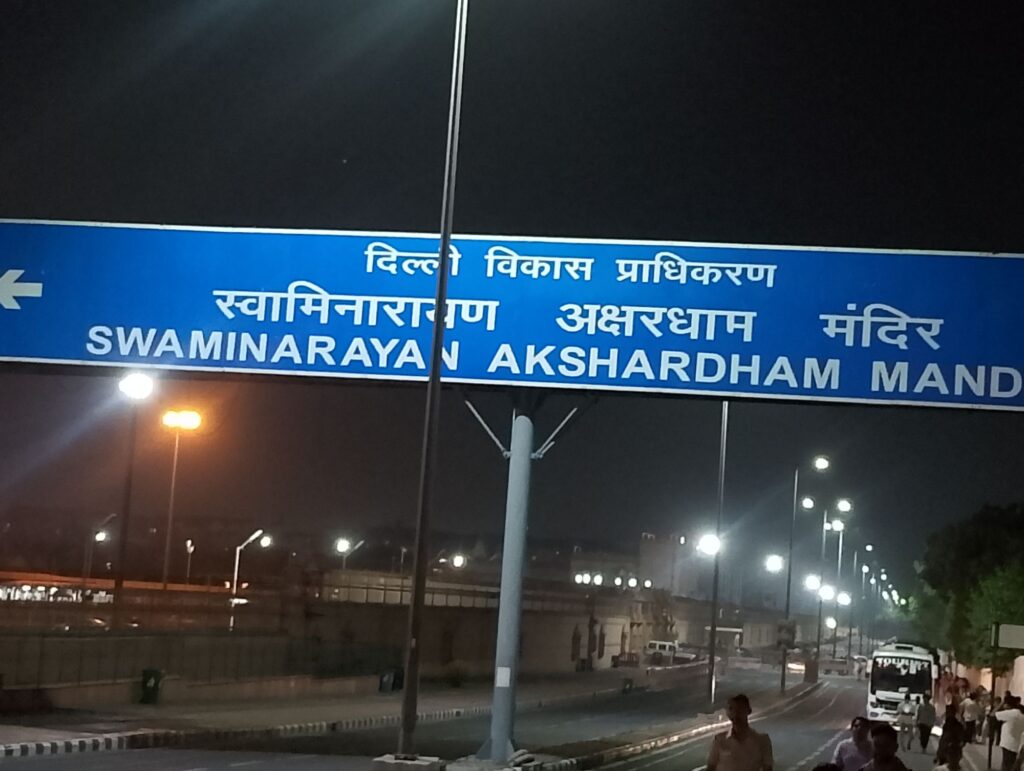
- By Bus & Auto :– Numerous city buses routing towards Anand Vihar, Noida, or Kashmere Gate pass via the NH-24 highway, stopping right at the Akshardham flyover cut. Local auto-rickshaws and app-based cabs are readily available across Delhi.
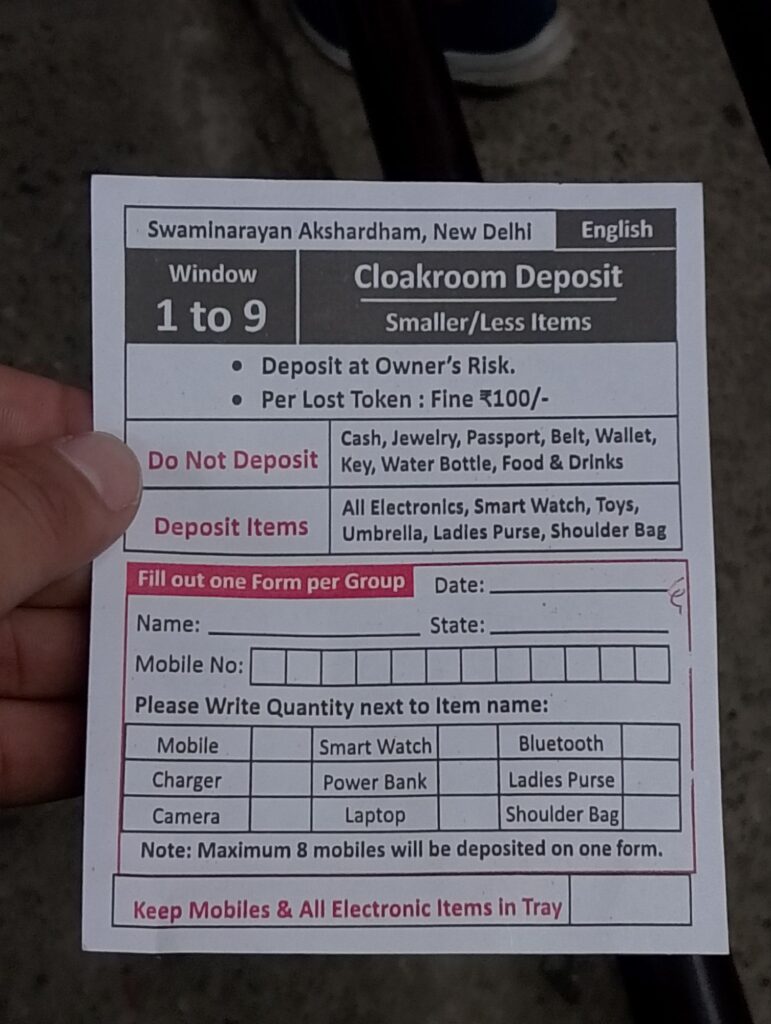
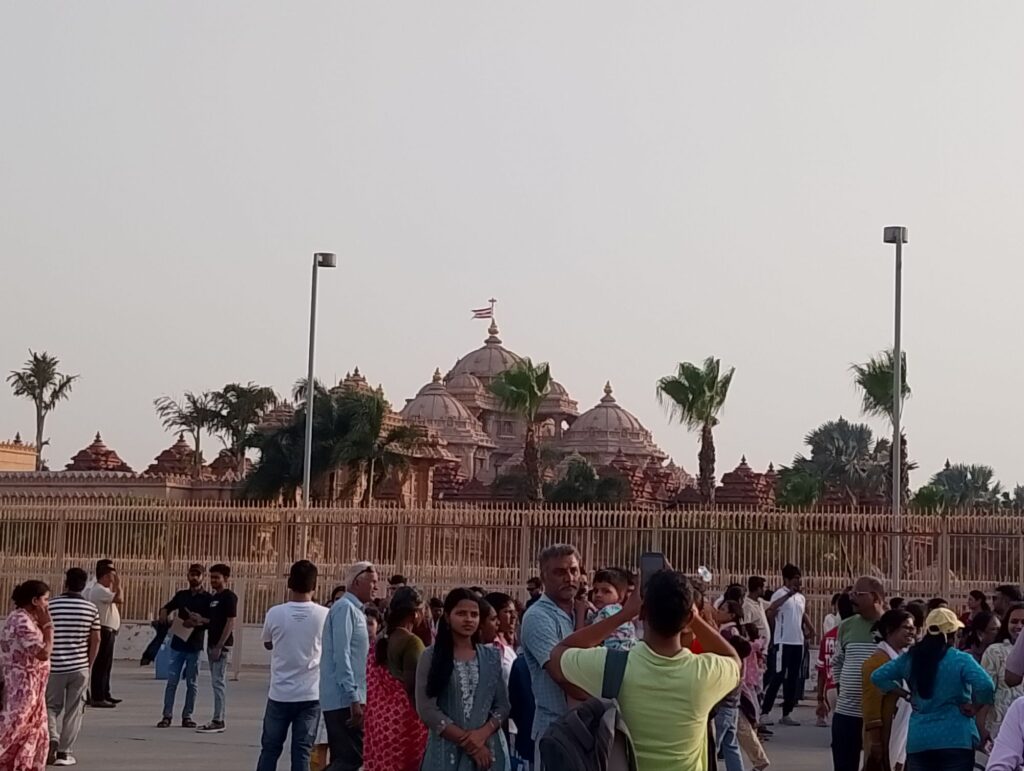
- Photography Spots :– Due to high-level security regulations, carrying mobile phones, cameras, or any electronic items inside the Akshardham complex is strictly prohibited. Consequently, interior photography is not possible. However, spectacular panoramic views of the entire temple structure can be captured from outside the main perimeter gate or from the elevated platform of the Akshardham Metro Station.
- Local Flavors :– Inside the complex lies the vast ‘Premvati Food Court’, which serves 100% pure vegetarian, satvik food. Local favorites such as hot Chole Bhature, authentic South Indian platters, traditional snacks like samosas and dhokla, and custom herbal ice creams are highly popular among travelers. Outside the complex gates, the nearby neighborhoods of Shakarpur and Mayur Vihar offer rich varieties of classic Delhi street food and paranthas.
- Famous Markets :– The internal Souvenir Shop offers an array of spiritual literature, authentic Ayurvedic wellness products, and traditional hand-carved handicrafts. For general clothing and local items, visitors can explore the nearby Laxmi Nagar Market or take a quick metro ride to Connaught Place.
Nearby Attractions in Detail
- Exhibitions & Water Show (In-house Highlights) :– The complex offers three phenomenal exhibitions—Sahajanand Darshan (Hall of Values, displaying moral parables through animatronic robotics), Neelkanth Darshan (a giant IMAX screen film tracking the epic journey of a young Swaminarayan across India), and Sans संस्कृति Vihar (a cultural boat ride traversing 10,000 years of ancient Indian inventions and Vedic civilization). At twilight, the complex hosts the ‘Sahaj Anand Water Show’, a breathtaking display involving multi-colored lasers, video projections, synchronized water jets, and live music.
- Sanjay Lake :– Positioned about 4 kilometers away in Trilokpuri, this is an expansive artificial lake surrounded by a green park. It offers a peaceful spot for paddle-boating and bird-watching amidst tranquil natural surroundings.
- Connaught Place :– Directly accessible via the metro Blue Line from Akshardham, visitors can reach Delhi’s iconic Georgian-style commercial arcade in just 15 minutes to enjoy top-tier shopping and premium dining options.
- Purana Qila (Old Fort) :– Located roughly 6 kilometers away, this is one of Delhi’s oldest fortresses, constructed by Sher Shah Suri and Humayun. The stone fort features beautiful stepwells, lake boating facilities, and a popular evening light and sound show.
Interesting Facts
- The entire structural layout of the main temple has been designed to endure for over a thousand years. Because iron and steel components were excluded from construction, there is zero risk of structural rusting or material degradation over centuries.
- The internal ‘Yagnapurush Kund’ stands as India’s largest stepwell-styled pool, engineered with 2,870 ritual steps and 108 minor shrines. This massive structure serves as the main arena for the evening laser water show.
- Surrounding the central monument is the ‘Narayan Sarovar’, a sacred water body filled with holy water carried from 151 prominent rivers, lakes, and traditional steps wells across India.
- To highlight the botanical and scientific wisdom of ancient India, the complex features ‘Yogi Hraday Kamal’, a massive sunken garden designed in the shape of a blooming sunflower, inscribed with philosophical quotes from world thinkers.
Important Questions and Answer :-
Question 1:- Can visitors carry mobile phones or bags inside Akshardham Temple?
Answer:– No, carrying mobile phones, digital cameras, USB drives, remote car keys, or any electronic items inside the Akshardham compound is strictly banned. Devotes must safely deposit these belongings at the free electronic luggage counter (Cloak Room) located right outside the main security checkpoint.
Question 2:- How much time is required to explore Akshardham and what is the ideal time to visit?
Answer:– If you only wish to visit the main sanctum for darshan, 1 to 2 hours are sufficient. However, if you intend to experience all three dynamic exhibitions and the evening laser water show, you should allocate at least 4 to 5 hours. Arriving around 2:00 PM is considered ideal.
Question 3:- Is Akshardham Temple open to public tourists on Mondays?
Answer:– No, Akshardham Temple is strictly closed to all tourists, visitors, and devotees on Mondays for maintenance. The complex operates from Tuesday to Sunday.
Author’s Thoughts :-
Akshardham Temple is far more than an intricate assemblage of pink stone and marble; it stands as a brilliant modern mirror reflecting the timeless spiritual depth and cultural grandeur of ancient India. Constructing a monumental, towering structure entirely out of interlocking stone blocks without a single ounce of structural iron or modern concrete represents a towering triumph of ancient masonry techniques in the modern world. Stepping into this serene sanctuary, completely detached from the constant buzz of mobile phones and fast technology, offers an immediate wave of inner peace. As a writer and traveler, I believe that a visit to Akshardham is an absolute must for anyone visiting Delhi, providing a rare opportunity to experience millennia of history, art, and human ethics integrated into a singular, mesmerizing masterpiece.
“A magnificent bridge connecting ancient craftsmanship with modern grandeur, this sacred sanctuary shines as a brilliant global beacon of India’s eternal heritage.”