Kartavya Path Delhi :- Complete History and Architecture
Located in the administrative and political heart of New Delhi, ‘Kartavya Path‘ (formerly known as ‘Rajpath‘ and originally ‘Kingsway‘ during the British Raj) is one of the most significant, historic, and majestic boulevards in India. Spanning nearly 3 kilometers through the center of the capital, this ceremonial avenue is not just a road, but a living monument to India’s democratic pride, sovereignty, and architectural brilliance. Every year on January 26, India’s historic Republic Day Parade moves along this very path, showcasing the nation’s military prowess and diverse cultural heritage to the global community.
Detailed History
The history of Kartavya Path is deeply intertwined with the early decades of the 20th century. When the British Empire decided to shift the capital of India from Calcutta (now Kolkata) to Delhi in 1911, an ambitious plan was conceived for a grand imperial administrative capital named ‘New Delhi‘. The responsibility of designing this monumental city was entrusted to the legendary British architects Sir Edwin Lutyens and Sir Herbert Baker.
The British constructed this central axis as a ceremonial boulevard to honor King George V, naming it ‘Kingsway’. Following India’s independence from colonial rule, this imperial name was changed to ‘Rajpath’, which was a direct Hindi translation of ‘Kingsway’.
In alignment with the aspirations of a modernizing India and the resolution to shed colonial mindsets, the Government of India launched a massive redevelopment initiative known as the ‘Central Vista Revitalization Project’. In September 2022, Prime Minister Narendra Modi inaugurated the newly redeveloped boulevard, formally renaming it ‘Kartavya Path’ (Path of Duty). This new nomenclature serves as a philosophical reminder to public servants and ordinary citizens alike of their constitutional duties toward the nation.
Detailed Architecture
The architecture and urban planning of Kartavya Path stand as a masterclass in combining classical grandeur with public utility. Following its state-of-the-art redevelopment, a detailed description of its exterior and structural design is outlined below.
Exterior Architecture
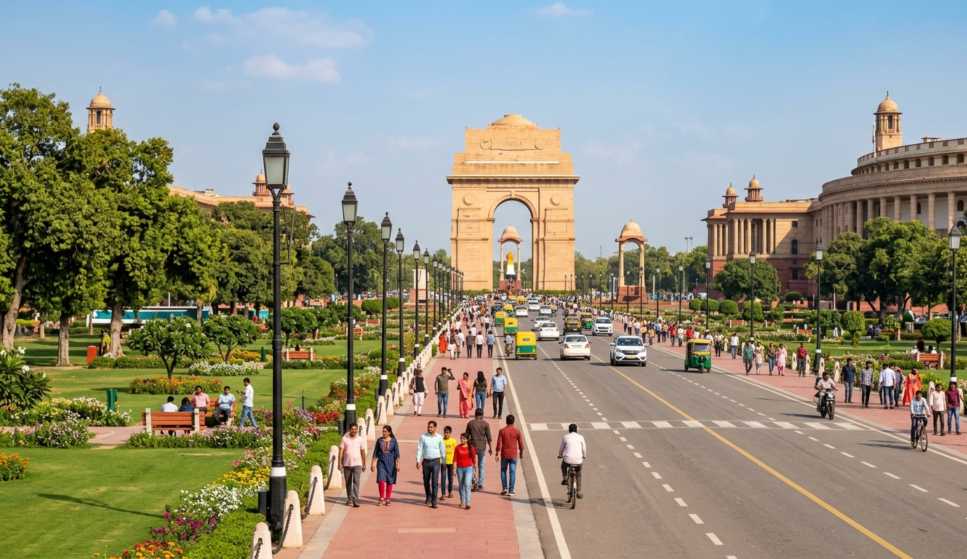
- Symmetrical Axial Layout :– Kartavya Path is a perfectly straight ceremonial avenue that establishes a powerful visual axis. It connects Rashtrapati Bhavan (perched on Raisina Hill) at its western end directly to the historic India Gate at its eastern terminus, presenting a flawless architectural symmetry.
- Red and Grey Granite Paving :– Under the recent redevelopment, the pedestrian walkways have been paved with over 16.5 kilometers of premium red granite tiles, which are resilient and echo traditional Indian masonry.
- Lush Canals and Fountains :– The avenue is flanked on both sides by expansive, meticulously manicured green lawns. Paralleling these lawns are historic water canals that have been updated with modern stepping fountains that put on a spectacular light show after dark.
Structural and Interior Details
- Underpasses and Pedestrian Transit :– To streamline high-volume traffic and safeguard the thousands of daily tourists, modern pedestrian underpasses have been integrated into Kartavya Path. This allows visitors to transition smoothly between the northern and southern lawns without crossing the main motor lanes.
- Heritage Lighting Refits :– Preserving the timeless aesthetics of the central axis, over 100 heritage-style light poles line the boulevard. These columns are fitted with advanced energy-efficient LED fixtures that bathe the entire avenue in a warm, regal glow at night.
- Eco-Friendly Infrastructure :– The modernized landscape incorporates solid waste management facilities, water recycling infrastructure for the canals, and hundreds of freshly planted native trees, making it one of the cleanest and greenest public promenades in Delhi.
Travel Guide & Routes
If you are planning to experience the transformed public space of Kartavya Path, here is a complete travel guide including transit info and timings.
- Ticket (Entry Fee) :– Walking along Kartavya Path or lounging in its surrounding public lawns is completely Free of cost. No ticket or prior booking is required.
- Visiting Time :– The avenue is accessible to the public 24/7. However, to avoid daytime heat, the ideal window to visit is between 5:00 PM and 9:00 PM when the twilight brings out the brilliant architectural illuminations.
- Photography Spots :– Capturing the clean line of sight toward India Gate from the slopes of Raisina Hill, the reflection of Rashtrapati Bhavan in the flanking canals, and evening frames against the vintage light poles make for excellent photography spots.
- Local Food :– The redeveloped avenue features designated, hygienic ‘Vending Zones’. Here, tourists can sample classic Delhi street items like Alu Chaat, Bhelpuri, Golgappas, kulfi, cotton candy, and the highly popular late-night ice creams.
- Nearby Markets :– The closest market is the vibrant Janpath Market, widely celebrated for regional textiles and handcrafts. The commercial circle of Connaught Place (CP) is also located just a short distance away.
How to Reach :-
- By Metro :– The most convenient metro station is ‘Central Secretariat’, which serves as an interchange node for the Yellow and Violet Lines. Additionally, the ‘Udyog Bhawan’ metro station (Yellow Line) sits directly parallel to the avenue.
- By Bus :– Central Delhi is extensively connected by public buses. Any DTC bus route terminating at Central Secretariat, Connaught Place, or Delhi Gate will pass close to the entry access points of the path.
- By Air :– The Indira Gandhi International Airport (IGI) is located approximately 13 kilometers away from this central zone.
- By Rail :– New Delhi Railway Station is roughly 5 kilometers away, while Hazrat Nizamuddin Railway Station is located about 6 kilometers from the boulevard.
Nearby Attractions
- Rashtrapati Bhavan :– Standing majestically at the western end of the path, it is the official palatial residence of the President of India, renowned for its classical symmetry.
- India Gate :– Positioned at the eastern terminus of the path, it is India’s signature national war memorial carrying the etched names of historical martyrs.
- National War Memorial :– Located right behind the India Gate roundel, this state-of-the-art monument pays tribute to the armed forces personnel who made the ultimate sacrifice in post-independence conflicts.
- North & South Blocks :– These structural wings flanking the presidential palace house the core administrative offices of India’s Ministries of Home Affairs, Finance, and External Affairs.
- New Parliament House :– Located just off the main axis, this newly constructed, triangular architectural marvel represents the modern temple of Indian democracy.
- National Museum :– Situated at the Janpath intersection of the path, this institution holds a legendary repository of ancient Indian antiquities dating from the Indus Valley Civilization onward.
Interesting Facts
- The Nominal Evolution :– It is one of the rare ceremonial avenues globally to have held three distinct names reflecting historical shifts from the colonial empire to an independent republic and finally a duty-bound democracy (Kingsway -> Rajpath -> Kartavya Path).
- Massive Green Infrastructure :– The Central Vista Project systematically revitalized and leveled over 400,000 square meters of public lawns flanking the main transit tracks.
- Solid Stone Refits :– Rather than using poured concrete, the stepped banks of the historic canals were rebuilt using solid blocks of red granite to prevent water seepage while maintaining structural heritage.
Important Questions and Answer :-
Question 1:– Where exactly is Kartavya Path located in Delhi?
Answer:– Kartavya Path is located within the Central Vista area of New Delhi, creating the central core axis that connects Rashtrapati Bhavan to India Gate.
Question 2:- When and why was Rajpath renamed to Kartavya Path?
Answer:– It was formally renamed in September 2022 to shed the vestiges of colonial terminology and emphasize the spirit of public duty and civic responsibility in modern India.
Question 3:– What is the total length of Kartavya Path?
Answer:– The total distance of Kartavya Path from the gates of Rashtrapati Bhavan to the arch of India Gate is approximately 3 kilometers (2.2 miles).
Question 4:- Is the general public permitted on Kartavya Path late at night?
Answer:– Yes, Kartavya Path is open 24 hours a day to the public, and its advanced security presence and brilliant nocturnal lighting make it a highly favored destination for late-night strolls.
Author’s Thoughts
Kartavya Path is far more than a meticulously paved stretch of asphalt; it is the silent witness to India’s epochal journey from colonial subjugation to the world’s most vibrant democracy. While the British designed ‘Kingsway’ to display imperial dominance over the populace, today’s ‘Kartavya Path’ stands as a democratic space that belongs entirely to the citizens of India. The thoughtful architectural updates—from the red granite walkways to the illuminated stepping fountains—have significantly enhanced its monumental character without losing its historic soul. Walking down this path as the evening lights turn on offers not just a scenic retreat from the city’s rush, but a powerful, up-close view of a nation moving confidently toward its future.
“Bridging the architectural grandeur of Raisina Hill with the eternal valor of India Gate, Kartavya Path stands as a majestic testament to a nation marching ahead with a clean purpose and resolute duty.”