
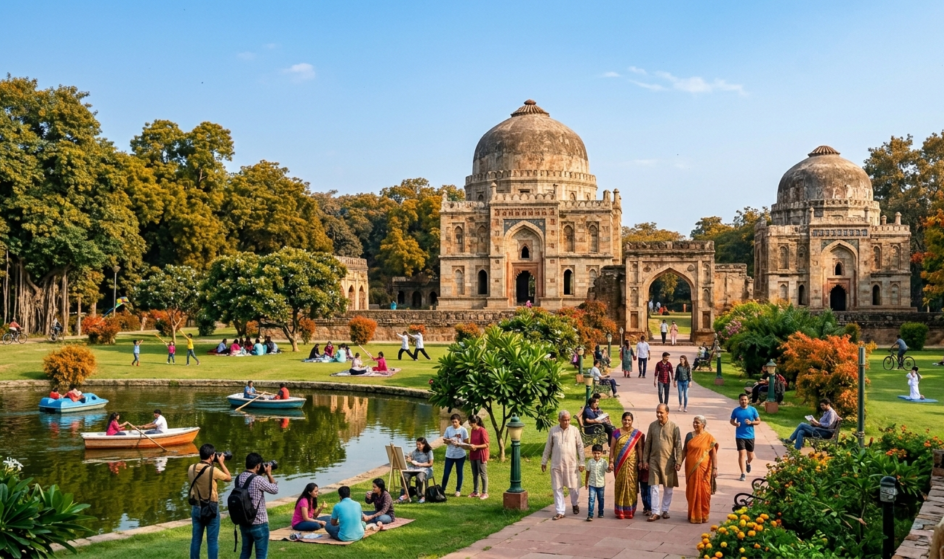
Lodhi Garden Delhi :- Complete History and Architecture
Situated near the affluent Khan Market in New Delhi, ‘Lodhi Garden‘ is one of the most picturesque, historically significant, and widely visited public parklands in India’s capital city. Spread across a sprawling 90 acres of beautifully landscaped terrain, this iconic destination is celebrated not just for its extensive green canopies, but also for its magnificent architectural inheritance—featuring ancient mausoleums and structural remains belonging to the Sayyid and Lodhi dynasties that ruled parts of India during the 15th and 16th centuries. Serving as a preferred morning walk and yoga sanctuary for Delhi’s politicians, bureaucrats, and local residents alike, the park seamlessly transforms into a favorite hub for nature enthusiasts, history buffs, and families seeking a serene afternoon picnic.
Detailed History :-
The operational history of Lodhi Garden is deeply rooted in the twilight years of the Delhi Sultanate. The primary architectural structures within the grounds were constructed during the independent regimes of the Sayyid dynasty ruler, Sultan Muhammad Shah (1434–1444), and the prominent Lodhi dynasty sovereign, Sultan Sikandar Lodhi (1489–1517). Following their demises, these rulers were interred here within elaborate structural tombs surrounded by vast designated fields.
During the subsequent Mughal era, the grand architectural monuments were structurally maintained, but over time, local settlements and small agricultural villages (collectively known as Khairpur) developed all around the tombs. During the British Raj, Lady Willingdon, the wife of the then Governor-General of India, Lord Willingdon, conceived a master plan to clear the historic zone and transform it into a premier landscaped public garden. In April 1936, the old village structures were successfully relocated, and a beautifully manicured garden landscape was introduced encircling the historic tombs. The colonial administration subsequently named the facility ‘Lady Willingdon Park’.
Following India’s independence in 1947, the municipal authorities appropriately renamed the urban landscape ‘Lodhi Garden’ to honor the historical roots of the location. In 1968, the eminent American landscape architect J.A. Stein, along with Margaret Stein, collaborated with the Government of India to comprehensively re-engineer the public spaces—introducing structural enhancements including an operational greenhouse, a central artificial lake, and symmetrical paved walking paths that significantly elevated its layout.
Detailed Architecture :-
The architectural installations dotted across Lodhi Garden present a brilliant evolutionary phase of Indo-Islamic architecture. The layout captures a definitive structural transition from the octagonal planning models popularized during the Sayyid period to the massive square-form layouts preferred by the Lodhi builders. The structural and interior architecture is detailed below:
Exterior Architecture
- Tomb of Muhammad Shah :– Positioned visibly from the peripheral roads, this is one of the earliest monumental structures within the garden. It exhibits a classic octagonal planning layout bounded by supportive deep verandas, decorative stone chhatris (pavilions), and a massive central dome that defines the architectural gravity of the Sayyid era.
- Bara Gumbad (The Grand Dome) :– Situated prominently at the core center of the parklands, this is a colossal, square-form monument with a soaring profile. True to its name, it carries a magnificent, high-dome crown. The main tower is structurally integrated with a historical three-domed assembly mosque and a residential guest house (Mehman Khana) displaying fine exterior carvings.
- Sheesh Gumbad (The Glass Dome) :– Positioned directly opposite the Bara Gumbad complex, this structure is historically referred to as the glass-clad dome. In its prime, the exterior facade was covered with striking blue-glazed ceramic tiles that reflected sunlight like mirrors. Significant fragments of these vibrant tiles are still visible upon the high walls.
- Tomb of Sikandar Lodhi :– Located at the northern section of the parklands, this mausoleum features an advanced security profile. It is enclosed within a massive fortified boundary wall reinforced with bastions, lending it the defensive appearance of a compact citadel, centered around a flawless octagonal tomb.
Interior Architecture :-
- Intricate Mosque Calligraphy :– The inner arches of the mosque attached to the Bara Gumbad feature highly sophisticated stone-cut incisions displaying verses from the Holy Quran and crisp geometric patterns that showcase the refined craftsmanship of Islamic artisans.
- Incised Incrustations and Plasterwork :– The interior ceilings and inner domes of the Sheesh Gumbad and Muhammad Shah’s tomb display excellent incised plaster medallions and floral geometric decorations that remain remarkably preserved. The interior floors contain multiple aligned stone graves belonging to forgotten rulers and family members.
- Athpula Bridge :– Spanning across the lake in the eastern sector of the garden, this is a spectacular Mughal-era eight-pier stone bridge. It was commissioned during the reign of Emperor Akbar by Nawab Bahadur Khan. The structural arches beneath the bridge are engineered to distribute water currents efficiently while maintaining structural longevity.
Travel Guide & Routes
If you are planning to experience the tranquil heritage trails of Lodhi Garden, here is a complete structural travel and visitor guide:
- Ticket (Entry Fee) :– Admission to the entire Lodhi Garden complex is absolutely Free of cost for all domestic and international travelers. There are no fees associated with touring or holding family picnics.
- Visiting Time :– The garden is accessible all 7 days of the week. The general operating hours are from 5:00 AM to 8:00 PM during the summer months and from 6:00 AM to 8:00 PM during the winter season. The early morning hours and the golden twilight windows offer the most scenic and atmospheric conditions.
- Photography Spots :– Capturing the symmetry of the Athpula Bridge with the reflection of the monuments in the lake, shooting through the deep shadowed entryways of Sheesh Gumbad, and wide frames centering Muhammad Shah’s tomb amidst the green lawns are highly celebrated photography spots for heritage and pre-wedding shoots.
- Local Food :– Located right near Gate No. 1 of the garden is ‘The Lodhi – Garden Restaurant’, famous for its lush open-air dining setup and excellent Italian and European delicacies. For diverse culinary options, the adjacent Khan Market offers legendary local seekh kebabs, kathi rolls, quick street food, and top-rated premium cafes.
- Nearby Markets :– The world-famous and premium Khan Market is right next door, serving as a high-end destination for luxury brands, independent bookshops, and boutique apparel. The cultural stalls of Delhi Haat INA are also located nearby.
How to Reach :-
- By Metro :– The most accessible metro options are ‘Jor Bagh’ Metro Station (on the Yellow Line) and ‘Khan Market’ Metro Station (on the Violet Line). Both stations are situated within a convenient 1-kilometer radius of the garden entrances, easily coverable via a quick walk or a brief e-rickshaw ride.
- By Bus :– The central road network of Lodhi Road is extensively serviced by DTC public buses. Routes heading toward Lodhi Colony, Khan Market, or Central Secretariat drop commuters within a short walking distance of the access gates.
- By Air :– The Indira Gandhi International Airport (IGI) is located approximately 14 kilometers away from the park grounds.
- By Rail :– New Delhi Railway Station is roughly 6 kilometers away, while the Hazrat Nizamuddin Railway Station sits a close 4.5 kilometers to the east.
Nearby Attractions
- Safdarjung Tomb :– Positioned just 1.5 kilometers away from the garden, it is the last monumental enclosed garden-tomb of the Mughal era, renowned for its grand vertical scale and fountains.
- Humayun’s Tomb :– Located 3.5 kilometers away, this spectacular UNESCO World Heritage Site represents the absolute pinnacle of early Mughal architecture and served as the direct design precursor to the Taj Mahal.
- Sunder Nursery :– An expansive, beautifully redeveloped 16th-century heritage parkland adjacent to Humayun’s Tomb, highly favored by naturalists and birdwatchers.
- Khan Market :– Delhi’s premier retail and dining market hub, widely recognized for high-end designer stores, independent bookshops, and diverse global restaurants.
- India Gate :– Situated just 3 kilometers down the road axis, it represents India’s definitive national war memorial and the sprawling public lawns of Kartavya Path.
- National Crafts Museum :– Located close to Pragati Maidan, this unique destination showcases a living village setup and rich regional handcraft traditions from across various Indian states.
Interesting Facts
- The Displaced Khairpur Settlement :– To lay out the grand colonial landscape of Lady Willingdon Park, the British administration completely evacuated and relocated an entire historical hamlet called Khairpur village that had occupied the ruins for centuries.
- Botanical and Avian Paradise :– Far exceeding a standard urban park, Lodhi Garden accommodates over 100 rare tree species, an extensive dedicated Rose Garden, a specialized Bonsai enclave, and serves as an important sanctuary for migratory birds and urban butterflies.
- Cinematic Prominence :– Owing to its striking combination of structural history and raw natural beauty, the park has been featured prominently as a filming location for several blockbusters, including Bollywood films like Rang De Basanti, Chak De! India, and Fan.
Important Questions and Answer :-
Question 1:- Where exactly is Lodhi Garden situated and what is the closest transit point?
Answer:– Lodhi Garden is located on Lodhi Road in the central diplomatic area of New Delhi. The nearest transit choices are the Jor Bagh station (Yellow Line) and the Khan Market station (Violet Line).
Question 2:- Which historical eras do the monuments within Lodhi Garden belong to?
Answer:– The primary structural tombs and mosque installations belong to the late Delhi Sultanate phase, specifically commemorating rulers of the Sayyid and Lodhi dynasties across the 15th and 16th centuries.
Question 3:- Is there a booking fee required to host an afternoon family picnic in the lawns?
Answer:– No, the parklands are entirely public-access, and lounging or organizing small picnics within the manicured lawns is completely free of charge.
Question 4:- When is the ideal season to experience the flora of Lodhi Garden?
Answer:– The winter and spring stretch from October to March is the prime time to visit. The daily climate remains comfortably cool, and the seasonal flower beds and rose gardens are in peak visual bloom.
Author’s Thoughts
Lodhi Garden is much more than a green lung for the national capital; it is a profound temporal bridge where the rich historical legacy of Delhi effortlessly coalesces with its dynamic contemporary life. Walking past these towering centuries-old stone structures, one is struck by the beautiful contrast of old monuments coexisting with families enjoying sunny picnics, artists sketching arches, and joggers keeping fit under the shade of ancient trees. In a fast-paced metropolis defined by glass facades and heavy traffic, Lodhi Garden provides an invaluable emotional and psychological sanctuary. The clean geometry of the tombs blended with the soft textures of blooming rose beds forces you to slow down and reflect. A journey through New Delhi is fundamentally incomplete without spending a quiet evening watching the sunset cast its golden glow on the magnificent dome of the Bara Gumbad.
“Cradled tenderly in the lap of ancient green glades, these silent stone monuments continue to breathe the grand historical legends of a bygone era into the busy skies of modern Delhi.”