
Detailed History
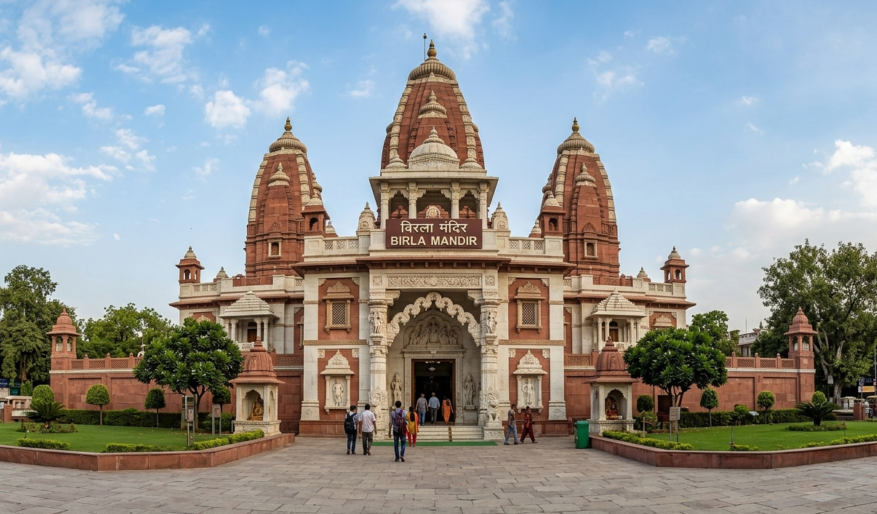
The Birla Mandir of Delhi, officially known as the Lakshminarayan Temple, is one of the most prominent and historically significant religious landmarks in the capital city. The construction of this grand temple was initiated in 1933 by the renowned Indian industrialist Baldeo Das Birla and his son Jugal Kishore Birla, and it was fully completed in 1939. A deeply profound historical aspect of this temple is that it was inaugurated by the Father of the Nation, Mahatma Gandhi. Upon being invited, Gandhiji laid down a strict condition for its inauguration: the temple must be open to people of all castes, creeds, and social backgrounds (especially the marginalized sections of society) without any discrimination. The temple is dedicated to Lord Vishnu (Narayan) and the goddess of wealth and prosperity, Lakshmi.
Detailed Architecture
The Lakshminarayan Temple is a magnificent blend of modern and traditional Hindu architectural styles. Its design was crafted by the celebrated architect Sris Chandra Chatterjee, who incorporated the core principles of the ‘Swadeshi Architecture Movement’ into its structure.
- Exterior Architecture :– The temple is predominantly built using vibrant red sandstone and Kota stone, beautifully accented with intricate white marble carvings. The main spire (Shikhara) rises to a towering height of approximately 160 feet (49 meters), exhibiting the classic Nagara style of temple architecture. Facing the East, the temple is situated on a high elevated plinth, which significantly enhances its grand and majestic visual appeal.
- Interior Architecture :– The sanctum sanctorum (Garbhagriha) houses exquisitely carved idols of Lord Lakshminarayan, sculpted by skilled artisans from Jaipur using pure white Makrana marble. The interior walls are adorned with stunning Jaipur-style fresco paintings that vividly bring to life scenes from Hindu mythology, the Vedas, and the Upanishads. Apart from the main deities, the sprawling complex features separate dedicated shrines for Lord Shiva, Goddess Durga, Lord Hanuman, and Lord Buddha. The backside of the temple features a massive artificial garden (fountain park) and beautifully constructed caves for visitors to explore.
Travel Guide & Routes
- Ticket and Fees :– Entry to the Birla Mandir is completely Free for all visitors. There are no entry charges or fees of any kind.
- Visiting Time :– The temple is open to devotees and tourists from 4:30 AM to 1:30 PM, and from 2:30 PM to 9:00 PM. The temple sees an immense surge of celebrations and modified timings during major festivals like Janmashtami and Diwali.
- How to Reach :–
- By Metro :– The nearest metro stations to the temple are the ‘RK Ashram Marg Metro Station’ (Blue Line) and the ‘Shivaji Stadium Metro Station’ (Orange/Airport Express Line). From either station, you can reach the temple in 5-10 minutes via a short walk or an e-rickshaw.
- By Road :– Located on Mandir Marg near Connaught Place in Central Delhi, the temple is highly accessible. You can easily reach here from any part of Delhi using public buses, auto-rickshaws, or app-based cabs.
- Photography Spots :– Due to strict security regulations, mobile phones, cameras, and all electronic gadgets are completely prohibited inside the main temple building (free secure locker rooms are provided to store them). However, brilliant photographs can be captured around the outer complex, the majestic main entrance gate, and the beautiful fountains and gardens located at the back.
- Local Food :– The immediate vicinity of the temple features small street-food stalls serving Delhi’s famous local chaat, golgappas, and kachoris. For a more elaborate dining experience, the iconic Connaught Place (CP) is just 1.5 kilometers away, offering a vast array of premium cafes, bakeries, and multi-cuisine restaurants.
- Famous Markets :– The historic Gole Market and the premium shopping hubs of Connaught Place are located close to the temple. These markets are excellent for shopping for handicrafts, traditional clothing, books, and various souvenirs.
Author’s Thoughts (Cultural Perspective)
In my perspective, Delhi’s Birla Mandir is not merely a religious structure carved out of stone and marble; it is a living monument to modern India’s social reform and cultural harmony. When Mahatma Gandhi inaugurated this temple on the foundational condition of absolute social equality, the seeds of inclusivity were permanently sown into its spiritual fabric. Amidst the fast-paced, bustling life of contemporary Delhi, this temple complex offers a profound oasis of spiritual peace where one can instantly find inner tranquility. The temple stands as a beautiful testament to how ancient heritage and modern progressive values can blend seamlessly to guide society forward. The indigenous pride reflecting through its architecture serves as an enduring inspiration for every visitor to connect deeply with their roots.
Interesting Facts
- The Birla Mandir was the very first large-scale Hindu temple built in modern Delhi, serving as the architectural and cultural blueprint for numerous other ‘Birla Temples’ constructed across India later on.
- The walls of the temple are unique because they do not just display religious icons; they are inscribed with timeless quotes, philosophical thoughts, and verses from ancient Indian rishis, scientists, and philosophers, giving it an educational dimension.
- The entire construction was executed exclusively using Indian artisans, native materials, and homegrown architectural styles, reflecting the fierce nationalistic spirit of the ‘Swadeshi Movement’ of that era.
Important Questions and Answer :-
Question 1:- What is the official name of Delhi’s Birla Mandir and to whom is it dedicated?
Answer:- The official name of the Birla Mandir is the ‘Lakshminarayan Temple’, and it is dedicated to Lord Vishnu (Narayan) and his consort, the Goddess of prosperity, Lakshmi.
Question 2:- Who inaugurated the Birla Mandir and what was the condition attached to it?
Answer:- The temple was inaugurated in 1939 by Mahatma Gandhi. His mandatory condition was that the temple gates must remain open to all sections and castes of society equally, without any form of untouchability or discrimination.
Question 3:– Is photography allowed inside the Birla Mandir?
Answer:- No, due to security measures and religious decorum, cameras, smartphones, and photography are strictly prohibited inside the main inner sanctum of the temple. They must be safely deposited at the luggage counter outside.
“Birla Mandir is that sacred threshold of faith where the heritage of social harmony and the divine light of spirituality meet as one.”