
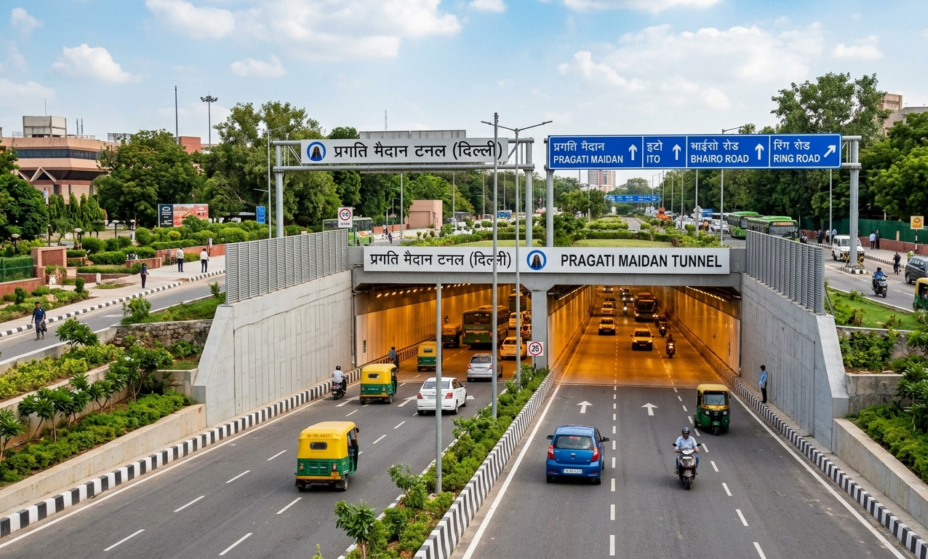
Pragati Maidan Tunnel, Delhi :- An Architectural Marvel of Art, Modernity, and Speed
In a sprawling metropolis like Delhi, where traffic congestion is an everyday hurdle, the Pragati Maidan Tunnel stands out as a magnificent testament to modern engineering, time optimization, and artistic excellence. As Delhi’s first smart and longest road tunnel, it does not merely ease your daily commute; the moment you step inside, it transitions into an upscale subterranean art gallery. Running right beneath the redeveloped International Exhibition-cum-Convention Centre (Bharat Mandapam), this corridor is a true pride of the national capital.
Detailed History
The tunnel was conceived and constructed under the ambitious Pragati Maidan Integrated Transit Corridor Project.
- Inception and Purpose :– The construction work on this mega project commenced in March 2018. The prime objective was to establish a signal-free connection between Central Delhi and East Delhi, Noida, and Ghaziabad, thereby bypassing the perennially choked ITO junction and Bhairon Marg.
- Budget and Inauguration :– Built at an expenditure of approximately ₹920 crore, funded entirely by the Central Government, the project overcame immense technical complexities and multiple lockdowns. After missing five deadlines, it was finally inaugurated by Prime Minister Narendra Modi on June 19, 2022.
- Environmental Dividend :– According to government estimates during its launch, the integrated corridor helps save around 55 lakh liters of fuel daily. This significantly slashes vehicular emission loads, driving Delhi closer to a greener and cleaner atmosphere.
Detailed Architecture
The Pragati Maidan Tunnel is a masterclass in civil engineering and high-end tech integration, spanning a length of 1.3 kilometers.
- Main Structure & Interior Design :– It features a spacious 6-lane configuration (a 3-lane dual carriageway). The tunnel originates near the National Sports Complex of India (NSCI) on Purana Qila Road and cuts directly beneath the sprawling Pragati Maidan complex to culminate at the Ring Road near the Pragati Power Station. Impressively, engineers executed the tunneling right below 7 functional railway tracks without disrupting train schedules. Inside, a dedicated entry/exit loop seamlessly links to the massive underground parking basement of Bharat Mandapam.
- Exquisite Murals :– The internal walls serve as a massive canvas celebrating India’s rich cultural heritage. Commuters are treated to hand-painted and digital murals showcasing traditional festivals, the six Indian seasons, indigenous folk arts, and local avifauna stretching from Kashmir to Kanyakumari. The brilliant ambient lighting accentuates these paintings, turning a mundane drive into a surreal experience.
- Exterior Framework & Smart Tech :– The entrance and exit portals boast a clean, futuristic architectural design. Structurally, the tunnel is managed via a centralized digital control room with integrated public announcement systems. Specially designed German-made exhaust fans ensure continuous air ventilation. To mitigate any risks of monsoon flooding, seven automated underground sumps have been built to instantly collect and pump out rainwater.
Travel Guide & Routes
Since the Pragati Maidan Tunnel is functionally a transit freeway rather than a traditional tourist monument, here is the structured layout for commuters and visitors.
- Opening Times :–
- The tunnel allows vehicular movement from 06:00 AM to 10:00 PM daily.
- Note:– It remains closed during the late-night hours for comprehensive cleaning and security maintenance.
- Ticket Prices :– There is no toll tax or entry fee to pass through this tunnel. It is completely Free for the public.
- How to Reach & Routes :–
- From Central/Lutyens’ Delhi :– If driving from India Gate or Supreme Court, enter the tunnel through the access ramp on Purana Qila Road (near NSCI).
- From Noida/Ghaziabad/East Delhi :– If commuting via the Ring Road or Sarai Kale Khan, enter through the access point near the Pragati Power Station.
- Nearest Metro Station :– The nearest transit hub is the Supreme Court (formerly Pragati Maidan) Metro Station on the Blue Line.
- Photography Spots :– Due to strict transit safety regulations, stopping vehicles or walking inside the tunnel is rigorously prohibited and monitored by speed/surveillance cameras to prevent accidents. However, co-passengers can comfortably capture stunning slow-motion videos or cinematic reels of the murals through the car window. Safe photography can also be done around the exterior entry architecture from a distance.
- Local Flavors :– Right outside the transit stretch near Matka Peer, you can relish the legendary Mughlai kebabs and biryani at ‘Babu Shahi Bawarchi’ or head to the elite cafes of nearby Kaka Nagar.
- Famous Nearby Markets :– The ultra-premium Khan Market and the historic Bengali Market are just a short drive away, offering premier shopping and iconic Delhi street food.
Nearby Attractions
You can comfortably integrate a drive through the Pragati Maidan Tunnel with visits to these surrounding landmarks.
- Bharat Mandapam :– The state-of-the-art international convention center sitting right above the tunnel, famous for hosting the global G20 Summit.
- Purana Qila (Old Fort) :– Located right across the eastern mouth of the tunnel, this historic fort offers scenic lake boating and a captivating evening Light and Sound show.
- National Zoological Park (Delhi Zoo) :– Flanking the Old Fort, this expansive zoo serves as an ideal weekend getaway for families.
- National Crafts Museum :– Situated on Bhairon Marg, it beautifully preserves Indian rural heritage, textile history, and tribal arts.
- Supreme Court Museum :– Located in close proximity, it gives deep insights into the evolution of the Indian judicial system.
Interesting Facts
- Underneath 7 Railway Lines :– The engineering team successfully accomplished the monumental challenge of carving the tunnel beneath 7 busy arterial railway tracks without halting a single train.
- Saving 15 Minutes of Commute :– Prior to its construction, crossing the ITO bottleneck during peak hours took at least 15–20 minutes. The tunnel cuts down this commute time to just under 2 minutes.
- India’s Longest Underground Art Gallery :– Thanks to the uninterrupted chain of heritage artwork decorating the walls, it is informally recognized as the longest subterranean art gallery in the country.
- Smart Sensors :– The infrastructure is guarded by intelligent rain sensors that automatically activate high-capacity drainage pumps at the slightest hint of water accumulation.
Important Questions and Answer :-
Question 1:– Are two-wheelers allowed inside the Pragati Maidan Tunnel?
Answer:– Yes, all light motor vehicles, including cars, auto-rickshaws, and two-wheelers, are permitted inside the tunnel. However, heavy commercial trucks and interstate buses are strictly barred.
Question 2:– Can tourists walk inside the tunnel to view the artwork closely?
Answer:– Absolutely not. Walking, cycling, or halting your vehicle to take selfies inside the tunnel is a serious traffic violation. The entire facility is monitored by PWD and Traffic Police CCTVs, and violators are heavily penalized.
Question 3:– Is the tunnel operational 24/7?
Answer:– No, the tunnel does not stay open through the night. For security checks, structural maintenance, and regular cleaning, it shuts down at 10:00 PM and reopens at 06:00 AM.
Author’s Thoughts
In my perspective, the Pragati Maidan Tunnel is not merely a passageway of concrete, bitumen, and steel; it is a dynamic mirror of a progressive and tech-driven ‘New India’. Most transit underpasses are conventionally dark, monotone, and claustrophobic. However, the ingenious integration of India’s cultural tapestry across the walls transforms a tedious traffic crawl into an uplifting visual journey. Driving through it evokes an undeniable sense of pride in our domestic civil engineering capabilities. It has effectively redefined urban commuting in Delhi, blending everyday utility with sublime aesthetic art.
S“A magical subterranean corridor where high-speed transit meets the vibrant canvas of Indian heritage—that is the Pragati Maidan Tunnel.”