
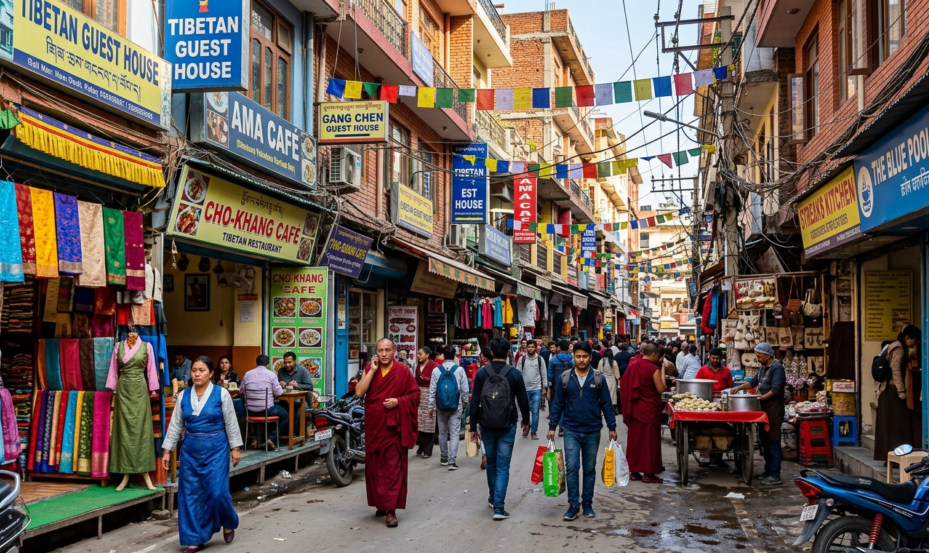
Majnu ka Tila, New Delhi :- The Vibrant Tapestry of Capital’s ‘Little Tibet’ and Cultural Oasis
Perched gracefully on the banks of the Yamuna River in North Delhi, Majnu ka Tila (MKT) stands as one of the most uniquely mesmerizing, colorful, and tranquil enclaves in the National Capital Region. Officially designated as ‘New Aruna Nagar,’ this urban settlement is globally celebrated as Delhi’s very own “Little Tibet.” Stepping out of the chaotic rush of the Outer Ring Road and entering the labyrinth of MKT’s narrow, winding alleys instantly transports you from the plains of Delhi straight into a serene Himalayan hamlet akin to Dharamshala. Its deep-rooted Buddhist spiritualism, spinning prayer wheels, burgeoning indie-cafe culture, and exceptional culinary offerings make it a high-velocity magnet for youth, backpackers, and cultural explorers alike.
Detailed History
The soil of Majnu ka Tila holds a multi-layered historic lineage, intertwining early medieval Sikh spiritual history with the mid-20th-century geopolitical displacement and rehabilitation of the Tibetan community.
- The Sufi Saint and Nomenclature :– The historical origins of the name trace back to the 15th century during the reign of Sikandar Lodi. A reclusive Iranian Sufi saint named Abdulla established a hermitage atop this high clay mound along the Yamuna. His profound, ecstatic absorption in divine love led the locals to give him the epithet ‘Majnu’ (the crazed lover). He routinely ferried travelers across the river free of charge as a form of spiritual service.
- The Historic Visit of Guru Nanak Dev Ji :– In the year 1505, the foundational spiritual leader of Sikhism, Guru Nanak Dev Ji, arrived at this mound during his travels. Deeply moved by Majnu’s pure devotion, the Guru spent considerable time indexing spiritual discourses here. Centuries later, in 1783, the legendary Sikh military leader Baghel Singh constructed the historic Gurudwara Majnu ka Tila to institutionalize the memory of that sacred meeting.
- The Tibetan Resettlement (The Dawn of Little Tibet) :– The contemporary cultural geography of MKT took shape between 1959 and 1960. Following the flight of His Holiness the 14th Dalai Lama from Tibet, thousands of Tibetan refugees sought political asylum in India. The Government of India allocated this specific riverfront tract for their temporary rehabilitation. Over the ensuing decades, the community transformed this once-barren ridge into a thriving, self-sustaining micro-economy and an essential cultural repository.
Detailed Architecture
The architectural structuralism of Majnu ka Tila sharply diverges from the standard urban geometry of New Delhi, reflecting a high-density, vertical alpine-style settlement layout adapted to an urban grid.
- The Alleyway Matrix and Spatial Design :– The colony is engineered entirely as a pedestrianized zone composed of ultra-narrow, interlocking concrete alleyways where vehicular entry is physically impossible. Multi-story residential blocks rise steeply on either side, utilizing a mixed-use model where ground floors house stylized cafes, boutiques, and bakeries, while the upper structural tiers serve as family quarters or community guest houses.
- The Central Monastery and Sacred Stupa :– The spatial core of the colony opens into a central public courtyard anchored by a beautifully detailed Buddhist Monastery and a soaring, gold-accented Buddhist Stupa. The base of the stupa is ringed with a continuous sequence of embossed copper Prayer Wheels (Mani Wheels) that pedestrians ritually rotate. The monastery façade features brilliant pigments of crimson, indigo, and gold, adorned with intricate hand-painted Thangka iconographies and traditional Tibetan eave structures.
- Visual and Semiotic Accents :– The skyline across the narrow avenues is heavily saturated with dense webs of multi-colored Tibetan Prayer Flags (Lungta), which add dynamic movement and cultural symbolism to the airspace. Doorways are uniformly framed with heavy woven fabric drapes and traditional dragon motif carvings, reinforcing the authentic architectural vernacular of trans-Himalayan settlements.
Travel Guide & Routes
To plan a seamless, logistically sound, and culturally immersive exploration of Majnu ka Tila, consult this comprehensive operational index.
- Market Timings :–
- The commercial zone operates from 11:00 AM to 10:00 PM daily.
- Weekly Holiday :– The market is officially closed on Mondays. On this day, the central monastery, community workshops, and a vast majority of retail clothing stores remain shut, though a small selection of prominent cafes continue limited operations.
- Entry Fee :–
- Admission to this public cultural and commercial settlement is entirely Free of Charge.
- How to Reach :–
- By Metro (The Most Efficient Route) :– The primary mass transit node serving the locality is the Vidhan Sabha Metro Station, situated on the Yellow Line. Upon exiting the station, commuters can easily hire an e-rickshaw for a nominal fee of ₹20-₹30, reaching the main gateway of MKT within 5 minutes. Kashmere Gate Metro Station is another major nearby interchange hub.
- By Road/Bus :– The colony sits directly adjacent to the Outer Ring Road near the ISBT Kashmere Gate corridor, making it highly accessible via app-based cabs, local auto-rickshaws, and arterial DTC bus routes.
- Photography Spots :–
- The Golden Stupa Courtyard :– Capturing the motion of devotees spinning the copper prayer wheels against the vivid geometric backdrop of the stupa provides a powerful cultural frame.
- The Prayer Flag Canopies :– Looking upward from the deep, narrow alleyways where the geometric lines of the buildings intersect with the vibrant crisscross of prayer flags creates exceptional leading lines for urban street photography.
- The Curated Indie Cafe Interiors :– Spaces like AMA Cafe feature beautiful timber-clad walls, vintage Himalayan maps, artisanal lighting fixtures, and rustic furniture that offer highly aesthetic backdrops for interior photography.
- Local Flavors (Must-Try Food Guide) :– Majnu ka Tila is universally celebrated as a premier culinary destination for eccentric and authentic international dining:
- AMA Cafe :– The definitive landmark of MKT. It is immensely popular for serving artisan pancakes, dense mud cakes, specialty Himalayan mint teas, and elaborate breakfast spreads that draw crowds from all corners of the city.
- Laphing :– An iconic Tibetan street food delicacy. It is a cold, spicy dish composed of smooth mung bean starch sheets rolled with a fiery paste of red chili oil, garlic, and soy chunks, served either dry or submerged in a chilled, seasoned broth.
- Traditional Tibetan Thali and Momos :– Authentic local diners like Wongdhen House and Busan Korean Restaurant are famous for serving perfectly steamed or fried momos, rich Thukpa (comforting noodle soup), and highly precise traditional Korean barbecues, kimbap, and ramen sets.
- Famous Specialized Items to Shop :–
- Himalayan Art & Craftwork :- ( Resonant metal singing bowls used for sonic therapy, cast bronze Buddhist idols, ritual incense blends, and exquisite hand-painted Thangkas.
- East Asian & Tibetan Fashion Lines:– Small boutiques curate excellent high-quality winter apparel, oversized streetwear hoodies, Korean-aesthetic knitwear, modern sneakers, and leather boots.
- Imported Merchandise & Curios :– Specialized grocery stores retail high-grade instant Korean Ramens, traditional dried yak cheese (Chhurpi), and organic green teas sourced directly from Himalayan estates.
Nearby Attractions
A visit to the cultural micro-district of Majnu ka Tila can be effortlessly coupled with these prominent surrounding historical and natural landmarks:
- The Historic Gurudwara Majnu ka Tila :– Located immediately on the periphery of the Tibetan colony, this serene white-marble Sikh shrine offers deep spiritual calm and commemorates the early footprints of Guru Nanak Dev Ji.
- Hudson Lane & DU North Campus :– Located barely 3 kilometers away, this energetic institutional zone is the primary student hub of North Delhi, famous for its dense array of budget-friendly multi-cuisine cafes and active student culture.
- Coronation Park :– Situated approximately 5 kilometers away, this expansive historical park marks the exact site of the 1911 Delhi Durbar, where King George V proclaimed the shifting of the imperial capital of British India from Calcutta to Delhi.
- Yamuna Biodiversity Park :– Located 6 kilometers away, this massive ecological conservation reserve is an absolute haven for nature enthusiasts, showcasing restored wetlands and hosting numerous species of migratory birds during the winter.
Interesting Facts
- A Borderless Geopolitical Experience :– Majnu ka Tila acts as a fascinating cultural enclave within the capital where visitors can experience the language, attire, spiritual framework, and cuisine of Tibet without ever requiring a passport or a visa.
- The Seat of Sacred Visits :– Given its position as the premier Tibetan settlement in the capital, His Holiness the Dalai Lama has personally visited the colony multiple times, consecrating the main community monastery and interacting directly with the local populace.
- The Birthplace of Delhi’s K-Wave :– Long before Korean entertainment and cuisine achieved mainstream saturation across India, MKT was already functioning as the primary hub for authentic Korean dining and East Asian street fashion in Delhi, catering to niche subcultures.
Important Questions and Answer :-
Question 1:- Is extensive price negotiation common when buying goods inside Majnu ka Tila?
Answer:– Unlike the high-octane bargaining environments of Sarojini Nagar or Janpath, the retail ecosystem inside Majnu ka Tila operates on a much more structured pricing model. The indie boutiques, specialized shoe dens, and handicraft stores source unique, imported apparel, meaning prices are mostly fixed or subject to only minimal, polite adjustment. However, standard roadside apparel racks offer a minor window for negotiation.
Question 2:– Is Majnu ka Tila a safe and appropriate destination to visit with family?
Answer:– Yes, Majnu ka Tila is an exceptionally safe, deeply welcoming, and peaceful neighborhood suitable for families. The local community maintains a highly disciplined, respectful, and hospitable environment. Due to the high foot density and the extreme narrowness of the pedestrian walkways on busy weekends, it is simply advised to keep a close eye on young children.
Question 3:- What is the ideal season and time window to experience MKT to its fullest?
Answer:– The absolute prime period to visit is during the winter months from October to March, when the pleasant ambient temperatures allow you to navigate the outdoor alleys comfortably and enjoy hot thukpa and specialized teas. Structurally, planning your arrival between 01:00 PM and 08:00 PM ensures all cafes, bakeries, and cultural boutiques are fully active and vibrant.
Author’s Thoughts
From a sociological and urban standpoint, Majnu ka Tila is far more than a specialized culinary enclave; it is a profound testament to the resilience of human culture and its capacity to recreate a home far away from home. Amidst the relentless speed, concrete expansions, and high-decibel energy of New Delhi, this community operates like a deliberate pause button. The true experiential genius of MKT lies in its deep sensory contrast—the moment you step past the threshold of the main gate, the mechanical roar of the Ring Road is replaced by the low, meditative resonance of turning prayer wheels, the gentle chanting of monks, and the aromatic warmth of freshly baked artisan pastries. It rejects the generic, mass-produced layout of modern commercial malls, offering instead an organic, deeply human encounter with a living heritage. Whether you are looking to spend a contemplative afternoon with a book at AMA Cafe, explore the complex notes of East Asian street food, or simply absorb the deep spiritual peace of the central monastery, a walk through the colorful corridors of Majnu ka Tila is a deeply enriching journey that changes your perspective on Delhi’s diverse identity.
“Where the frantic rush of Delhi dissolves into the soothing hum of sacred chants, the aroma of artisan brewing, and the enduring warmth of Himalayan hospitality—that is the incomparable magic of Majnu ka Tila.”